

Buying or selling land in Maharashtra now comes with tighter reporting. The state government has ordered that land transactions involving cash of more than ₹2 lakh will be reported directly to the Income Tax Department. On the instruction of Chief Minister Devendra Fadnavis, Revenue Minister Chandrashekhar Bawankule has directed the Inspector General of the Stamps and Registration Department to implement the new system.
Here is a simple guide to the new rules, the SFT report, why the government is doing this and what it means for property buyers and sellers.
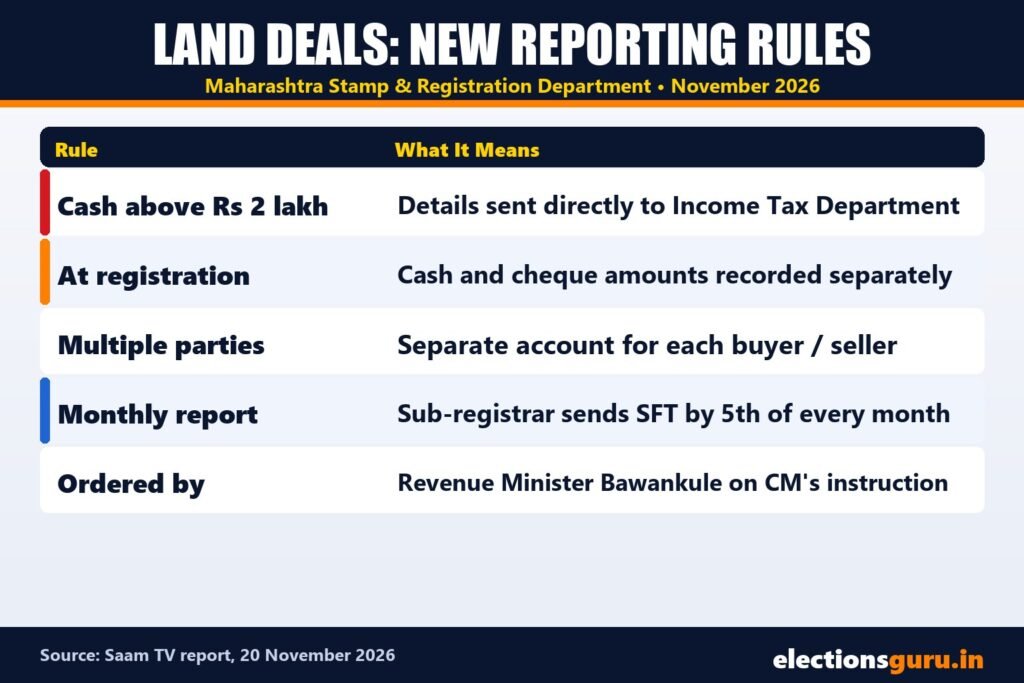
New Land Transaction Rules at a Glance
| Detail | Information |
|---|---|
| Trigger | Cash of more than ₹2 lakh in a land deal |
| Reported to | Income Tax Department, directly |
| Ordered by | Revenue Minister Chandrashekhar Bawankule, on CM Fadnavis’ instruction |
| Directed to | Inspector General, Stamps and Registration Department |
| Registration change | Cash and cheque amounts recorded separately |
| Multiple buyers/sellers | Separate account for each person |
| Monthly reporting | Sub-registrar offices send SFT report by the 5th of every month |
What Exactly Changes at Registration?
- At the time of registration, the cash amount and the cheque amount will be recorded separately
- Where a deal has several buyers or sellers, a separate account will be compiled for each person
- Every sub-registrar office must send the SFT (Statement of Financial Transactions) to the Income Tax Department by the 5th of every month
- Any cash component above ₹2 lakh will therefore reach the tax department quickly
What Is an SFT Report?
The Statement of Financial Transactions (SFT) is a report that specified entities, such as banks and registrars, file with the Income Tax Department about high-value transactions. The department uses this information, along with PAN data, to match spending against declared income. Property purchases and sales above prescribed limits are among the transactions it tracks, and the state’s new order tightens how the cash part of land deals is captured and sent.
Why the ₹2 Lakh Limit?
Under Section 269ST of the Income Tax Act, receiving ₹2 lakh or more in cash in a single transaction, from one person in a day, or for one event is generally not allowed. Land deals are one of the areas where large cash components have traditionally been used to under-report the value of a property. Separately recording cash and reporting it monthly makes it harder to hide such payments.
| Point | Explanation |
|---|---|
| Section 269ST | Generally bars receiving ₹2 lakh or more in cash in one transaction |
| Problem targeted | Hidden cash component in property deals |
| New state step | Separate cash entry + monthly SFT from sub-registrars |
Why the Government Is Doing This
- To curb concealment of financial information in property deals
- To reduce the use of unaccounted cash (“black money”) in land transactions
- To improve transparency in property registration
- To share timely data with the Income Tax Department
What Buyers and Sellers Should Do
- Pay by cheque, demand draft or bank transfer wherever possible
- Make sure the registered document shows the correct payment mode and amount
- Keep bank records and source of funds ready in case of a tax query
- In joint purchases, keep each person’s contribution clearly documented, since separate accounts will be prepared
Election Guru Analysis
The order is a technical but important reform. Maharashtra registers a very large number of property deals every year, and cash components have long been an open secret. By recording cash separately and reporting it every month, the state is closing a common loophole. For honest buyers, the main change is paperwork; for those using undeclared cash, the risk of a tax notice has gone up sharply.
Watch: Land Deals Above ₹2 Lakh Cash to Be Reported to Income Tax Video
For the detailed background, watch the full Election Guru video below.
Land Deals Above ₹2 Lakh Cash to Be Reported to Income Tax FAQ
What is the new rule for land transactions in Maharashtra?
Land deals involving more than ₹2 lakh in cash will be reported directly to the Income Tax Department.
Who issued the order?
Revenue Minister Chandrashekhar Bawankule directed the Stamps and Registration Department on CM Devendra Fadnavis’ instruction.
What changes at registration?
Cash and cheque amounts will be recorded separately, with separate accounts for each buyer and seller.
What is the SFT report?
A Statement of Financial Transactions that sub-registrar offices must send to the Income Tax Department by the 5th of every month.
Why ₹2 lakh?
Section 269ST of the Income Tax Act generally bars receiving ₹2 lakh or more in cash in one transaction.
How can buyers stay safe?
Pay through banking channels and make sure the registered document shows the correct payment details.