
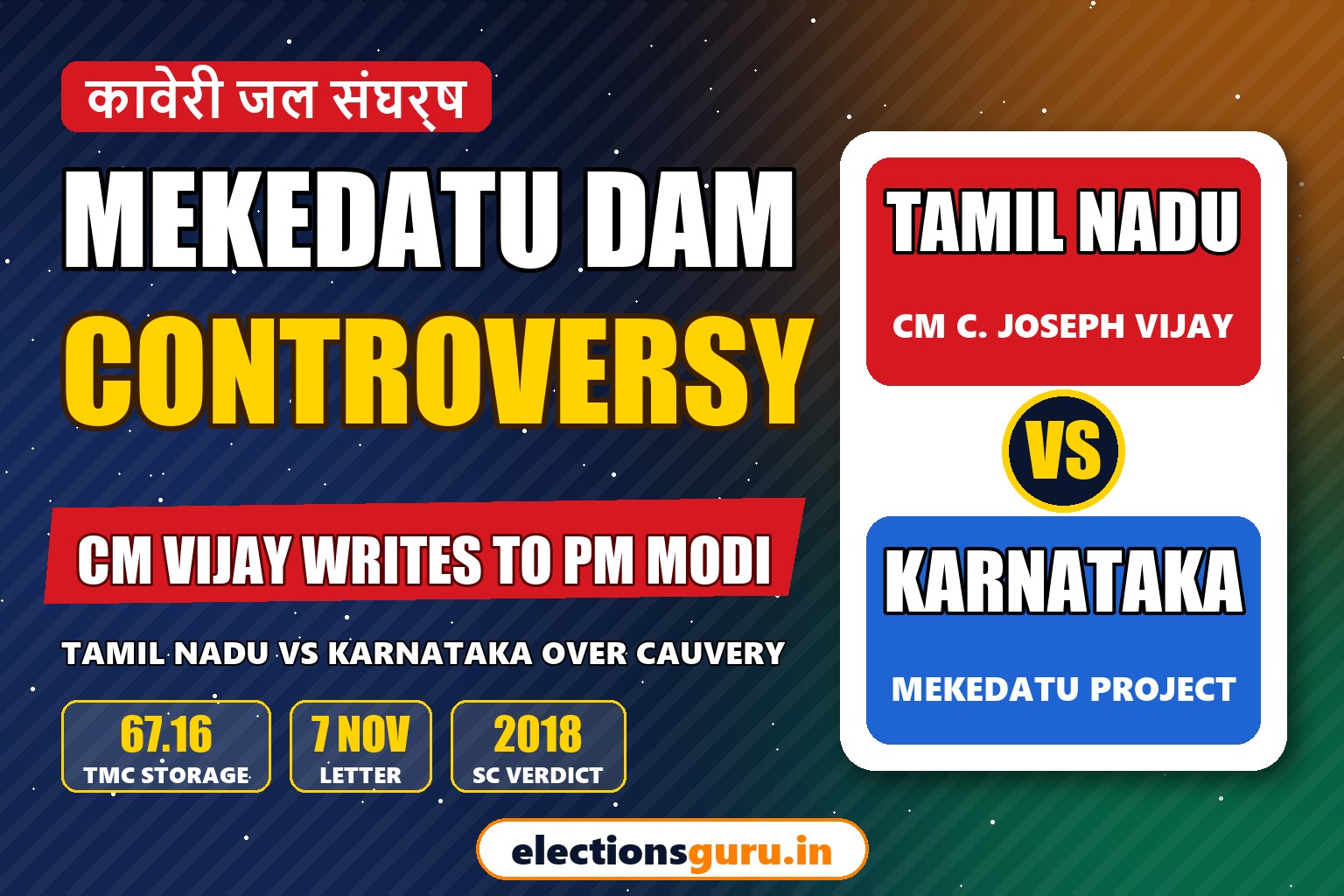
The Mekedatu Dam controversy has flared up again. On 7 November 2026, Tamil Nadu Chief Minister C. Joseph Vijay wrote to Prime Minister Narendra Modi objecting to a reported site inspection by Union government officials at the proposed Mekedatu dam site in Karnataka. He urged the Centre not to grant any statutory or administrative approval to the project without the consent of the Cauvery co-basin states, and said Cauvery delta farmers were living in “perpetual anxiety”.
What is the Mekedatu project? Why does Tamil Nadu oppose it so strongly? What does the Cauvery water dispute history say, and what legal steps has Tamil Nadu taken? This Election Guru explainer covers the full Mekedatu story.
Mekedatu Dam at a Glance
| Detail | Information |
|---|---|
| Project | Mekedatu balancing reservoir and drinking water project |
| State proposing | Karnataka |
| River | Cauvery, just upstream of the Karnataka – Tamil Nadu border |
| Storage | 67.16 TMC (thousand million cubic feet) |
| Purpose | Drinking water for Bengaluru and hydroelectric power |
| Opposed by | Tamil Nadu (lower riparian state) |
| Latest flashpoint | Tamil Nadu CM’s letter to PM Modi, 7 November 2026 |
What Is the Mekedatu Project?
Mekedatu – literally “goat’s leap” in Kannada – is a narrow gorge on the Cauvery river close to the inter-state border. Karnataka plans to build a large balancing reservoir there with a storage capacity of 67.16 TMC. Karnataka says the project is mainly meant to meet Bengaluru’s drinking water needs and to generate hydroelectric power, and that it will help regulate water releases to Tamil Nadu in lean years.
Why Tamil Nadu Opposes Mekedatu
Tamil Nadu, the lower riparian state, fears that a large reservoir just above the border would give Karnataka control over water that would otherwise flow freely into Tamil Nadu, particularly during the monsoon. Chief Minister Vijay argues that the reservoir could block flows to Tamil Nadu and affect the monthly releases stipulated by the Supreme Court. The Cauvery delta in Tamil Nadu – the state’s rice bowl – depends heavily on these flows.
What CM Vijay Wrote to PM Modi
- No statutory or administrative clearance for Mekedatu without the consent of all co-basin states.
- The Jal Shakti and Environment ministries should stop site inspections, technical evaluations and clearances without the consent of lower riparian states.
- Any action arising from the reported central site inspection should be deferred.
- Karnataka should be advised not to proceed without the agreement of co-basin states.
- Considering the DPR and holding unilateral central inspections at this stage is “highly inappropriate”.
Vijay also pointed out that 2026-27 is a deficit water year and that Karnataka had not released Tamil Nadu’s due share of water, even on a pro-rata basis. He referred to reported meetings between Karnataka’s Chief Minister and Union ministry officials seeking clearance for the project’s Detailed Project Report (DPR) without Tamil Nadu’s concurrence.
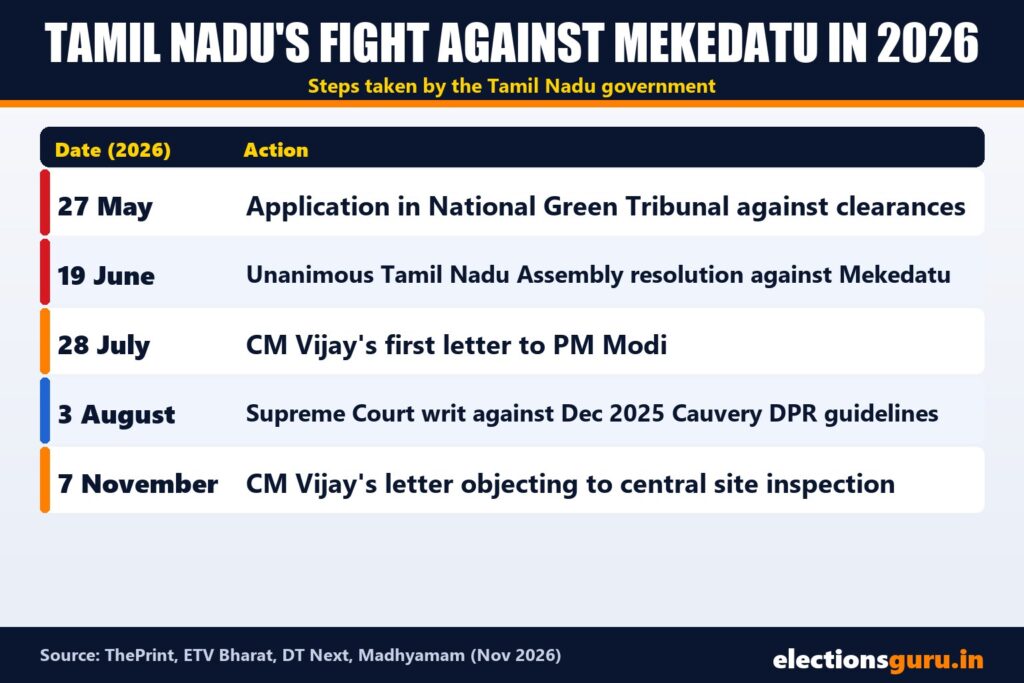
Tamil Nadu’s Legal and Political Steps in 2026
| Date | Step |
|---|---|
| 27 May 2026 | Application before the National Green Tribunal seeking to restrain environmental permissions until inter-state issues are settled |
| 19 June 2026 | Tamil Nadu Assembly unanimously passed a resolution opposing any clearance to Karnataka |
| 28 July 2026 | CM Vijay’s earlier letter to PM Modi |
| 3 August 2026 | Writ petition in the Supreme Court challenging the Jal Shakti Ministry’s December 2025 DPR guidelines for Cauvery basin projects (pending) |
| 7 November 2026 | Letter to PM Modi objecting to site inspection |
Cauvery Water Dispute: A Short History
The Cauvery dispute between Karnataka and Tamil Nadu goes back to agreements of 1892 and 1924 between the Madras Presidency and the princely state of Mysore. After decades of conflict, the Centre set up the Cauvery Water Disputes Tribunal (CWDT) in 1990.
| Year | Milestone |
|---|---|
| 1892 & 1924 | Agreements between Madras Presidency and Mysore |
| 1990 | Cauvery Water Disputes Tribunal set up |
| 2007 | Tribunal’s final award |
| 16 Feb 2018 | Supreme Court judgment modifies the award |
| 2018 | Cauvery Water Management Authority (CWMA) and Regulation Committee set up |
The 2018 Supreme Court Verdict
In its 16 February 2018 judgment, the Supreme Court modified the tribunal’s award. Karnataka’s share was increased to 284.75 TMC and Tamil Nadu’s share was fixed at 404.25 TMC, with Kerala getting 30 TMC and Puducherry 7 TMC. The court allowed extra water for Bengaluru’s drinking needs and directed Karnataka to release 177.25 TMC annually at Biligundlu on the inter-state border, in monthly instalments. Tamil Nadu argues that any new project must be consistent with this judgment and the tribunal’s final award.
Also Read: Census 2027: Caste Enumeration, Dates and Questions
Karnataka’s Argument
Karnataka says Mekedatu lies entirely within its territory, that drinking water for a fast-growing Bengaluru is a priority under the Supreme Court verdict, and that the reservoir will not reduce Tamil Nadu’s share – instead, it will help store surplus water and ensure regulated releases. Successive Karnataka governments across parties have backed the project.
Why Mekedatu Is Also a Political Issue
Mekedatu is an emotive issue in both states. In Tamil Nadu, every major party opposes it, and the Assembly’s June 2026 resolution was unanimous. For Vijay, whose government took office in 2026, standing firm on Cauvery is crucial to win the trust of delta farmers. In Karnataka, the project is a promise to Bengaluru and the old Mysore region. The Centre, caught between the two, has to balance federal relations and legal obligations.
What Happens Next
- The Supreme Court’s decision on Tamil Nadu’s writ against the DPR guidelines.
- NGT proceedings on environmental clearances.
- The Centre’s response to Vijay’s letter and Karnataka’s push for DPR clearance.
- Monthly water releases to Tamil Nadu in the deficit year 2026-27.
The Cauvery River: Key Facts
The Cauvery (Kaveri) rises at Talakaveri in Kodagu district of Karnataka and flows about 800 km through Karnataka and Tamil Nadu before reaching the Bay of Bengal. Its basin also covers parts of Kerala and Puducherry. Major reservoirs include the Krishna Raja Sagar (KRS) and Kabini in Karnataka and the Mettur dam (Stanley Reservoir) in Tamil Nadu. The river enters Tamil Nadu near Hogenakkal, close to the Mekedatu site, and feeds the fertile Cauvery delta in Thanjavur, Tiruvarur and Nagapattinam districts.
| State / UT | Share Under 2018 SC Verdict |
|---|---|
| Tamil Nadu | 404.25 TMC |
| Karnataka | 284.75 TMC |
| Kerala | 30 TMC |
| Puducherry | 7 TMC |
Why Bengaluru Needs More Water
Bengaluru is one of India’s fastest-growing cities, and its water supply depends heavily on the Cauvery, pumped over long distances and a steep elevation. The city faced a severe water crisis in 2024 when many borewells dried up. Karnataka argues that the Supreme Court recognised Bengaluru’s drinking water needs in 2018 and that Mekedatu is essential for the city’s future.
Distress Years: The Real Flashpoint
In normal or surplus years, Cauvery water sharing works without much trouble. Conflicts flare in deficit years, when rainfall in Karnataka’s catchment is poor and both states need water at the same time. In such years, the Cauvery Water Management Authority applies a pro-rata “distress sharing” formula. Tamil Nadu says Karnataka has not released its due share even on this basis in 2026-27, which is why it fears that a new reservoir would make its position even weaker.
Past Cauvery Crises
| Year | What Happened |
|---|---|
| 1991 | Violence in Karnataka after the tribunal’s interim order |
| 2007 | Tribunal’s final award triggers protests |
| 2016 | Violence in Bengaluru after Supreme Court orders release of water to Tamil Nadu |
| 2018 | Supreme Court’s final verdict and creation of CWMA |
| 2023 | Fresh protests in both states during a deficit year |
How Inter-State River Disputes Are Settled in India
Article 262 of the Constitution allows Parliament to make laws for settling inter-state river water disputes. Under the Inter-State River Water Disputes Act, 1956, the Centre sets up a tribunal whose award becomes binding. In the Cauvery case, the Supreme Court heard appeals against the tribunal’s award and gave the final verdict in 2018. Any new project on an inter-state river usually needs clearance from the Central Water Commission, environmental clearance and, in practice, the agreement of the other basin states.
Mekedatu: Arguments at a Glance
| Karnataka Says | Tamil Nadu Says |
|---|---|
| Project is within Karnataka’s territory | Cauvery is an inter-state river; consent of co-basin states is needed |
| Needed for Bengaluru’s drinking water | Bengaluru’s share is already provided in the 2018 verdict |
| Will help regulate releases to Tamil Nadu | Will give Karnataka control over free flows in good years |
| Will generate clean hydropower | Will submerge forest areas and affect wildlife |
Environmental Concerns
The proposed reservoir area lies in a forested landscape near the Cauvery Wildlife Sanctuary, home to elephants and other wildlife. Environmental clearance would require a detailed assessment of forest loss and wildlife impact, which is why Tamil Nadu has approached the National Green Tribunal to prevent any clearances while inter-state issues remain unresolved.
What Is a TMC?
Water in river disputes is measured in TMC – thousand million cubic feet, or one billion cubic feet. One TMC is roughly 28.3 billion litres. So Mekedatu’s proposed storage of 67.16 TMC would hold about 1.9 trillion litres of water – a very large reservoir in the context of the Cauvery, where Tamil Nadu’s annual share is 404.25 TMC.
Hogenakkal: Tamil Nadu’s Own Drinking Water Project
Tamil Nadu has its own Hogenakkal Integrated Drinking Water Project near the same stretch of the Cauvery, which supplies drinking water to Dharmapuri and Krishnagiri districts. Karnataka had objected to it in 2008, leading to protests in both states. Karnataka now cites drinking water needs for Bengaluru in a similar way – showing how both states use the “drinking water” argument when it suits them.
Political Parties’ Stand in Tamil Nadu
| Party | Stand on Mekedatu |
|---|---|
| TVK (ruling) | Strongly opposes; CM Vijay has written twice to PM Modi |
| DMK | Opposes; raised the issue repeatedly when in power |
| AIADMK | Opposes; has demanded Centre reject the DPR |
| BJP (Tamil Nadu unit) | Has opposed the project in Tamil Nadu |
| Farmers’ groups | Delta farmers’ associations oppose any new dam upstream |
Mekedatu is one of the few issues on which almost all of Tamil Nadu’s parties agree, as seen in the unanimous Assembly resolution of June 2026.
What the Centre Can Do
- Ask Karnataka and Tamil Nadu to discuss the project under the CWMA framework.
- Withhold clearance of the DPR until the basin states agree.
- Await the Supreme Court’s decision on Tamil Nadu’s challenge to the DPR guidelines.
- Use the Central Water Commission’s technical review to assess downstream impact.
Cauvery Delta: Why Farmers Are Anxious
The Cauvery delta in Tamil Nadu – spread across Thanjavur, Tiruvarur, Nagapattinam, Mayiladuthurai and parts of nearby districts – grows the bulk of the state’s paddy in the kuruvai and samba seasons. The opening of the Mettur dam on 12 June each year is a key date for delta farmers. In deficit years, delayed or reduced releases from Karnataka can mean failed crops, which is why any project upstream triggers strong reactions.
Mekedatu Dam Controversy FAQ
What is the Mekedatu dam project?
Mekedatu is a proposed balancing reservoir on the Cauvery river in Karnataka near the Tamil Nadu border, with 67.16 TMC storage, meant for Bengaluru’s drinking water and hydropower.
Why does Tamil Nadu oppose the Mekedatu dam?
Tamil Nadu fears the reservoir would block Cauvery flows and affect the monthly water releases fixed by the Supreme Court in 2018.
What did CM Vijay write to PM Modi about Mekedatu?
On 7 November 2026, Vijay asked the PM not to grant any approval without the consent of co-basin states and objected to a reported central site inspection.
What is Tamil Nadu’s share of Cauvery water?
Under the Supreme Court’s 2018 judgment, Tamil Nadu’s share is 404.25 TMC and Karnataka must release 177.25 TMC annually at Biligundlu.
What legal steps has Tamil Nadu taken against Mekedatu?
Tamil Nadu has approached the NGT (May 2026), passed an Assembly resolution (June 2026) and filed a Supreme Court writ against the Cauvery DPR guidelines (August 2026).
Who is the Chief Minister of Tamil Nadu?
C. Joseph Vijay is the Chief Minister of Tamil Nadu.
What is the Cauvery Water Management Authority?
The CWMA was set up in 2018 after the Supreme Court verdict to implement the Cauvery water-sharing arrangement among the basin states.