
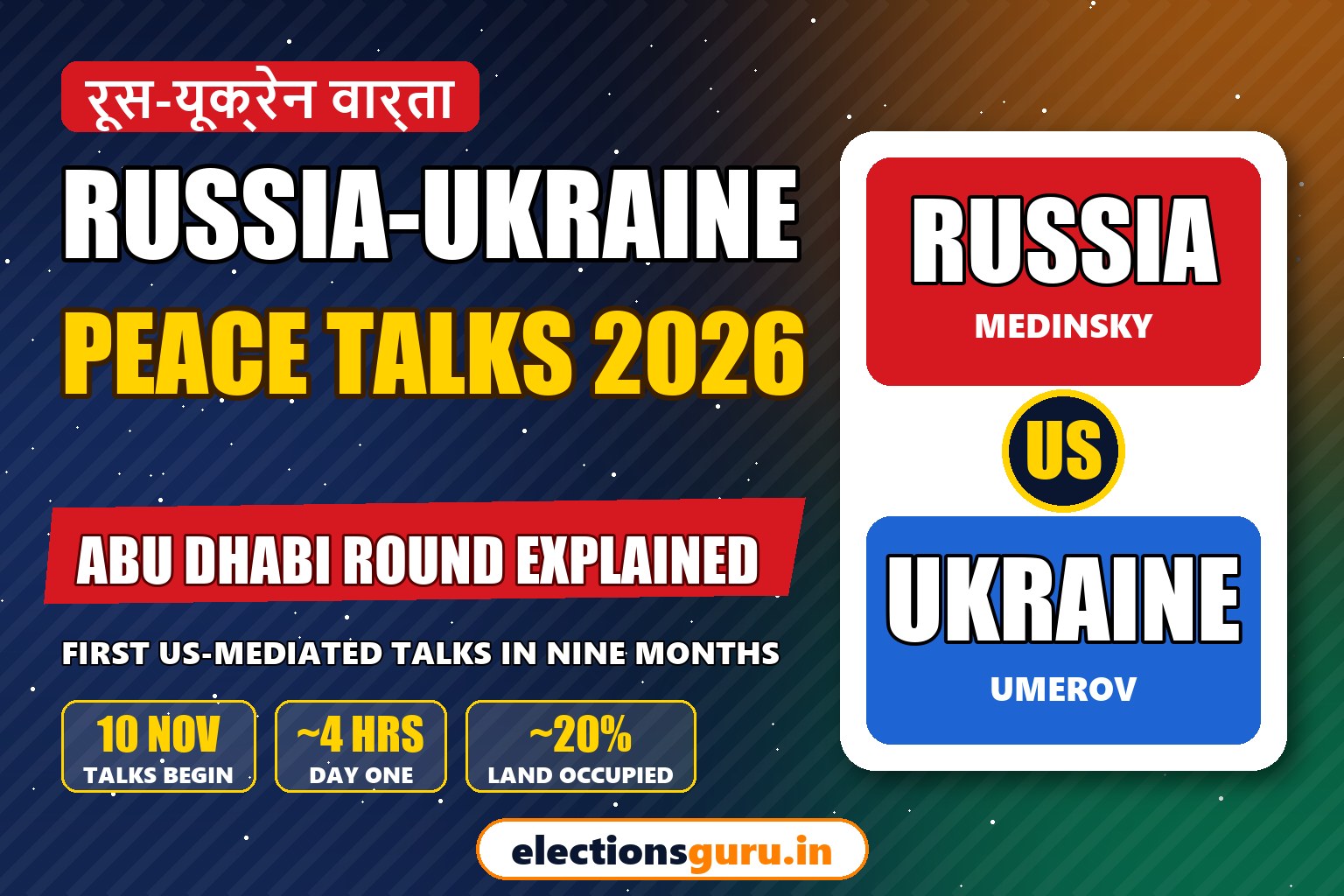
The Russia-Ukraine peace talks in Abu Dhabi resumed on 10 November 2026 – the first US-mediated meeting between the two sides in nine months. The session lasted about four hours, with a second day planned for 11 November. Ukrainian President Volodymyr Zelenskyy called the first day “constructive and quite substantive”, while US Secretary of State Marco Rubio described it as “very productive” but warned that it was not “something that’s on the verge of being solved in the next 24 hours”.
Who is at the table? What was discussed? Why are Russia and Ukraine still so far apart, and what does this mean for the world and for India? This Election Guru explainer covers everything about the Abu Dhabi talks.
Abu Dhabi Talks 2026 at a Glance
| Detail | Information |
|---|---|
| Venue | Abu Dhabi, United Arab Emirates |
| Dates | 10 – 11 November 2026 |
| Format | Trilateral – Russia, Ukraine, with US mediation |
| US mediators | Jared Kushner and envoy Steve Witkoff |
| Russian delegation head | Vladimir Medinsky |
| Ukrainian delegation head | Rustem Umerov |
| Main topics | Humanitarian issues, prisoner exchange, security guarantees |
| Previous rounds | Three earlier rounds in 2026 without major breakthrough |
Who Is at the Table
| Side | Delegation |
|---|---|
| United States | Jared Kushner, Steve Witkoff; NATO commander Gen. Alexus Grynkewich present |
| Russia | Vladimir Medinsky (head), deputy foreign ministers Sergei Ryabkov and Mikhail Galuzin, military intelligence chief Igor Kostyukov |
| Ukraine | Rustem Umerov (head); Kyrylo Budanov reportedly included |
Neither Zelenskyy nor Rubio attended in person – Zelenskyy was speaking at the University of Copenhagen, and Rubio was at the G7 foreign ministers’ meeting in Paris. Medinsky said Russia’s delegation had “become bigger and more professional”.
What Was Discussed on Day One
According to Zelenskyy, the talks focused largely on humanitarian issues: prisoner exchanges, the return of Ukrainian civilians held in captivity, and Ukrainian children taken to Russia. A senior Ukrainian official said the sides discussed a large-scale prisoner swap, with details to be worked out in the coming days. Security guarantees for Ukraine were also discussed. Kushner said there were “some good ideas how to bridge” the differences and spoke of building “a new framework”.
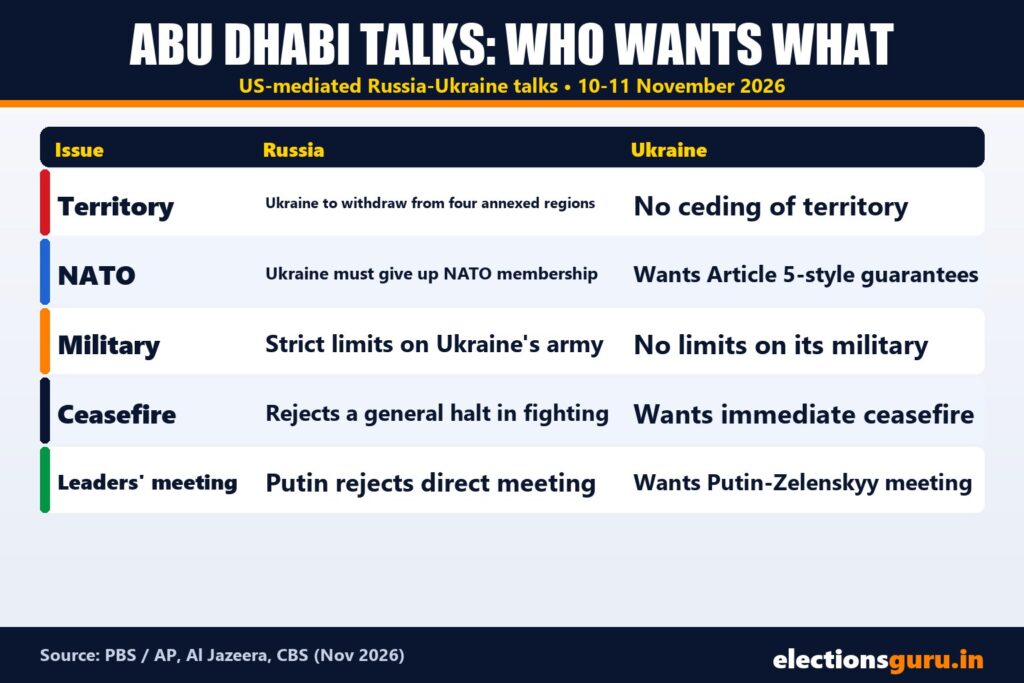
Where Russia and Ukraine Stand
Russia’s Demands
President Vladimir Putin wants Ukraine to withdraw from the four regions Russia has annexed but never fully captured, to give up NATO membership and to accept strict limits on its military. He rejects a general ceasefire before a final deal and has refused a direct meeting with Zelenskyy.
Ukraine’s Demands
Ukraine rejects ceding any territory and any limits on its armed forces. It wants an immediate ceasefire and a direct Putin-Zelenskyy meeting. Kyiv’s long-term position is that Russia should withdraw to the pre-war border. Russia currently occupies roughly 20% of Ukraine’s territory.
Signs of Flexibility
US officials said both sides had privately shown “a little bit of flexibility” on the future control of eastern regions, but a territorial deal would likely come last. A US official said security guarantees – possibly an Article 5-style defence commitment – are central to any agreement.
Europe Wants a Seat at the Table
Before the talks, representatives of the UK, France, Germany, Italy, NATO and the European Commission met the Ukrainian team and US envoys. France says a lasting peace needs European involvement. Russia objected to Europeans joining the three-way talks but said EU representatives could join later. President Donald Trump has said a broader European security deal is in the works, calling it “a big agreement”.
The War Continues During Talks
Fighting has not stopped. On the night before the talks, Russia launched 162 drones and a ballistic missile, while Russia’s Defence Ministry said it shot down 155 Ukrainian drones. Russia has intensified strikes on Ukraine’s power grid as winter approaches, and the front lines remain largely deadlocked nearly five years after the February 2022 invasion.
Timeline of the Peace Process
| Date | Event |
|---|---|
| 24 Feb 2022 | Russia launches full-scale invasion of Ukraine |
| Jan – Feb 2026 | Security consultations; earlier rounds of talks including Abu Dhabi |
| 2026 | Three rounds of talks this year without major breakthrough |
| 10 Nov 2026 | Abu Dhabi talks resume after nine-month pause – about 4 hours |
| 11 Nov 2026 | Second day of talks |
The US Politics Angle
The US midterm elections have given the Democrats control of Congress from January. Analysts told Al Jazeera that this may be one reason for the push for a quick agreement, as a new Congress could change the terms of US support for Ukraine. Analyst Ilya Timtchenko said the talks were unlikely to produce a deal.
What It Means for India
India has consistently called for dialogue and diplomacy to end the war, and Prime Minister Narendra Modi has said “this is not an era of war”. India maintains ties with both Russia and Ukraine and has been one of the largest buyers of Russian crude oil since 2022, which has been a point of friction with the United States. A peace deal could ease pressure on energy prices, fertiliser and grain supplies, and India’s trade with both Russia and the West.
Also Read: INDIA Bloc vs CEC Gyanesh Kumar: Vote Chori Row Explained
What Happens Next
- Details of a large-scale prisoner exchange are to be worked out.
- Possible framework on security guarantees for Ukraine.
- Europe’s role in future rounds.
- Whether Putin agrees to a ceasefire or a leaders’ meeting.
Background: How the War Began
Tensions between Russia and Ukraine date back to 2014, when Russia annexed Crimea and backed separatists in the Donbas region of eastern Ukraine. On 24 February 2022, Russia launched a full-scale invasion. Its forces were pushed back from Kyiv within weeks, but Russia kept control of large areas in the south and east. In September 2022, Russia declared the annexation of four Ukrainian regions – Donetsk, Luhansk, Zaporizhzhia and Kherson – even though it did not fully control any of them.
| Year | Key Event |
|---|---|
| 2014 | Russia annexes Crimea; conflict begins in Donbas |
| Feb 2022 | Full-scale Russian invasion |
| Mar 2022 | Early peace talks in Belarus and Istanbul fail |
| Jul 2022 | Black Sea Grain Initiative signed (ended July 2023) |
| Sep 2022 | Russia declares annexation of four regions |
| 2023 – 2025 | Ukrainian counter-offensive; front lines largely static |
| 2026 | US-mediated talks, including Abu Dhabi rounds |
The Four Regions at the Heart of the Dispute
| Region | Status |
|---|---|
| Donetsk | Partly occupied by Russia; heavy fighting |
| Luhansk | Mostly occupied by Russia |
| Zaporizhzhia | Partly occupied; includes Europe’s largest nuclear power plant |
| Kherson | Partly occupied; Ukraine retook Kherson city in November 2022 |
Why Peace Has Been So Hard
- Territory: Ukraine’s constitution and public opinion oppose giving up land; Russia has written the annexations into its own constitution.
- Security: Ukraine wants guarantees so Russia cannot attack again; Russia sees NATO expansion as a threat.
- Trust: Earlier agreements such as the Minsk accords of 2014-15 failed to hold.
- Sanctions and assets: Western sanctions on Russia and frozen Russian assets are part of any final deal.
India’s Balancing Act
India has refused to take sides in votes at the United Nations, abstaining on most resolutions condemning Russia while calling for respect for the UN Charter and territorial integrity. Prime Minister Narendra Modi told President Putin at the 2022 SCO summit in Samarkand that “today’s era is not an era of war”. In 2024, Modi visited Moscow in July and Kyiv in August – the first visit by an Indian Prime Minister to independent Ukraine. India also evacuated around 22,500 citizens, mostly students, from Ukraine in 2022 under Operation Ganga.
Economic Impact on India
The war pushed up global prices of crude oil, fertilisers, edible oils and wheat in 2022. India responded by buying large quantities of discounted Russian crude oil, and Russia became one of India’s biggest oil suppliers. In 2025, the United States imposed additional tariffs on Indian goods, citing these purchases. A peace deal could lower energy and commodity prices, ease pressure on India’s trade with the West and open opportunities in Ukraine’s reconstruction.
| Area | Impact of the War on India |
|---|---|
| Energy | Higher prices in 2022; later, large imports of discounted Russian crude |
| Fertiliser | Supply disruptions and higher subsidy bill |
| Edible oil | Sunflower oil supplies from Ukraine and Russia disrupted |
| Students | Thousands of Indian medical students had to leave Ukraine |
| Trade with US | Tariff pressure linked to Russian oil purchases |
Who Are the Key Negotiators?
| Name | Role |
|---|---|
| Jared Kushner | US mediator; former senior White House adviser |
| Steve Witkoff | US special envoy |
| Vladimir Medinsky | Head of Russian delegation; aide to President Putin |
| Rustem Umerov | Head of Ukrainian delegation |
| Marco Rubio | US Secretary of State (not present in Abu Dhabi) |
What Is NATO’s Article 5?
Article 5 of the North Atlantic Treaty says an armed attack against one NATO member is an attack against all, and that members will assist the attacked country. Ukraine is not a NATO member. An “Article 5-style” guarantee in a peace deal would mean that the US and/or European countries commit to come to Ukraine’s defence if Russia attacks again, without formally admitting Ukraine to NATO.
The UAE’s Role as a Mediator
The United Arab Emirates has maintained relations with both Russia and Ukraine throughout the war and has mediated several prisoner exchanges between them. Hosting the talks in Abu Dhabi reflects the UAE’s growing role as a neutral venue for sensitive diplomacy, alongside countries like Turkey, Saudi Arabia and Qatar, which have also hosted talks or mediated humanitarian deals.
What a Final Peace Deal Might Include
| Possible Element | Explanation |
|---|---|
| Ceasefire line | A line of control along current or negotiated front positions |
| Security guarantees | Commitments by the US/Europe to defend Ukraine against future attack |
| Status of occupied regions | Temporary or permanent arrangements for areas held by Russia |
| Sanctions relief | Phased easing of Western sanctions on Russia |
| Prisoners and civilians | All-for-all prisoner exchange and return of deported children |
| Reconstruction | International fund to rebuild Ukraine |
Key Terms Explained
| Term | Meaning |
|---|---|
| Donbas | Eastern industrial region of Ukraine made up of Donetsk and Luhansk |
| Annexation | Claiming another country’s territory as one’s own |
| Ceasefire | Agreement to stop fighting, often before a final settlement |
| Security guarantee | Promise by other countries to help defend a state |
| Trilateral talks | Talks involving three parties – here Russia, Ukraine and the US |
How Long Has the War Lasted?
By November 2026, the full-scale war has lasted more than four and a half years – making it the largest war in Europe since the Second World War. It has caused massive loss of life on both sides, displaced millions of Ukrainians and damaged cities, power plants and infrastructure across Ukraine. This human cost is why prisoner exchanges and the return of civilians are the first items on the table in Abu Dhabi.
Why the Talks Matter for the World
- Energy prices: A deal could stabilise oil and gas markets.
- Food security: Ukraine and Russia are major exporters of wheat, maize and sunflower oil.
- European security: The war has pushed Europe to rearm and expand NATO with Finland and Sweden.
- Global diplomacy: The outcome will shape US-Russia relations and the role of the UN.
Russia-Ukraine Peace Talks Abu Dhabi 2026 Explained FAQ
When did the Russia-Ukraine talks in Abu Dhabi begin?
The US-mediated talks began on 10 November 2026 in Abu Dhabi, with a second day on 11 November.
Who are the mediators in the Abu Dhabi talks?
US envoys Jared Kushner and Steve Witkoff are mediating the talks.
Who leads the Russian and Ukrainian delegations?
Vladimir Medinsky leads the Russian delegation and Rustem Umerov leads the Ukrainian delegation.
What was discussed in the Abu Dhabi talks?
The talks focused on humanitarian issues such as prisoner exchanges and return of civilians and children, along with security guarantees for Ukraine.
What does Russia want in the peace deal?
Russia wants Ukraine to withdraw from four annexed regions, give up NATO membership and accept limits on its military.
How much of Ukraine does Russia occupy?
Russia occupies roughly 20% of Ukraine’s territory.
What is India’s position on the Russia-Ukraine war?
India has called for dialogue and diplomacy and says “this is not an era of war”, while maintaining ties with both countries.