
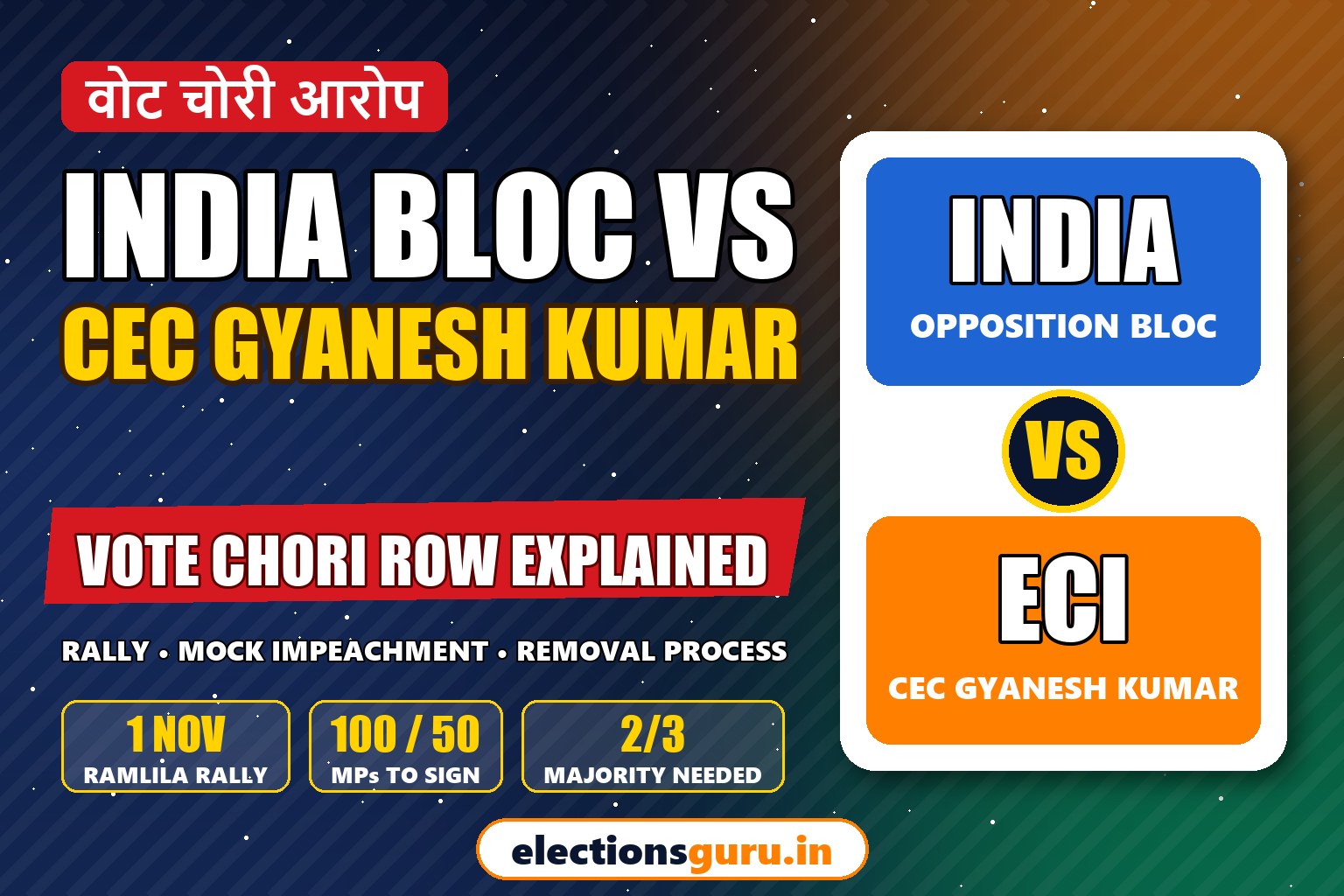
The battle between the INDIA bloc and Chief Election Commissioner (CEC) Gyanesh Kumar has become the biggest institutional fight in Indian politics. On 1 November 2026, opposition parties held a huge “Vote Bachao, Desh Bachao” rally at Delhi’s Ramlila Maidan demanding the CEC’s resignation over alleged “vote chori” (vote theft) and the Special Intensive Revision (SIR) of electoral rolls. A day earlier, the bloc staged a symbolic “public impeachment” of the CEC at Congress president Mallikarjun Kharge’s residence.
What are the allegations? Who is Gyanesh Kumar? Can a CEC actually be removed, and does the opposition have the numbers? This Election Guru explainer covers the entire controversy.
INDIA Bloc vs CEC at a Glance
| Detail | Information |
|---|---|
| CEC | Gyanesh Kumar (CEC since 19 February 2025) |
| Opposition demand | Resignation / removal of the CEC, end to SIR, repeal of 2023 appointment law |
| Mock impeachment | 31 October 2026, 10 Rajaji Marg (Kharge’s residence), presided by Meira Kumar |
| Mega rally | 1 November 2026, Ramlila Maidan, New Delhi (“Vote Bachao, Desh Bachao”) |
| Key allegation | “Vote chori” and large-scale deletion of voters through SIR |
| Removal process | Same as a Supreme Court judge – needs 2/3 majority in both Houses |
Who Is Gyanesh Kumar?
Gyanesh Kumar, born on 27 January 1964 in Agra, is a 1988-batch IAS officer of the Kerala cadre. He holds a B.Tech in civil engineering from IIT Kanpur. In the Union government he served as Joint Secretary in the Department of Defence Production, Parliamentary Affairs Secretary and Cooperation Secretary. At the Home Ministry he worked on the Jammu and Kashmir Reorganisation Act, 2019 and was involved in setting up the Shri Ram Janmbhoomi Teerth Kshetra trust.
He was appointed Election Commissioner on 14 March 2024 and became Chief Election Commissioner on 19 February 2025 – the first CEC appointed under the Chief Election Commissioner and Other Election Commissioners Act, 2023. The selection panel was Prime Minister Narendra Modi, Home Minister Amit Shah and Leader of Opposition Rahul Gandhi, who opposed the appointment.
The 2023 Law at the Centre of the Fight
Before 2023, the Supreme Court had ruled that a panel including the Chief Justice of India should select election commissioners until Parliament made a law. The 2023 Act replaced the Chief Justice with a Union Cabinet minister nominated by the Prime Minister. The opposition says this gives the government a 2-1 majority in choosing the CEC. Kharge has said the law was passed when around 145 opposition MPs had been suspended from Parliament, and that it “gives the CEC impunity which even the President and Prime Minister do not have”.
What Are the “Vote Chori” Allegations?
The “vote chori” campaign began in 2025 when Rahul Gandhi alleged large-scale electoral fraud in the 2024 Lok Sabha election, citing the Mahadevapura Assembly segment in Karnataka. The opposition then targeted the Special Intensive Revision (SIR) of electoral rolls – a door-to-door verification of voters that began in Bihar and was later extended to other states – alleging that genuine voters were being deleted.
Charges Read at the Mock Impeachment
- Running the Election Commission on the directions of the Prime Minister and the Home Minister.
- Deleting around 14 crore voters from electoral rolls through the SIR exercise (as alleged by Kharge).
- Amending Form 6, the new voter registration form, without taking Parliament into confidence.
- Centralising control over electoral rolls and keeping the other two Election Commissioners out of decisions.
- Violating the constitutional mandate and betraying public trust.
The Election Commission and the government reject these allegations. The CEC has accused the opposition of spreading misinformation, and the Commission says SIR is meant to remove dead, shifted and duplicate entries and keep electoral rolls accurate.
The Mock “Public Impeachment” – 31 October 2026
The INDIA bloc set up a stage resembling the Lok Sabha at Kharge’s residence at 10 Rajaji Marg. Former Lok Sabha Speaker Meira Kumar presided. Kharge moved the motion, accused the CEC of treason and said “the right to vote is under threat”. Rahul Gandhi gave the concluding remarks, and the resolution was “adopted”. People who said their names had been removed from voter lists also took part. Kharge said opposition notices to remove the CEC had been submitted in both Houses of Parliament earlier but were rejected.
Ramlila Maidan Rally – 1 November 2026
The “Chalo Dilli” rally, first planned for 30 October, was postponed to 1 November because of rain. More than 4,000 police and central forces were deployed, the ground was divided into 14 zones with over 200 CCTV cameras, and traffic was diverted in west Delhi.
| Leader | Party | What They Said |
|---|---|---|
| Rahul Gandhi | Congress | Vote chori has happened for years; action will be taken against the CEC |
| Tejashwi Yadav | RJD | CEC should be tried for treason for undermining democracy |
| Akhilesh Yadav | Samajwadi Party | BJP will be removed from power; pointed to Gen Z protests |
| Mamata Banerjee | TMC | Democracy can be saved if the CEC is removed |
| M. A. Baby | CPI(M) | “Fascist tactics” will not be tolerated for long |
Also Read: UP Election 2027: Akhilesh Won’t Contest, BJP May Field Yogi
Can the CEC Be Removed? The Legal Process
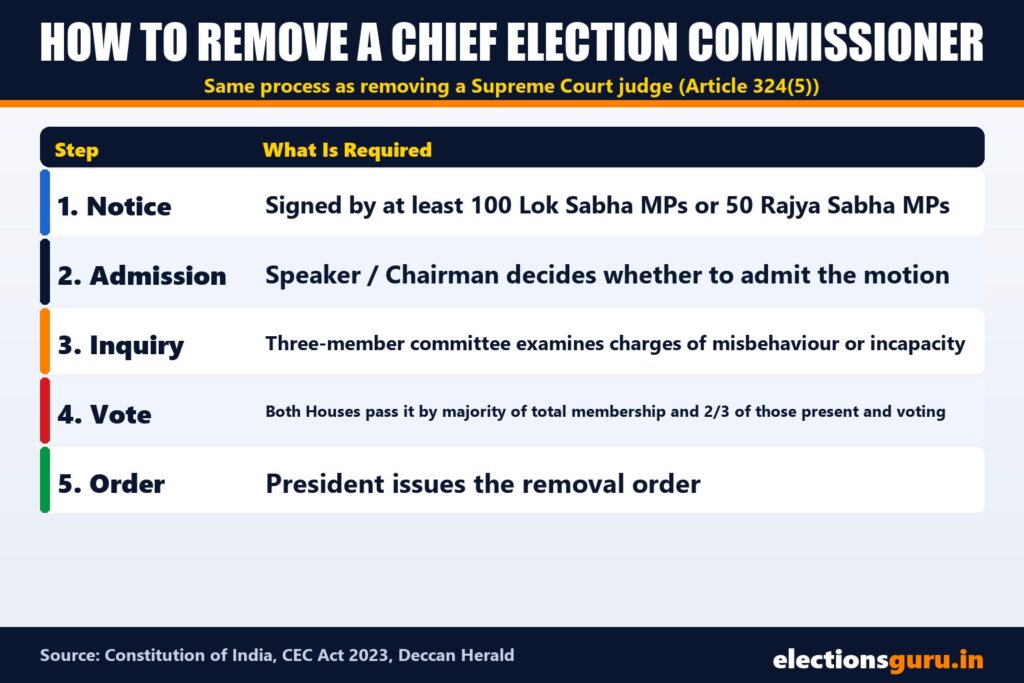
Under Article 324(5) of the Constitution and the 2023 Act, the Chief Election Commissioner can be removed only “in like manner and on the like grounds” as a judge of the Supreme Court – that is, for proved misbehaviour or incapacity. The process is deliberately difficult:
| Step | Requirement |
|---|---|
| Notice of motion | At least 100 Lok Sabha MPs or 50 Rajya Sabha MPs must sign |
| Admission | Lok Sabha Speaker or Rajya Sabha Chairman decides whether to admit it |
| Inquiry committee | A three-member committee investigates the charges |
| Vote in Parliament | Both Houses must pass the motion by a majority of total membership and two-thirds of members present and voting |
| Removal | The President passes the removal order |
No Chief Election Commissioner has ever been removed this way. The opposition itself acknowledges that it lacks the two-thirds numbers in either House. That is why the campaign has moved to the streets – a rally, a mock impeachment and a public pressure campaign rather than a realistic parliamentary removal.
What the Government and BJP Say
The BJP calls the “vote chori” campaign an attempt to discredit institutions after electoral defeats, and points out that opposition parties have also won several state elections under the same Election Commission. Rahul Gandhi, in turn, claimed at the rally that the BJP was spreading rumours because it was “scared” of the opposition.
Why This Fight Matters for 2027
Seven states – including Uttar Pradesh, Punjab, Uttarakhand, Goa, Manipur, Himachal Pradesh and Gujarat – vote in 2027, and SIR is being carried out in more states. The credibility of electoral rolls and the Election Commission will be central to these elections. The INDIA bloc is likely to keep the issue alive in the Winter Session of Parliament and in state campaigns.
Also Read: Elections in 2027: Full List of State and National Polls
The Election Commission of India: A Short History
The Election Commission of India was set up on 25 January 1950 – a date now celebrated as National Voters’ Day. Article 324 of the Constitution gives it the power of “superintendence, direction and control” of elections to Parliament, state legislatures and the offices of President and Vice-President. For most of its history it was a single-member body; it became a three-member commission in 1993. Leaders like T. N. Seshan (CEC from 1990 to 1996) are remembered for enforcing the Model Code of Conduct strictly and making the Commission a powerful institution.
| Milestone | Year |
|---|---|
| Election Commission set up | 1950 |
| First general election | 1951 – 52 |
| T. N. Seshan becomes CEC | 1990 |
| Commission becomes three-member | 1993 |
| Supreme Court’s Anoop Baranwal verdict on appointments | 2023 |
| New CEC appointment law | 2023 |
| Gyanesh Kumar becomes CEC | 2025 |
The Anoop Baranwal Judgment (2023)
In March 2023, a Constitution Bench of the Supreme Court ruled in the Anoop Baranwal case that, until Parliament made a law, the CEC and Election Commissioners should be appointed on the advice of a committee of the Prime Minister, the Leader of the Opposition (or leader of the largest opposition party) and the Chief Justice of India. Parliament then passed the 2023 Act, which replaced the Chief Justice with a Union Cabinet minister. Critics say this undoes the spirit of the judgment; the government says Parliament has the power to make the law.
What Is the Special Intensive Revision (SIR)?
Electoral rolls are normally updated every year through a “summary revision”. An “intensive revision” means preparing the roll afresh through door-to-door verification by Booth Level Officers. The Election Commission began a Special Intensive Revision in Bihar in mid-2025 before the state election, asking voters to submit forms and documents. Lakhs of names were left out of the draft roll on grounds of death, migration or duplication, which triggered protests and court cases. The SIR was then extended to other states and union territories in phases.
| SIR Step | What Happens |
|---|---|
| Enumeration | BLOs visit homes and distribute and collect forms |
| Draft roll | Published with names of those who submitted forms |
| Claims and objections | Voters can seek inclusion or object to wrong entries |
| Final roll | Published after hearings and verification |
Opposition’s Key Demands
- Resignation or removal of CEC Gyanesh Kumar.
- Repeal of the 2023 law on appointment of the CEC and Election Commissioners.
- An end to the SIR exercise in its current form.
- Transparency on deleted voters and machine-readable electoral rolls.
- Accountability on the “vote chori” allegations.
Election Commission’s Position
The Election Commission has said that electoral rolls are prepared in a transparent manner with the participation of political parties’ booth-level agents, that every deletion follows a legal process with notice, and that voters can appeal. The CEC has accused the opposition of spreading misinformation and has asked those making allegations of fraud to submit specific evidence.
Past Controversies Involving Election Commissioners
This is not the first time the Election Commission has been at the centre of a political storm. In 2009, then CEC N. Gopalaswami recommended the removal of Election Commissioner Navin Chawla, alleging partisanship; the government rejected the recommendation and Chawla later became CEC. Over the years, opposition parties of different stripes have questioned the Commission’s decisions on poll schedules, Model Code violations and EVMs. But a coordinated campaign of rallies and a mock impeachment against a sitting CEC is unprecedented.
How This Fight Could Play Out
| Possible Development | Likely Impact |
|---|---|
| Formal removal notice in Parliament | Symbolic, as the opposition lacks a two-thirds majority |
| Court challenges to SIR and the 2023 Act | Could decide the legal future of the appointment law |
| Street protests in poll-bound states | Keeps “vote chori” as a campaign issue in 2027 |
| EC transparency steps | Could reduce the heat if accepted by parties |
The INDIA Bloc: Who Is In It?
The Indian National Developmental Inclusive Alliance (INDIA) was formed in July 2023 at a meeting of opposition parties in Bengaluru to take on the BJP-led NDA in the 2024 Lok Sabha election. Its main members include the Congress, Samajwadi Party, Trinamool Congress, DMK, Shiv Sena (UBT), NCP (Sharadchandra Pawar), RJD, JMM, the Left parties and others. The alliance has had internal differences, but the campaign against the Election Commission has brought most of its parties together on one stage.
EVMs and VVPAT: The Older Debate
Before “vote chori”, the opposition’s main complaint was about Electronic Voting Machines (EVMs). Since 2013, EVMs have been paired with Voter Verifiable Paper Audit Trail (VVPAT) machines, which print a slip showing the voter’s choice. In April 2024, the Supreme Court rejected petitions seeking 100% counting of VVPAT slips and a return to paper ballots, while allowing candidates to seek verification of EVM microcontrollers. The current campaign focuses more on electoral rolls than on machines.
How Voters Can Protect Their Vote
| Form | Purpose |
|---|---|
| Form 6 | New registration as a voter (including first-time voters) |
| Form 7 | Objection to inclusion of a name or request for deletion |
| Form 8 | Correction of entries, shifting of residence, replacement of EPIC |
- Check your name on the Election Commission’s voter services portal or the Voter Helpline app.
- If your name is missing during a revision, file a claim within the notified period.
- Keep a copy of the acknowledgement for any form you submit.
- Contact your Booth Level Officer (BLO) for help.
What Happens in the Winter Session
The opposition is expected to raise the CEC issue, SIR and the 2023 appointment law in Parliament’s Winter Session. It may attempt to move a formal removal notice, seek a debate on electoral reforms, or stage protests inside and outside Parliament. The government, with its majority, is likely to resist any discussion on removing the CEC.
INDIA Bloc vs CEC Gyanesh Kumar FAQ
Why is the INDIA bloc demanding CEC Gyanesh Kumar’s removal?
The bloc accuses him of “vote chori”, large-scale deletion of voters through the SIR exercise, acting on the government’s directions and keeping the other Election Commissioners out of decisions. The Election Commission rejects these charges.
When was the INDIA bloc rally at Ramlila Maidan?
The “Vote Bachao, Desh Bachao” rally was held on 1 November 2026 at Ramlila Maidan, New Delhi.
What was the mock impeachment of the CEC?
On 31 October 2026, the INDIA bloc held a symbolic “public impeachment” at Mallikarjun Kharge’s residence, presided over by Meira Kumar, where a resolution against the CEC was adopted.
How can a Chief Election Commissioner be removed?
A CEC can be removed only like a Supreme Court judge: a motion signed by 100 Lok Sabha or 50 Rajya Sabha MPs, an inquiry committee, and passage by both Houses with a special two-thirds majority.
When did Gyanesh Kumar become CEC?
Gyanesh Kumar became Chief Election Commissioner on 19 February 2025, the first under the 2023 Act.
What is SIR?
SIR (Special Intensive Revision) is a door-to-door verification of electoral rolls by the Election Commission, which began in Bihar and was extended to other states in phases.
Has any CEC been removed before?
No Chief Election Commissioner in India has ever been removed through the impeachment-like process.