
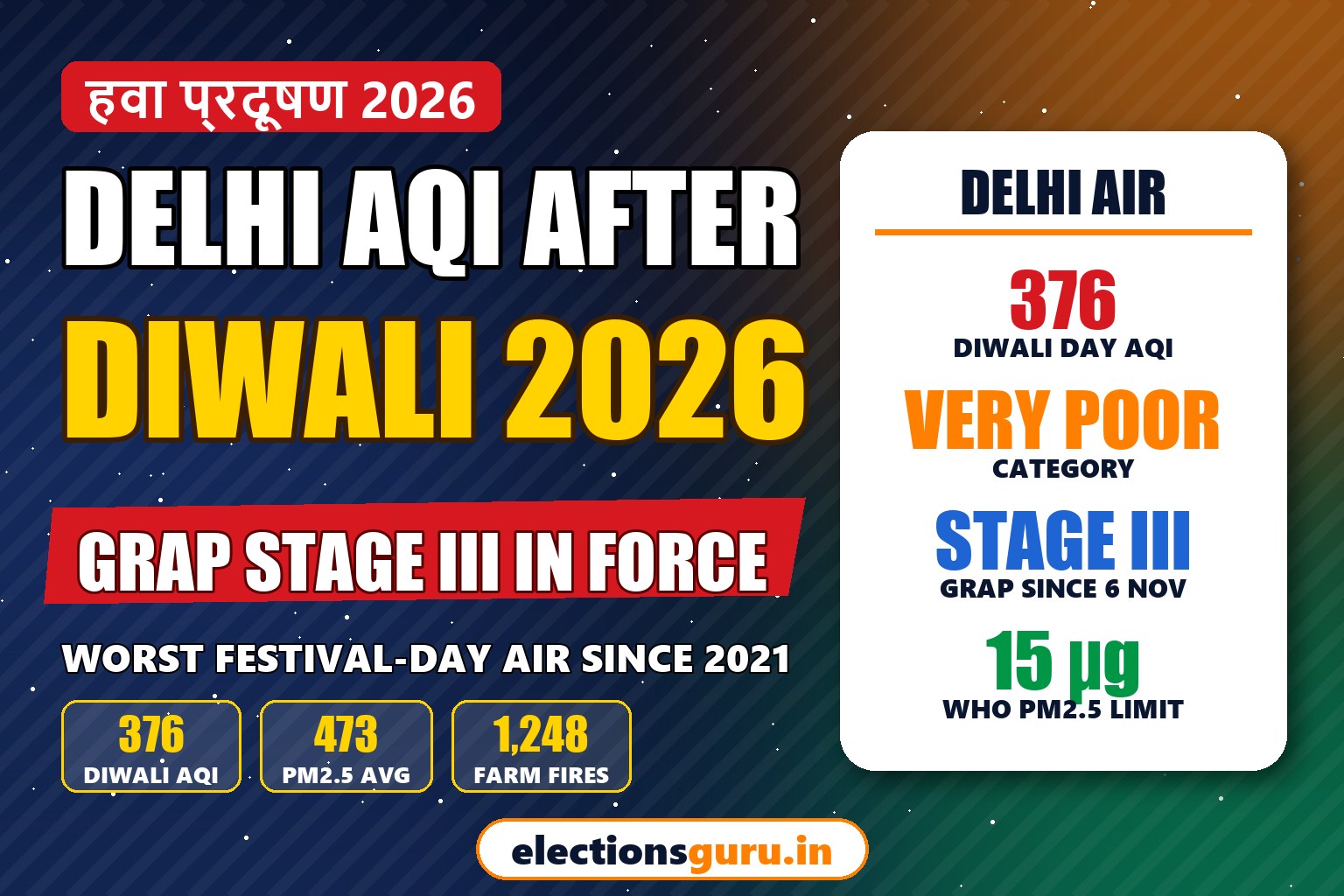
Delhi AQI after Diwali 2026 has once again turned the national capital into a gas chamber. On Diwali day, 8 November 2026, Delhi’s 24-hour average Air Quality Index (AQI) was 376 – the worst festival-day reading since 2021. A day later, 14 of 51 reporting stations were in the “severe” range, and stubble fires in Punjab jumped to more than 1,100 in a single day. GRAP Stage III has been in force across Delhi-NCR since 6 November.
This Election Guru explainer gives you the full picture: the AQI numbers, how bad PM2.5 really got, what GRAP Stage III bans, why the data has gaps, the role of crackers and stubble burning, how to protect your health, and what to expect in the coming days.
Delhi AQI After Diwali 2026 at a Glance
| Detail | Information |
|---|---|
| Diwali 2026 | Sunday, 8 November |
| Diwali-day 24-hour AQI | 376 (very poor) – highest since 2021 |
| 9 Nov, 10 am | AQI 371; 14 of 51 stations severe |
| Highest station on 9 Nov | Delhi Technological University – 439 |
| 10 Nov, 8 am | AQI 304 (very poor) |
| PM2.5 (24-hr avg, Diwali) | 473 µg/m³ (DPCC) |
| WHO 24-hr PM2.5 guideline | 15 µg/m³ |
| GRAP stage | Stage III since 6 November 2026 |
| Stubble fires on Diwali | 1,248 (Punjab 1,152) |
How Bad Was Delhi’s Air This Diwali?
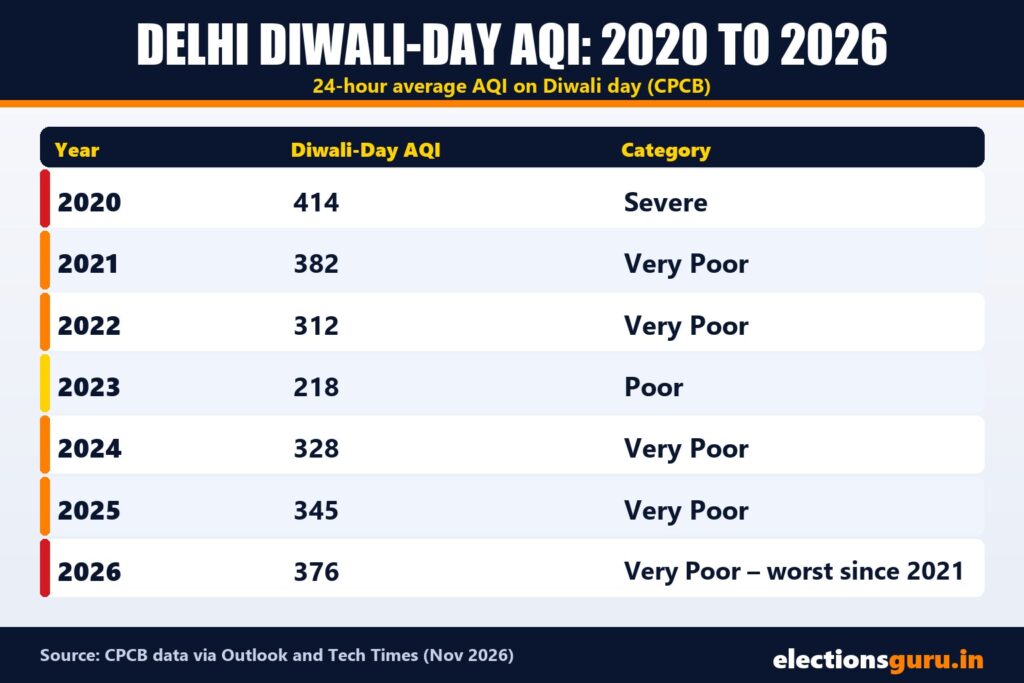
The Central Pollution Control Board’s 24-hour average on Diwali day was 376, compared with 345 in 2025, 328 in 2024, 218 in 2023 and 312 in 2022. On the morning after Diwali, the hourly AQI touched 370 at 8 am and 371 at 10 am. The official daily bulletin for 9 November recorded 344, but Hindustan Times estimated the figure at about 360 after restoring missing data.
According to the Delhi Pollution Control Committee, the 24-hour city average of PM10 on Diwali was 682 µg/m³ and PM2.5 was 473 µg/m³ – slightly lower than 2025 (703 and 520), but still more than 30 times the WHO’s 24-hour PM2.5 guideline of 15 µg/m³.
India’s AQI Categories Explained
| AQI Range | Category | Health Impact |
|---|---|---|
| 0 – 50 | Good | Minimal impact |
| 51 – 100 | Satisfactory | Minor breathing discomfort to sensitive people |
| 101 – 200 | Moderate | Discomfort to people with lung or heart disease, children and older adults |
| 201 – 300 | Poor | Breathing discomfort to most people on prolonged exposure |
| 301 – 400 | Very Poor | Respiratory illness on prolonged exposure |
| 401 – 500 | Severe | Affects healthy people; serious impact on those with existing disease |
What Is GRAP and What Does Stage III Mean?
The Graded Response Action Plan (GRAP) is a set of emergency steps that the Commission for Air Quality Management (CAQM) imposes in Delhi-NCR as pollution gets worse. It has four stages linked to the AQI. This year, Stage II was invoked first, and Stage III was imposed on 6 November when the AQI was 382 – even before it crossed the 400 mark, based on forecasts of severe air.
| GRAP Stage | AQI Level | Category |
|---|---|---|
| Stage I | 201 – 300 | Poor |
| Stage II | 301 – 400 | Very Poor |
| Stage III | 401 – 450 | Severe |
| Stage IV | Above 450 | Severe Plus |
What Is Banned Under GRAP Stage III?
- All non-essential construction and demolition work across NCR stops (railway, Metro, airport, defence and hospital projects are exempt).
- BS-III petrol and BS-IV diesel four-wheelers are banned in Delhi, Gurugram, Faridabad, Noida and Ghaziabad.
- Classes 1 to 5 in Delhi-NCR shift to hybrid mode.
- Stricter checks on dust, waste burning and polluting industries.
If the AQI crosses 450, CAQM can invoke Stage IV, which brings even tougher curbs such as a ban on entry of most trucks into Delhi and more school closures. As of 10 November 2026, Stage IV had not been invoked.
Green Crackers: What the Supreme Court Allowed
Under the Supreme Court’s order in the Arjun Gopal vs Union of India case, only certified green crackers (with the CSIR-NEERI mark and QR code) were allowed for limited hours: 6 am to 8 pm on Saturday, 7 November, and 7 am to 10 pm on Diwali, 8 November. The full ban resumed from 9 November. Conventional crackers remained banned. Reports said cracker use spiked on Diwali night, when Delhi’s air was already in the “very poor” range.
Stubble Burning: 1,248 Fires on Diwali Day
Farm fires in neighbouring states added to the problem. On Diwali day, 1,248 stubble-burning incidents were recorded across Punjab, Haryana, Uttar Pradesh and Delhi, compared with just 135 on the same day last year.
| State | Fires on Diwali Day (8 Nov 2026) |
|---|---|
| Punjab | 1,152 |
| Haryana | 80 |
| Uttar Pradesh | 16 |
| Delhi | 0 |
| Total | 1,248 |
Punjab logged nearly 200 more incidents on 9 November, and its season total reached 4,657 according to a CAQM report. Studies estimate that stubble burning can contribute up to 45% of Delhi’s PM2.5 on peak days.
Also Read: Punjab Election 2027: BJP-Akali Dal Alliance, AAP and Congress
Missing Data: The Monitoring Gap Problem
One of the biggest controversies this year was missing data. Hindustan Times found that PM2.5 data were missing at 43 of 59 stations between 10 pm and 6 am on Diwali night – exactly when pollution peaks. At 39 long-standing stations, 148 of 351 expected readings (42%) were missing. When data was restored, peaks were shocking: Mundka recorded 3,744 µg/m³ at 2 am on 9 November, JNU 3,023 and NSUT West Campus 3,008. The average across 22 stations with full data was 1,480 µg/m³ at 1 am.
Weather Made It Worse
Calm winds and cool nights trapped pollutants close to the ground. Visibility at Safdarjung fell to just 50 metres at 6:30 am on 9 November, and the India Meteorological Department reported “smog along with fog”. Slightly stronger winds of 10-15 km/h on 10 November gave a small improvement. IMD forecast no rain in Delhi until 15 November, which means little natural cleaning of the air.
How to Protect Yourself from Delhi Pollution
- Check the AQI on the SAMEER app or CPCB website before stepping out.
- Avoid outdoor exercise, especially in early morning and late evening.
- Wear an N95 or N99 mask outdoors; cloth masks do not filter PM2.5.
- Keep windows closed during peak hours and use an air purifier if possible.
- Children, older people and those with asthma or heart disease should take extra care and consult a doctor if symptoms appear.
Why Delhi Pollution Is Also a Political Issue
Every winter, Delhi’s air becomes a blame game between governments – over stubble burning in Punjab and Haryana, cracker enforcement in Delhi, and vehicle and dust control across NCR. With Punjab heading to Assembly elections in early 2027, farm fires and the state’s record on stubble management will again be debated politically.
What Next for Delhi’s Air?
The Early Warning System expected “very poor” air on 10 and 11 November, and IITM forecasts suggested “severe to very poor” air for several days. Unless winds pick up or rain arrives, GRAP Stage III curbs are likely to stay, and CAQM may consider Stage IV if the AQI crosses 450.
Also Read: Elections in 2027: Full List of State and National Polls
How GRAP Began
GRAP was first notified in January 2017 after Supreme Court directions, and was initially enforced by the Environment Pollution (Prevention and Control) Authority (EPCA). Since 2021, the Commission for Air Quality Management in NCR and Adjoining Areas (CAQM), set up by an Act of Parliament, has been in charge. CAQM revised GRAP so that curbs are imposed in advance on the basis of forecasts, rather than only after the air has turned severe – which is why Stage III was imposed this year at an AQI of 382.
Main Sources of Delhi’s Winter Pollution
| Source | Why It Matters in Winter |
|---|---|
| Vehicles | Lakhs of vehicles add NOx and PM2.5, especially in traffic jams |
| Road and construction dust | Major source of PM10 across NCR |
| Stubble burning | Smoke from Punjab and Haryana arrives with north-westerly winds |
| Industries and power plants | Emissions from NCR industrial clusters |
| Waste and biomass burning | Open burning of garbage and wood in winter |
| Firecrackers | Sharp spikes around Diwali night |
| Weather | Low winds, low mixing height and fog trap pollutants |
Why Farmers Burn Stubble
In Punjab and Haryana, farmers grow paddy in the kharif season and wheat in rabi. Since 2009, state laws to save groundwater have delayed paddy transplanting until mid-June, which pushes the paddy harvest into late October. That leaves only a few weeks to clear fields before sowing wheat. Burning the stubble is the quickest and cheapest option. Alternatives such as the Happy Seeder and Super Seeder machines, the Pusa bio-decomposer and ex-situ use of straw in biomass plants are available, and the Centre funds machines under the Crop Residue Management scheme – but cost, time and access remain problems for small farmers.
Health Impact of PM2.5
PM2.5 particles are less than 2.5 micrometres wide – about 30 times thinner than a human hair. They enter deep into the lungs and even the bloodstream, causing asthma attacks, bronchitis, heart disease, strokes and lung cancer over time. Children, older people, pregnant women and people with existing illnesses are most at risk. Doctors in Delhi report a sharp rise in respiratory cases every November.
National Clean Air Programme (NCAP)
The Centre launched the National Clean Air Programme in 2019 to cut particulate pollution in over 130 non-attainment cities. The target was later revised to a 40% reduction in PM10 levels by 2025-26 compared with 2017-18. Delhi’s post-Diwali numbers show how far the capital still is from clean air despite years of plans.
Delhi Pollution: Past Emergency Measures
| Measure | What It Did |
|---|---|
| Odd-even scheme | Restricted private cars by number plate on alternate days |
| Cracker bans | Supreme Court-ordered limits and bans on firecrackers |
| School closures | Physical classes suspended on severe days |
| Construction bans | Halt on non-essential construction under GRAP |
| Truck entry curbs | Ban on non-essential trucks under GRAP Stage IV |
| Work from home advisories | Reduced office travel on severe days |
Delhi AQI Myths vs Facts
| Myth | Fact |
|---|---|
| Cloth masks protect from smog | Only N95/N99 masks filter PM2.5 effectively |
| Pollution is only a Diwali problem | Delhi’s air stays poor for most of winter |
| Stubble burning is the only cause | Local sources like vehicles and dust are major year-round contributors |
| Indoor air is always clean | Outdoor PM2.5 enters homes; purifiers or closed windows help |
How Is AQI Calculated?
India’s National Air Quality Index was launched in 2014. It considers up to eight pollutants – PM10, PM2.5, nitrogen dioxide (NO2), sulphur dioxide (SO2), carbon monoxide (CO), ozone (O3), ammonia (NH3) and lead (Pb). Each pollutant’s concentration is converted into a sub-index, and the highest sub-index becomes the station’s AQI. In Delhi’s winter, PM2.5 is almost always the pollutant that decides the AQI. The city AQI is the average of readings from all working stations, which is why missing data can make the official figure look better than the actual air.
What Happens Under Other GRAP Stages
| Stage | Typical Measures |
|---|---|
| Stage I (Poor) | Dust control at construction sites, ban on open burning, PUC checks, mechanised road sweeping |
| Stage II (Very Poor) | Restrictions on diesel generator sets, higher parking fees to discourage private vehicles, more public transport services |
| Stage III (Severe) | Halt on non-essential construction, curbs on older BS-III petrol and BS-IV diesel cars, hybrid classes for young students |
| Stage IV (Severe Plus) | Ban on entry of non-essential trucks, halt on even public linear projects, more school closures, work-from-home advisories |
Measures of earlier stages continue when a higher stage is imposed. CAQM can also revoke stages step by step as the air improves.
WHO Air Quality Guidelines vs India’s Standards
| Pollutant (24-hour) | WHO Guideline (2021) | India’s Standard |
|---|---|---|
| PM2.5 | 15 µg/m³ | 60 µg/m³ |
| PM10 | 45 µg/m³ | 100 µg/m³ |
Even India’s own standards are four times looser than the WHO guideline for PM2.5 – and Delhi’s Diwali-day average of 473 µg/m³ was nearly eight times India’s standard.
What Delhi Residents Can Do
- Use public transport, carpool and avoid unnecessary trips during GRAP stages.
- Do not burn garbage, leaves or wood; report open burning on the Green Delhi app.
- Keep vehicles’ PUC certificates up to date and avoid idling engines.
- Plant and maintain trees and greenery in residential areas.
- Follow cracker rules strictly in the festival season.
Stubble Burning Trend in Punjab
Punjab had brought down farm fires significantly in recent years through machines, incentives and enforcement. But the jump from 135 fires on Diwali 2025 to 1,248 on Diwali 2026 shows how quickly the problem can return when harvest and sowing windows overlap with festival weather. With Punjab heading to elections in 2027, the state government faces pressure from both farmers and Delhi’s residents on this issue.
Also Read: Russia-Ukraine Peace Talks in Abu Dhabi 2026
Delhi AQI After Diwali 2026 and GRAP Stage III Explained FAQ
What was Delhi’s AQI on Diwali 2026?
Delhi’s 24-hour average AQI on Diwali day, 8 November 2026, was 376 in the “very poor” category – the highest festival-day reading since 2021.
Which GRAP stage is in force in Delhi?
GRAP Stage III has been in force across Delhi-NCR since 6 November 2026.
What is banned under GRAP Stage III?
Non-essential construction and demolition, BS-III petrol and BS-IV diesel four-wheelers in Delhi and nearby cities, and in-person classes for Classes 1-5 (hybrid mode) are among the main curbs.
When is GRAP Stage IV imposed?
GRAP Stage IV can be invoked when Delhi’s AQI crosses 450.
How many stubble fires were recorded on Diwali 2026?
1,248 stubble-burning incidents were recorded on Diwali day, including 1,152 in Punjab.
Were crackers allowed in Delhi on Diwali 2026?
Only certified green crackers were allowed for limited hours on 7 and 8 November under a Supreme Court order; the full ban resumed on 9 November.
What is the WHO limit for PM2.5?
The WHO’s 24-hour guideline for PM2.5 is 15 µg/m³. Delhi’s Diwali-day average was 473 µg/m³.