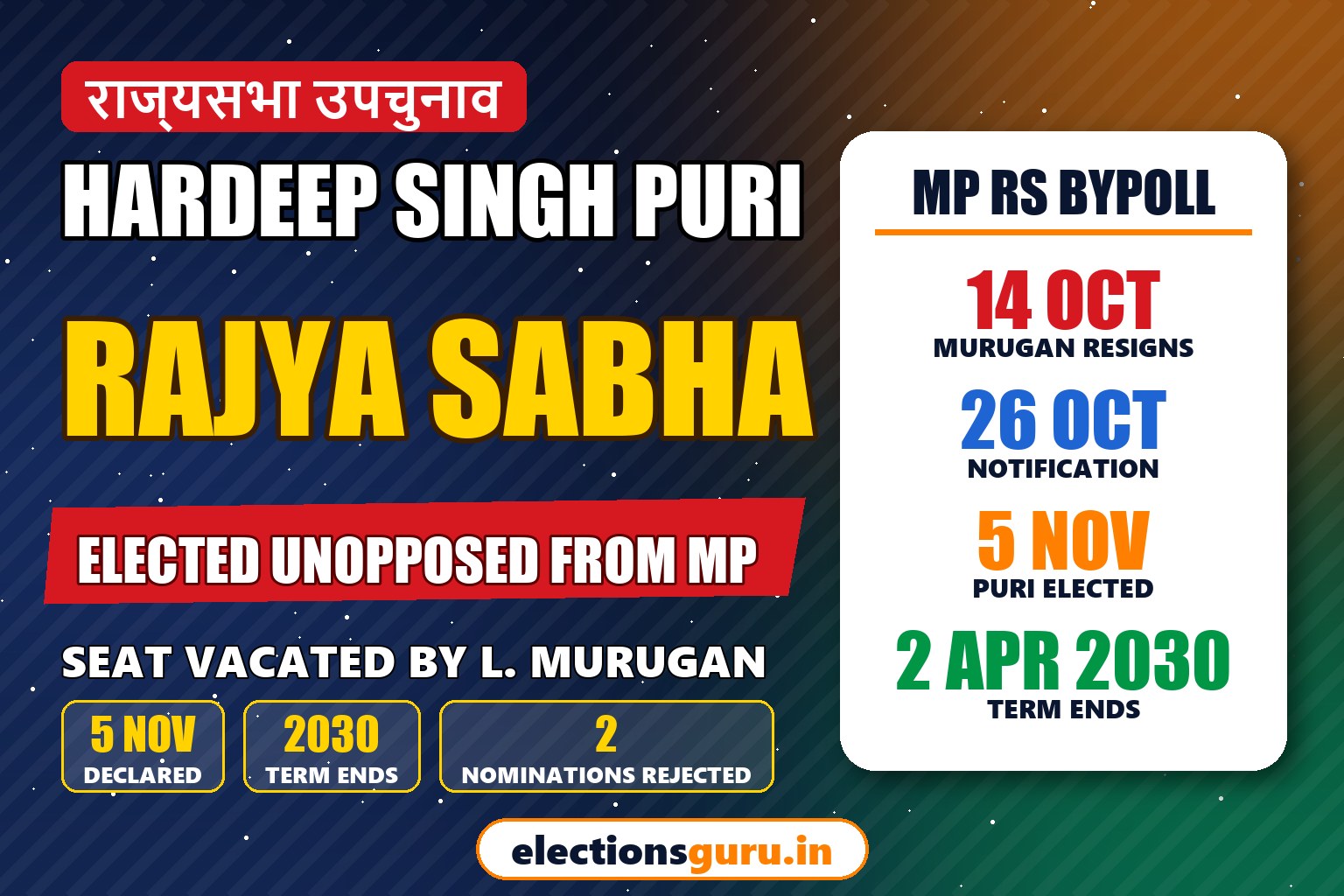
Hardeep Singh Puri, the Union Minister of Petroleum and Natural Gas, has been elected unopposed to the Rajya Sabha from Madhya Pradesh. Returning Officer Umesh Sharma declared him elected on 5 November 2026, the last day for withdrawal of nominations, after the nominations of the other two candidates were rejected during scrutiny. The seat had fallen vacant after former Union minister L. Murugan resigned from the Rajya Sabha and the Union Council of Ministers to focus on strengthening the BJP in Tamil Nadu.
This Election Guru explainer covers the full story of the Madhya Pradesh Rajya Sabha bypoll: why Murugan quit, the election schedule, how a candidate is “elected unopposed”, the numbers in the MP Assembly and a complete profile of Hardeep Singh Puri.
Madhya Pradesh Rajya Sabha Bypoll at a Glance
| Detail | Information |
|---|---|
| State | Madhya Pradesh |
| Seat vacated by | L. Murugan (BJP) |
| Reason | Resigned on 14 October 2026 to focus on Tamil Nadu BJP |
| Winner | Hardeep Singh Puri (BJP) |
| Result | Elected unopposed on 5 November 2026 |
| Returning Officer | Umesh Sharma |
| Other nominees | Two nominations rejected at scrutiny |
| Term | Remainder of term, up to 2 April 2030 |
| Scheduled polling date | 12 November 2026 (not required) |
Why L. Murugan Resigned
L. Murugan, a former Tamil Nadu BJP president, was a Minister of State in the Union government and a Rajya Sabha member from Madhya Pradesh. On 14 October 2026 he resigned from both the Union Council of Ministers and the Rajya Sabha, saying he wanted to focus on strengthening the BJP in Tamil Nadu. His Rajya Sabha term was due to run until 2 April 2030, so the bypoll winner will serve the remaining period.
Bypoll Schedule
| Stage | Date |
|---|---|
| Notification | 26 October 2026 |
| Last date for nominations | 2 November 2026 |
| Last date for withdrawal | 5 November 2026 |
| Polling (if needed) | 12 November 2026, 9 am – 4 pm |
| Counting (if needed) | 12 November 2026, 5 pm |
| Process to be completed by | 16 November 2026 |

How Hardeep Puri Was Elected Unopposed
Three nominations were filed for the seat. During scrutiny, the papers of the other two nominees – reported as Kante Sayanna and Rajkumar Lohani, who was said to have Congress backing – were rejected. With only one valid candidate left, Returning Officer Umesh Sharma declared Puri elected on 5 November, the last day for withdrawal. No vote was needed on 12 November.
What Does “Elected Unopposed” Mean?
Under Section 53(2) of the Representation of the People Act, 1951, if the number of valid candidates after withdrawal is equal to the number of seats, the Returning Officer declares them elected without a poll. This is common in Rajya Sabha elections, where the result can be predicted from party strength in the Assembly.
Why BJP Was Sure to Win
Rajya Sabha members are elected by the elected MLAs of the state. In a bypoll for a single seat, the candidate needs a majority of the votes cast. The BJP has a commanding majority in Madhya Pradesh – it won 163 of 230 seats in the 2023 Assembly election – so its candidate was certain to win even if there had been a contest.
| Party | Seats in MP Assembly (2023 result) |
|---|---|
| BJP | 163 |
| Congress | 66 |
| Others | 1 |
| Total | 230 |
Also Read: Elections in 2027: Full List of State and National Polls
Who Is Hardeep Singh Puri?
| Detail | Information |
|---|---|
| Full name | Hardeep Singh Puri |
| Born | 15 February 1952 |
| Former career | Indian Foreign Service (1974 batch) |
| Diplomatic role | India’s Permanent Representative to the United Nations, New York |
| Party | Bharatiya Janata Party (joined 2014) |
| Current post | Union Minister of Petroleum and Natural Gas |
| Earlier Rajya Sabha seat | Uttar Pradesh |
| Lok Sabha contest | Amritsar, 2019 (lost) |
From Diplomat to Minister
Hardeep Singh Puri joined the Indian Foreign Service in 1974 and had a long diplomatic career, including as India’s Permanent Representative to the United Nations in New York, where he also chaired the UN Security Council’s Counter-Terrorism Committee. After retiring, he joined the BJP in 2014.
Ministerial Career
Puri was inducted into the Union government in 2017 as Minister of State (Independent Charge) for Housing and Urban Affairs and entered the Rajya Sabha from Uttar Pradesh. He became Cabinet Minister for Petroleum and Natural Gas in 2021 and continued in the portfolio in the Modi government formed in 2024. He contested the 2019 Lok Sabha election from Amritsar but lost to the Congress candidate.
Why Madhya Pradesh?
Puri’s Rajya Sabha term from Uttar Pradesh was due to end in November 2026. The Madhya Pradesh bypoll gave the BJP a way to keep its Petroleum Minister in Parliament until 2030 without depending on the next round of Rajya Sabha elections.
Rajya Sabha Bypolls: How They Work
- A bypoll is held when a seat falls vacant due to resignation, death or disqualification.
- The winner serves only the remaining part of the original six-year term.
- Elected MLAs of the state vote; in a single-seat bypoll, the candidate with a majority wins.
- If only one valid candidate remains after scrutiny and withdrawal, he or she is declared elected unopposed.
What It Means for Tamil Nadu BJP
Murugan’s decision to give up a ministerial post and a Rajya Sabha seat signals that the BJP is serious about rebuilding in Tamil Nadu, where the political landscape has changed with C. Joseph Vijay as Chief Minister. Murugan is expected to focus on organisation-building ahead of the 2027 local body elections in the state and the 2029 Lok Sabha polls.
Also Read: Mekedatu Dam Controversy: CM Vijay’s Letter to PM Modi
Rajya Sabha: Key Facts
The Rajya Sabha, or Council of States, is the upper house of Parliament. Its maximum strength is 250 – up to 238 members elected by state and union territory legislatures and 12 nominated by the President. It is a permanent House that is never dissolved; one-third of its members retire every two years, and each member serves a six-year term. Madhya Pradesh has 11 Rajya Sabha seats.
| Feature | Rajya Sabha |
|---|---|
| Maximum strength | 250 (238 elected + 12 nominated) |
| Term of a member | 6 years |
| Retirement cycle | One-third every two years |
| Elected by | Elected MLAs of states and some union territories |
| Voting system | Single transferable vote, open ballot for party MLAs |
| Madhya Pradesh seats | 11 |
How Rajya Sabha Elections Work
Rajya Sabha members are elected by the elected MLAs of each state using proportional representation by means of the single transferable vote. Since a 2003 amendment, voting is by open ballot: MLAs of a party must show their ballot to the party’s authorised agent, to prevent cross-voting. NOTA is not allowed in Rajya Sabha elections, as held by the Supreme Court in 2018. In a bypoll for one seat, the candidate needs more than half of the valid votes, which usually makes the ruling party’s win certain.
Who Is L. Murugan?
L. Murugan is a BJP leader from Tamil Nadu who served as the state BJP president in 2020-21. In 2021 he was made a Minister of State in the Union government and entered the Rajya Sabha from Madhya Pradesh through a bypoll, and was re-elected from the state in 2024. He contested the Nilgiris Lok Sabha seat in Tamil Nadu in 2024 but lost to the DMK’s A. Raja. His resignation in October 2026 to focus on Tamil Nadu shows the BJP’s effort to strengthen its organisation in the state.
Hardeep Puri as Petroleum Minister
As Petroleum Minister since 2021, Puri has handled a period of volatile global oil prices after the Russia-Ukraine war. Under his ministry, India expanded LPG connections under the Ujjwala scheme, increased purchases of discounted Russian crude and met its target of 20% ethanol blending in petrol (E20) ahead of schedule. He also oversaw the expansion of city gas distribution networks across the country.
Also Read: Russia-Ukraine Peace Talks in Abu Dhabi 2026
Rajya Sabha Members Elected Unopposed: Why It Is Common
In Rajya Sabha elections, the number of seats a party can win is usually clear from its strength in the Assembly. Parties therefore field only as many candidates as they can win, and many candidates are elected unopposed. Contests happen only when parties try to win an extra seat with the help of independents or cross-voting. In this Madhya Pradesh bypoll, the BJP’s huge majority and the rejection of the other nominations made Puri’s election a formality.
| Election Type | Who Votes | Typical Outcome |
|---|---|---|
| Biennial Rajya Sabha election | All elected MLAs of the state | Seats split by party strength; many unopposed |
| Rajya Sabha bypoll (single seat) | All elected MLAs of the state | Ruling party almost always wins |
| Lok Sabha / Assembly bypoll | Voters of the constituency | Direct contest among candidates |
How a Rajya Sabha Nomination Can Be Rejected
A Rajya Sabha candidate must be an Indian citizen of at least 30 years of age and an elector in a parliamentary constituency. The nomination paper must be subscribed by the required number of elected MLAs as proposers, and the candidate must pay a security deposit of ₹10,000 (₹5,000 for SC/ST candidates). During scrutiny, the Returning Officer can reject nominations that do not meet these legal requirements – for example, if the required proposers are missing. The reports on this bypoll did not detail the specific reasons for the two rejections.
| Requirement | Rajya Sabha Candidate |
|---|---|
| Minimum age | 30 years |
| Citizenship | Indian citizen |
| Elector | Must be a voter in a parliamentary constituency |
| Proposers | Required number of elected MLAs of the state |
| Security deposit | ₹10,000 (₹5,000 for SC/ST) |
Hardeep Puri’s Earlier Elections
Puri first entered the Rajya Sabha from Uttar Pradesh in 2018 and was re-elected from the state in November 2020. He contested his only Lok Sabha election in 2019 from Amritsar in Punjab, where he lost to the Congress’s Gurjeet Singh Aujla. His move to a Madhya Pradesh seat continues a common practice of parties using Rajya Sabha seats from states where they are strong to keep ministers in Parliament.
Madhya Pradesh in the Rajya Sabha
Madhya Pradesh has 11 Rajya Sabha seats. Because the BJP has a large majority in the state Assembly, it holds most of these seats, and the state has often been used to elect leaders from other states – such as L. Murugan from Tamil Nadu and earlier George Kurian from Kerala in a 2024 bypoll.
What Happens After Election
- The Returning Officer issues a certificate of election.
- The Election Commission notifies the result in the Gazette.
- The new member takes oath in the Rajya Sabha before the Chairman.
- The member serves the remaining term of the seat – up to 2 April 2030 in this case.
Key Takeaways
| Point | Detail |
|---|---|
| Winner | Hardeep Singh Puri (BJP), elected unopposed |
| Date | 5 November 2026 |
| Seat vacated by | L. Murugan |
| Why Murugan quit | To focus on Tamil Nadu BJP |
| Term | Up to 2 April 2030 |
Hardeep Puri Elected Unopposed to Rajya Sabha from MP FAQ
Who won the Madhya Pradesh Rajya Sabha bypoll 2026?
Union Minister Hardeep Singh Puri of the BJP was declared elected unopposed on 5 November 2026.
Why was there a Rajya Sabha bypoll in Madhya Pradesh?
The seat fell vacant after L. Murugan resigned from the Rajya Sabha and the Union Council of Ministers on 14 October 2026.
Why did L. Murugan resign?
Murugan said he wanted to focus on strengthening the BJP in Tamil Nadu.
Why was Hardeep Puri elected unopposed?
The nominations of the other two candidates were rejected during scrutiny, leaving Puri as the only valid candidate.
Till when is Hardeep Puri’s Rajya Sabha term?
He will serve the remaining term of the seat, up to 2 April 2030.
Who is Hardeep Singh Puri?
He is a former IFS officer and India’s former Permanent Representative to the UN who is now Union Minister of Petroleum and Natural Gas.
How many seats does BJP have in the MP Assembly?
The BJP won 163 of 230 seats in the 2023 Madhya Pradesh Assembly election.