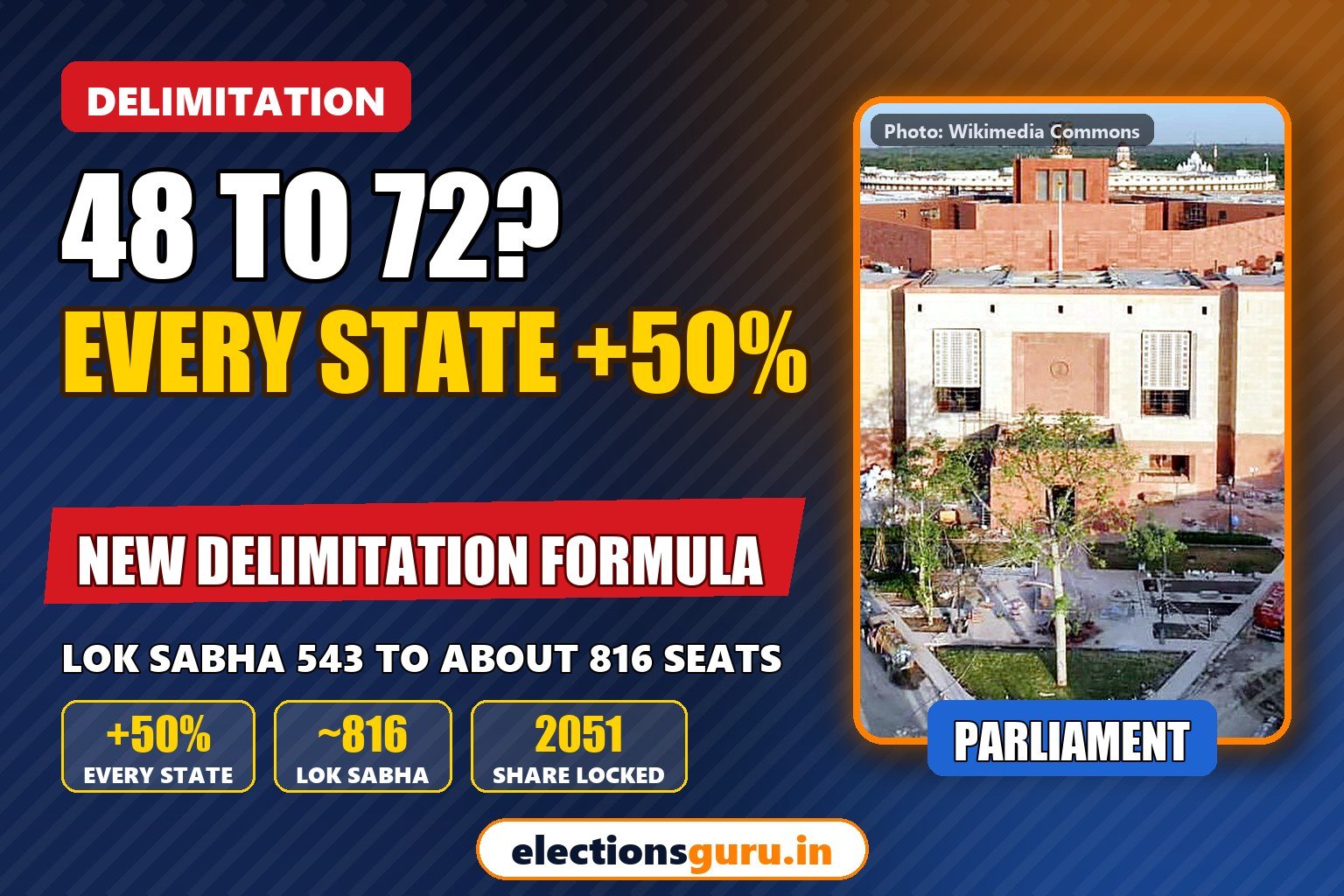
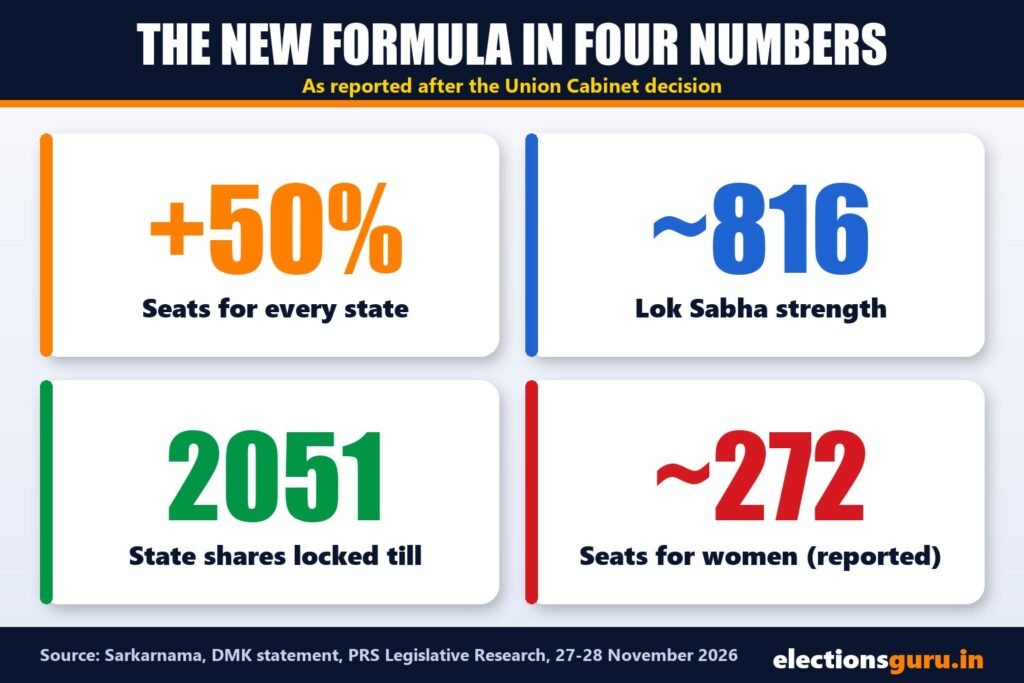
The Centre has brought a new formula for delimitation, the redrawing of Lok Sabha seats. As reported by Sarkarnama, the Union Cabinet approved a proposal on Friday under which every state’s Lok Sabha seats rise by 50%. The House would grow from 543 to about 816, and each state’s current share would stay the same until 2051. For Maharashtra, that means 48 MPs becoming 72.
Delimitation New Formula at a Glance
| Detail | Information |
|---|---|
| Rule | Every state +50% seats |
| Lok Sabha | 543 to about 816 |
| State share | Protected until 2051 |
| Population base | 1971, per the DMK |
| Women | About one-third, ~272 seats (reported) |
| Maharashtra | 48 to 72 (24 new seats) |
| Special session | Lok Sabha 30 Nov, Rajya Sabha 2 Dec |
How Is This Different From the April Bill?
The April 2026 bill capped the Lok Sabha at 850 seats, and according to PRS Legislative Research the seats were to be reorganised on the basis of the 2011 Census. That meant states whose population grew faster would gain more seats, while southern states that controlled population growth would see their share fall. On 17 April the constitutional amendment failed in the Lok Sabha: 298 for, 230 against, short of the two-thirds needed.
A flat 50% increase for every state removes that objection: no state’s share goes down.
State-Wise Seats Under the New Formula
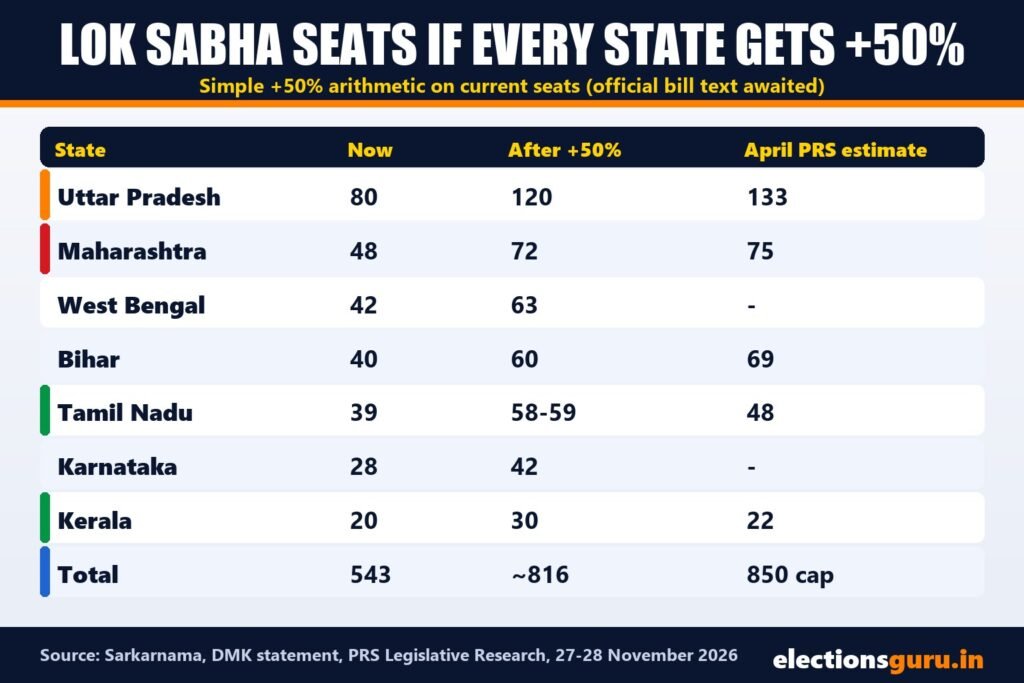
- Uttar Pradesh: 80 to 120 (the April PRS estimate was 133)
- West Bengal: 42 to 63
- Bihar: 40 to 60
- Tamil Nadu: 39 to 58-59 (April estimate: 48)
- Karnataka: 28 to 42
- Kerala: 20 to 30 (April estimate: 22)
Compared with April’s projections, the south gains and Uttar Pradesh gets fewer seats. These figures are simple +50% arithmetic; the official bill text has not been published.
What It Means for Maharashtra
Maharashtra would go from 48 to 72 MPs, adding 24 constituencies. The April PRS estimate had Maharashtra at 75, so the new formula gives three fewer seats but keeps the state’s share safe. Where the new constituencies come up and how boundaries are drawn will be decided during the delimitation process.
The Women’s Reservation Link
About one-third of the new seats, roughly 272, would be reserved for women, according to reports. On the same arithmetic, 24 of Maharashtra’s 72 seats could be reserved. If the bill passes next week, the 2029 Lok Sabha election could be held on the new seats.
DMK’s U-Turn
The DMK, the bill’s strongest opponent in April, announced support after a meeting of its MPs in Chennai. M.K. Stalin said the party backs the bill because it now includes its demands for fair delimitation, and called it a victory for the southern states. Congress and Shiv Sena (UBT) remain opposed.
Election Guru Analysis
The flat 50% formula is designed to win over the south, and the DMK’s support shows it has worked there. But a constitutional amendment needs a two-thirds majority in both Houses. With Congress and the Thackeray Sena opposed, the decision of smaller parties, especially Sharad Pawar’s NCP, could decide the outcome in the special session starting Monday.
Also Read: Delimitation Bill 2026 Explained: Lok Sabha 850 Seats, Maharashtra 75?
Also Read: INDIA Bloc Split on Delimitation: DMK Backs, Congress-UBT Oppose, Pawar Undecided
Watch: Delimitation New Formula Video
For the detailed background, watch the full Election Guru video below.
Delimitation New Formula FAQ
What is the new delimitation formula?
Every state’s Lok Sabha seats rise by 50%, taking the House from 543 to about 816, with each state’s share protected until 2051 (as reported).
How many Lok Sabha seats will Maharashtra get?
Under a 50% increase, Maharashtra would go from 48 to 72 seats, adding 24 constituencies.
How is it different from the April 2026 bill?
The April bill capped the House at 850 and, per PRS, used the 2011 Census, which would have cut the southern states’ share. The new formula gives every state the same 50% rise.
Why does the DMK support it now?
M.K. Stalin said the bill now includes the DMK’s demands for fair delimitation, including a uniform increase on the 1971 population base.
How many seats will be reserved for women?
About one-third, roughly 272 seats, according to reports.
When will the bill be taken up?
In the special session: the Lok Sabha from 30 November and the Rajya Sabha from 2 December 2026.