
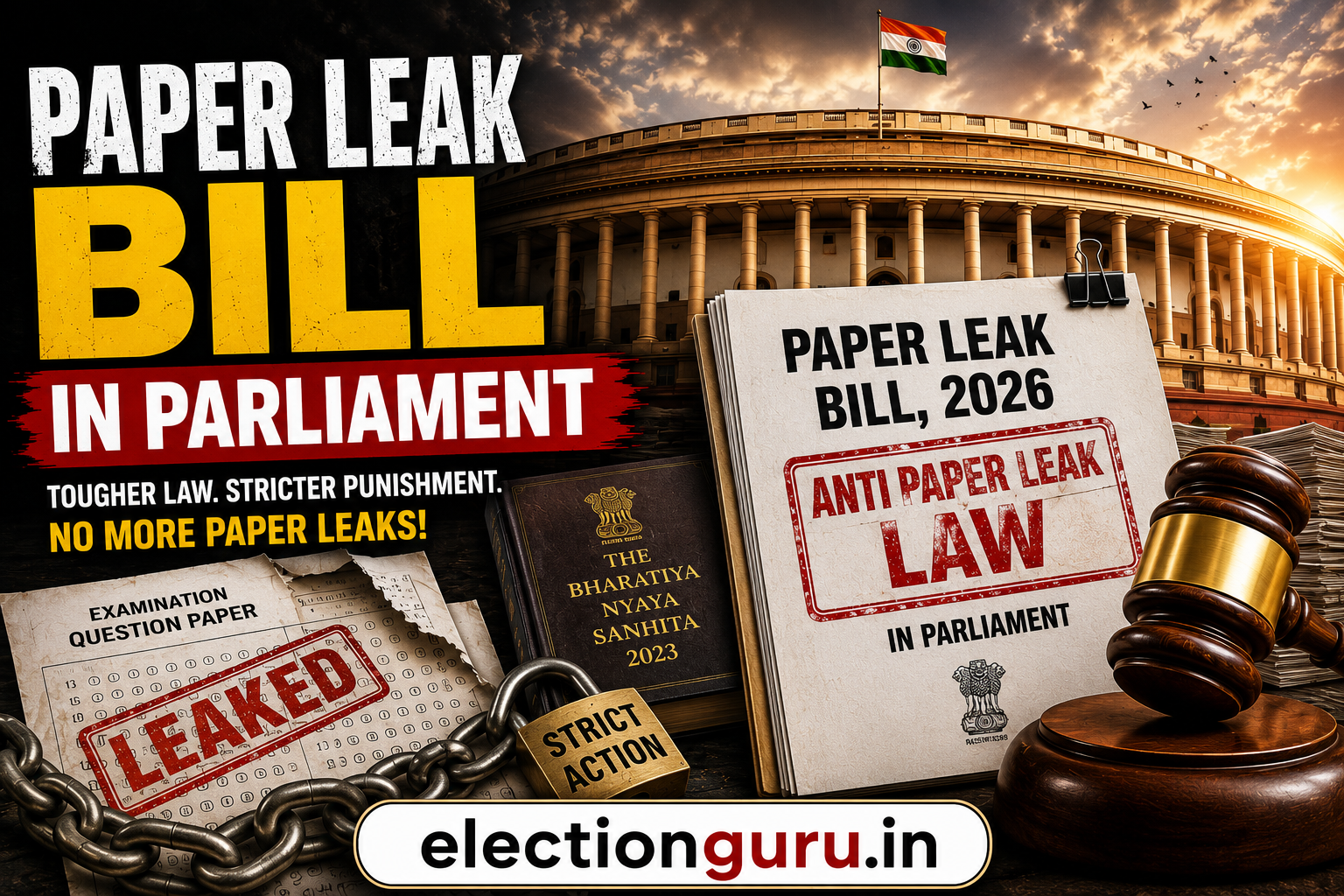
The paper leak bill in Parliament has captured the nation’s attention during the 2026 Monsoon Session. On 27 July 2026, Union Minister Dr Jitendra Singh placed the Public Examinations (Prevention of Unfair Means) Amendment Bill, 2026 before the Lok Sabha, presenting what officials describe as the toughest anti paper leak law the country has ever framed. Arriving amid the storm of the NEET-UG 2026 paper leak and huge student demonstrations, the legislation offers fast-track courts, ten-year jail terms, penalties reaching ₹10 crore, and confiscation of property for anyone who wrecks the future of sincere aspirants.
This Election Guru explainer walks you through every layer of the anti paper leak bill 2026 what it contains, the law it builds on, the scandals that forced it into being, the Nilekani reform panel, the political clash inside Parliament, and its meaning for millions of students. If you are searching for the most thorough breakdown of the paper leak bill 2026, this is it.
What is the Paper Leak Bill 2026?
The Public Examinations (Prevention of Unfair Means) Amendment Bill, 2026 is a piece of legislation designed to strengthen the country’s existing Public Examinations (Prevention of Unfair Means) Act, 2024. Its purpose is direct: seal the weaknesses in the 2024 framework, guarantee speedy trials, and turn organised exam fraud into a crime that simply is not worth the risk.
The Ministry of Personnel, Public Grievances and Pensions brought the bill to the Lok Sabha on 24 July 2026, packing it with tougher punishments, deadline-bound probes, and special fast-track courts dedicated purely to examination offences. Dr Jitendra Singh, the Minister of State for Personnel, formally tabled it. The law zeroes in on paper leaks, impersonation, proxy candidates, digital manipulation, and collusion across India’s largest recruitment and entrance tests NEET, UPSC, SSC, Railways, and banking exams alike.
Why Was the Anti Paper Leak Bill 2026 Introduced?
The paper leak bill in Parliament did not appear out of nowhere. It is a calculated answer to a run of examination disasters that peaked with the 2026 NEET episode. The government has openly acknowledged that repeated question paper leaks and malpractices, including the NEET row, have shaken public confidence in the fairness and credibility of major examinations.
The political spark was dramatic and immediate. The bill surfaced barely a day after Union Minister Dharmendra Pradhan stepped down as protests erupted across the country over irregularities in the NEET-UG 2026 examination. With more than 24 lakh medical hopefuls affected and students pouring onto the streets of Delhi and other cities, the government needed a strong legislative statement and this amendment became that statement.
The real flaw in the 2024 law was pace. Prosecutions crawled for years, the accused secured bail, and deterrence stayed weak. The 2026 amendment attacks that problem head-on with firm deadlines, exclusive courts, and specialised investigation squads.
Key Provisions of the Public Examinations Amendment Bill 2026
The anti paper leak bill 2026 rolls out a full arsenal of stern measures. Here is a detailed look at each major provision.
Tougher jail terms and ₹10 crore fines. The bill keeps the ceiling of ten years’ imprisonment while dramatically raising the financial cost for organised offenders. Fines can climb to ₹10 crore, aimed squarely at leak syndicates, complicit institutions, and service providers running examination fraud. Individual wrongdoers continue to face heavy jail time, while institutions and vendors risk fines that can bankrupt them.
Property seizure and forfeiture. Investigators gain real muscle. Alongside imprisonment and heavy fines, the law allows the seizure and attachment of a convict’s property. Institutions found guilty may also be forced to repay the full proportionate cost of conducting the compromised examination.
Investigation within 60 days. Endless probes are over. Every investigation must be wrapped up within sixty days, whether it is handled by state police, central agencies, or a special task force. This keeps momentum high and prevents evidence from going cold.
Fast-track courts with three-month trials. The bill sets up dedicated Special Fast-Track Courts that will hear cases on a day-to-day basis and conclude the trial inside three months. This is a sea change from the years-long delays that currently allow offenders to slip away.
Time-bound appeals. Even the appeal stage carries a clock. Appeals reaching the High Court are to be decided by a Division Bench within three months, shutting the door on offenders who try to stretch cases out endlessly.
Special Task Force. The legislation authorises dedicated Special Task Forces, armed with the expertise to break apart organised exam mafias, working hand in hand with state police and central agencies such as the CBI.
A wider definition of “unfair means.” Recognising how modern rackets actually function, the bill stretches the definition of unfair means to cover digital tampering, proxy candidates, and collusion with examination authorities categories that were far harder to prosecute earlier.
In short, the 2026 bill locks in a sixty-day investigation window, a three-month fast-track trial, a three-month appeal deadline, a maximum of ten years in jail, and fines up to ₹10 crore.
Background: The Public Examinations (Prevention of Unfair Means) Act, 2024
To grasp the 2026 amendment fully, you need to understand its parent India’s first national anti-paper-leak statute.
The bill for the 2024 Act was introduced by Dr Jitendra Singh on 5 February 2024. The Lok Sabha cleared it on 6 February and the Rajya Sabha on 9 February 2024. After presidential assent, the Act came into force on 21 June 2024. Before this, a serious legal gap existed there was no specific, substantive law to tackle unfair means and offences by the many players involved in conducting central government examinations.
The Act blankets the country’s biggest tests, covering examinations run by the Union Public Service Commission (UPSC), the Staff Selection Commission (SSC), the Railways, banking recruitment bodies, and the National Testing Agency (NTA), among others.
On the offences side, the Act bars any collusion or conspiracy to enable cheating. It lists unfair means such as unauthorised access or leakage of a question paper or answer key, unlawfully helping a candidate during the exam, and tampering with computer systems or networks. It also criminalises building fake websites, running fake examinations, issuing bogus admit cards, and rigging seating arrangements to enable malpractice.
The punishments were graded. A candidate resorting to unfair means faced three to five years in prison and a fine up to ₹10 lakh. Organised crime drew far harsher terms five to ten years’ imprisonment and a minimum fine of ₹1 crore, with the property of a guilty institution liable to be attached and forfeited. Every offence under the Act is cognizable, non-bailable, and non-compoundable.
Also Read : India’s GST Reform 2025: A Game-Changer for Citizens, Businesses, and the Economy
Top Paper Leak Scandals in India: The Full History
The paper leak bill in Parliament is the product of decades of examination fraud, and India’s record here is deeply troubling. Over the past twenty years, the country has recorded more than ninety instances of paper leaks and examination irregularities at the national and state levels, at least fifteen of them tied to central agencies. Here are the biggest and most infamous scandals that reduced countless dreams to ashes.
The Vyapam scam (2013). Madhya Pradesh’s Vyapam scandal remains the most shocking examination fraud in Indian memory a sprawling web of impersonation, bribery, and rigging in medical and government recruitment tests run by the state’s professional examination board. A CBI court eventually handed five-year rigorous imprisonment terms to ten people in one case connected to a 2008 recruitment exam. The scandal drew national horror not just for its scale but for the mysterious deaths of several people linked to it.
NEET-UG 2024. The 2024 medical entrance controversy was the defining scandal of that year. Held on 5 May for a record pool of around 24 lakh candidates, the exam was rocked by allegations of leaks, grace marks, and irregularities. The Supreme Court declined to scrap the whole exam but acknowledged a breach at some centres, and the uproar directly produced the Public Examinations Act, 2024.
NEET-UG 2026. The 2026 controversy is what set the current bill rolling. After leak allegations surfaced, the National Testing Agency cancelled the test taken by over 24 lakh candidates, igniting protests in Delhi. Students marched with placards outside government offices, and the resulting political heat led to a ministerial resignation and the introduction of the amendment bill.
UGC-NET 2024. The June 2024 UGC-NET, held to recruit assistant professors and research fellows, was scrapped a day after it took place over integrity fears. The story later twisted, though the CBI filed a closure report finding no evidence of an actual leak and concluded that a doctored screenshot had been circulated by a student chasing money. Even so, the affair cost the NTA’s Director General his post.
SSC-CGL 2018. One of the largest aspirant uprisings before the NEET saga came in 2018, when screenshots of alleged SSC Combined Graduate Level questions began spreading online. Protests flared outside SSC headquarters in Delhi and reached cities like Patna and Bareilly, with thousands of candidates demanding a CBI probe.
CBSE board leaks 2018. School examinations have suffered too. In 2018, the CBSE Class X Mathematics and Class XII Economics papers leaked, disrupting more than twenty lakh students and forcing re-examinations that badly dented parents’ trust.
Railway (RRB) recruitment leaks. As one of India’s largest employers, the Railways has faced recurring leaks from mass arrests in 2009 over an RRB paper-leaking racket to the later conviction of a former RRB chairman jailed for a 2010 recruitment exam leak.
Army CEE 2021. Even the armed forces were hit. In 2021, the Army cancelled its nationwide Common Entrance Examination for soldier recruitment after a leak, with a joint Military Intelligence and Pune Police operation cracking the racket.
State-level scandals BPSC, UPPSC and beyond. Recruitment and board exams across states have been battered by leaks. UPPSC and BPSC examinations were cancelled over paper leaks, delaying results and recruitment for huge numbers of graduates. This pressure pushed states such as Bihar, Uttarakhand, Gujarat, Rajasthan, Himachal Pradesh, and Arunachal Pradesh to enact their own anti-paper-leak laws.
The overall picture is grim: across roughly a decade, the country logged eighty-nine paper leak cases and forty-eight retests between the centre and the states. This unrelenting pattern is exactly why the government has moved to harden the law.
The NEET-UG 2026 Controversy: The Immediate Trigger
The NEET paper leak of 2026 sits at the very core of this legislation. The NEET-UG 2026, conducted for more than 24 lakh aspirants, was cancelled by the NTA once leak allegations gained ground. Protesting students outside government buildings in Delhi held placards demanding accountability, their anger fixed on how repeated leaks were rendering merit meaningless. The political fallout arrived fast, ending in Dharmendra Pradhan’s resignation and the government fast-tracking both the amendment bill and a major reform panel.
The Nandan Nilekani Task Force
Beside the legislation, the government launched a systemic reform drive. On 25 July 2026, the Prime Minister announced a task force headed by Nandan Nilekani to design a leak-proof examination system. Modi stressed that punishment alone cannot fix the problem and that the system itself must evolve. The panel brings together a multidisciplinary group of experts charged with overhauling how examinations are conducted, with a strong push toward reliability, transparency, and maximum use of technology.
Taken together, the amendment bill and the Nilekani Task Force form a twin strategy a stringent law to punish offenders, and technology-led reform to stop leaks before they occur.
Paper Leak Bill in Parliament: Current Status and the Political Battle
The bill’s passage has been turbulent. Dr Jitendra Singh tabled the amendment bill in the Lok Sabha on Monday, but the Opposition kept up its assault over the NEET paper leak, demanding an apology for police action during the protests. Proceedings were repeatedly disrupted by Opposition calls for a debate on police conduct and the wider collapse of examination integrity. The deadlock finally broke after Speaker Om Birla’s appeal, and a full discussion on the anti-paper leak bill was fixed for 28 July 2026.
Why the Paper Leak Bill Matters for Aspirants
For crores of students grinding away for UPSC, SSC, NEET, JEE, Railways, and banking exams, the anti paper leak law is intensely personal. In a nation where competitive exams are among the few genuine ladders of upward mobility, every leaked paper is an injustice against the poor and the deserving. When a paper leaks, honest candidates who studied for years lose to those who simply paid for early access. Retests drain money and morale, stall careers, and corrode faith in the fairness of the whole system. A leak-proof, swiftly-punishing, transparent examination regime is precisely what the paper leak bill 2026 aims to deliver.
Criticism and Challenges
Though broadly welcomed, the bill invites some hard questions. Critics note that a law is only as effective as its enforcement, and India’s history shows low conviction rates in leak cases. Some point out that the 2024 Act was already strict, yet the 2026 NEET leak still occurred hinting that the deeper issue lies in exam administration and technology rather than punishment alone. Others flag capacity concerns: fast-track courts and special task forces demand funding, trained personnel, and forensic infrastructure that will take time to build. This is why the technology-focused reforms expected from the Nilekani Task Force will be decisive for the law’s success.
Conclusion
The Public Examinations (Prevention of Unfair Means) Amendment Bill, 2026 marks a defining moment in India’s long and painful struggle against exam fraud. With sixty-day investigations, three-month fast-track trials, ₹10 crore fines, ten-year jail terms, property seizures, and a technology-driven Nilekani reform panel, the government has declared zero tolerance for paper leaks. From Vyapam to NEET, years of scandals have chipped away at public trust and this bill is a serious bid to restore it. Yet a law lives or dies by its implementation. Whether the paper leak bill in Parliament truly ends the reign of exam mafias will hinge on strict enforcement, judicial capacity, and real reform in how exams are run. For now, it hands millions of honest aspirants fresh hope for a fair, merit-driven future. Keep following Election Guru for every update as the bill advances toward becoming law.
Paper Leak Bill in Parliament FAQ
What is the Paper Leak Bill 2026?
The Paper Leak Bill 2026 is the Public Examinations (Prevention of Unfair Means) Amendment Bill, 2026, which strengthens the 2024 Act by adding tougher penalties, fast-track courts, sixty-day investigations, and three-month trials for exam paper leaks and malpractices. It was tabled in the Lok Sabha on 27 July 2026.
Who introduced the anti paper leak bill in Parliament?
Union Minister of State for Personnel, Dr Jitendra Singh, tabled the bill in the Lok Sabha during the 2026 Monsoon Session on behalf of the Ministry of Personnel, Public Grievances and Pensions.
What is the maximum punishment under the Paper Leak Bill 2026?
The maximum jail term is ten years, along with fines of up to ₹10 crore for organised paper leak syndicates, institutions, and service providers. Convicts can also face seizure and forfeiture of their property.
Which examinations are covered under the anti paper leak law?
It covers major public examinations conducted by UPSC, SSC, the Railway Recruitment Board (RRB), the National Testing Agency (NTA, including NEET and JEE), IBPS banking exams, and other central government recruitment bodies.
What is the Nilekani Task Force and how is it linked to the bill?
The Nilekani Task Force is a multidisciplinary expert committee set up under Nandan Nilekani on 25 July 2026 by the Prime Minister to recommend reforms for a leak-proof, technology-driven, transparent examination system. It complements the amendment bill as part of the government’s twin strategy of tough law plus systemic reform.