
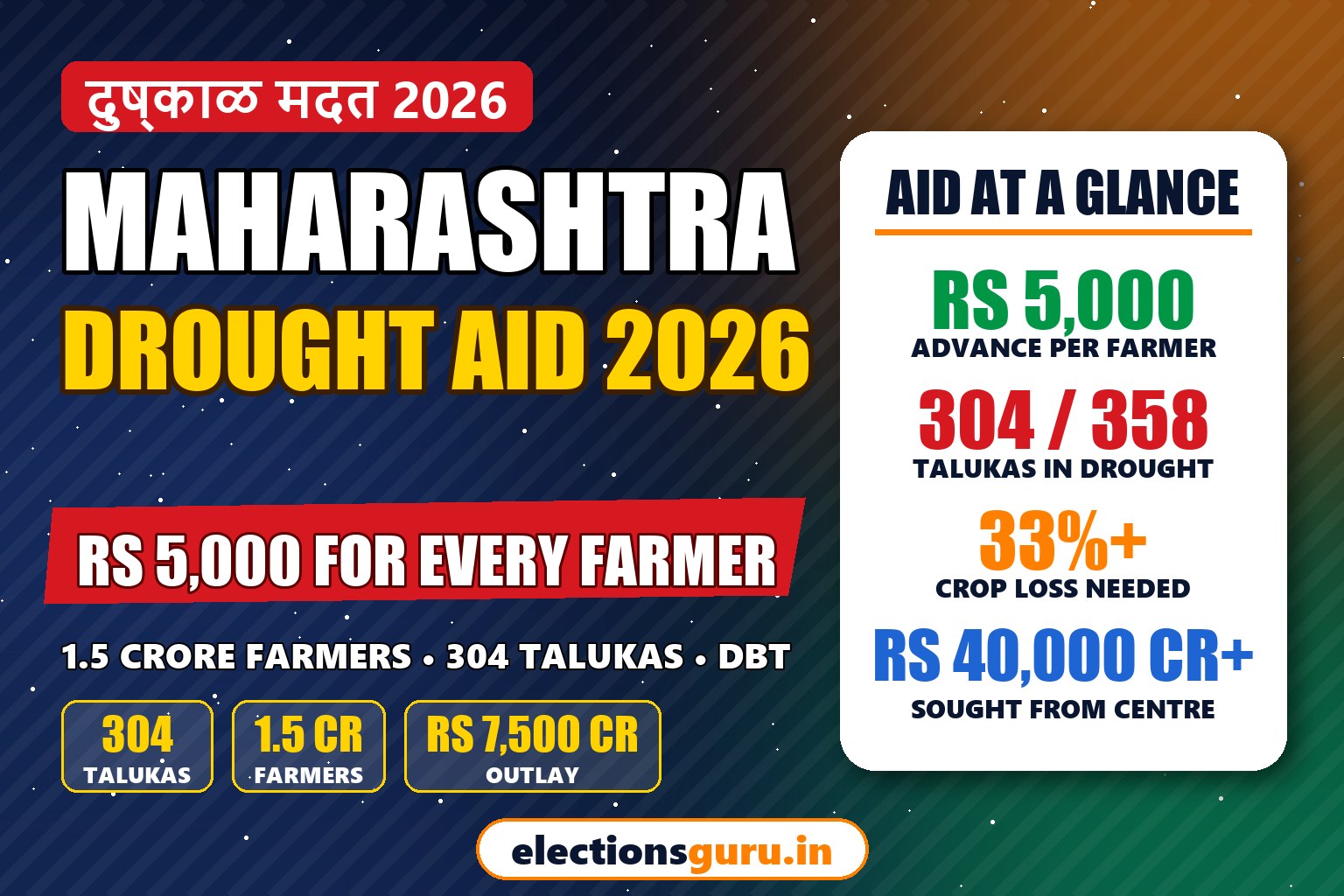
Maharashtra Drought Aid 2026 is the biggest relief measure for farmers in the state this year. With 304 of Maharashtra’s 358 talukas declared drought-hit after deficient rainfall, the state cabinet led by Chief Minister Devendra Fadnavis approved an advance assistance of ₹5,000 per farmer for nearly 1.5 crore farmers, to be credited directly into their bank accounts through DBT. The total cost to the state is about ₹7,500 crore.
Who is eligible? Who is excluded? Do farmers need to do e-KYC again? What other help will drought-hit talukas get, and how much has Maharashtra asked from the Centre? This Election Guru guide answers every question about the Maharashtra drought aid 2026.
Maharashtra Drought Aid 2026 at a Glance
| Detail | Information |
|---|---|
| Scheme | Advance drought assistance, Kharif 2026 |
| Amount | ₹5,000 per eligible farmer |
| Beneficiaries | About 1.5 crore farmers |
| Drought-hit talukas | 304 of 358 (declared in two phases) |
| Eligibility | Crop damage above 33% due to drought |
| Payment mode | Direct Benefit Transfer (DBT) to bank accounts |
| State outlay | About ₹7,500 crore |
| Cabinet approval | Late October 2026 |
| Central help sought | More than ₹40,000 crore under NDRF |
Why Maharashtra Declared Drought in 304 Talukas
Deficient rainfall during the 2026 monsoon badly hit kharif crops across large parts of Maharashtra. The government declared drought in two phases, finally covering 304 talukas out of 358 – one of the widest drought declarations in the state in recent years. Officials said four to five more talukas, including areas in Maval, Hatkanangle and Dindori, could be added after ground-truthing.
Once a taluka is declared drought-hit, farmers there become eligible for relief from the State Disaster Response Fund (SDRF), and the state can approach the Centre for additional help from the National Disaster Response Fund (NDRF). Declared talukas also receive a set of concessions – reports mention 12 types of concessions for drought-hit talukas this year.
₹5,000 Advance: How Much and to Whom
The ₹5,000 is an advance – not the final compensation. It is meant to reach farmers quickly before the full crop-loss assessment and central assistance are finalised. Chief Minister Fadnavis said: “We are making efforts to ensure that the money is credited to the bank accounts of all eligible farmers before Diwali.” He also admitted that ₹5,000 cannot make up for their losses but said it would give some relief.
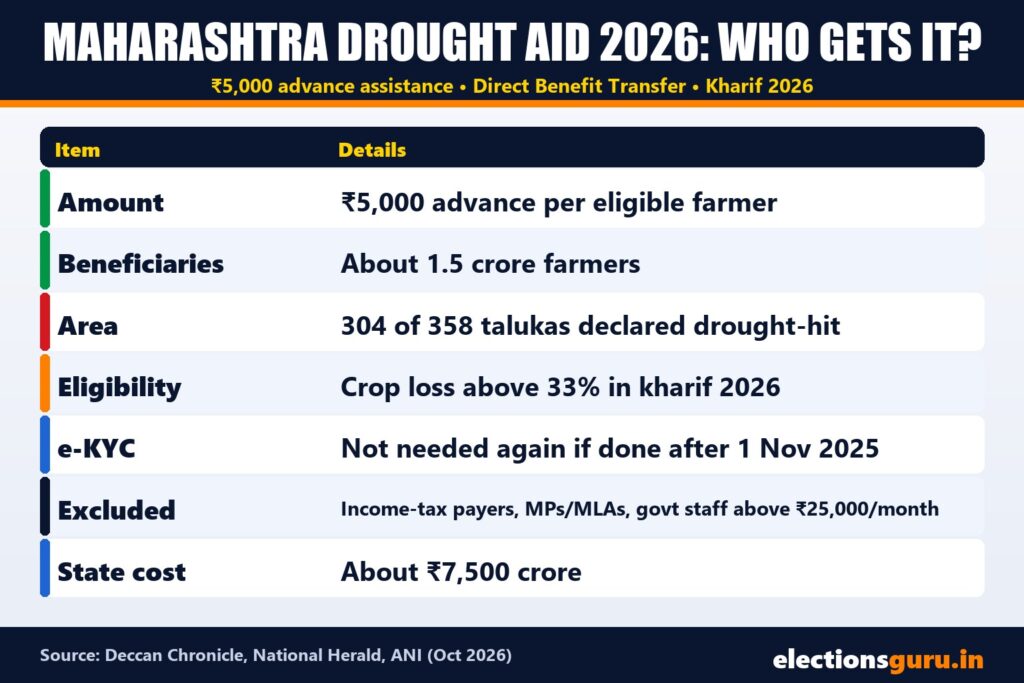
Eligibility for Maharashtra Drought Aid 2026
- The farmer must be in one of the 304 talukas declared drought-hit.
- The farmer must have suffered crop damage of more than 33% due to drought in the kharif 2026 season.
- The farmer’s bank account must be linked for DBT.
- Forest land title holders who do not have an AgriStack Farmer ID can get the aid on the basis of their e-KYC details.
Who Is Not Eligible?
The government has excluded certain categories from the ₹5,000 advance:
| Excluded Category | Details |
|---|---|
| Income-tax payers | Farmers paying income tax on non-agricultural income |
| Elected representatives | Serving or former ministers, MPs, MLAs and current local body members |
| Government employees | Central or state employees earning more than ₹25,000 a month |
| Pensioners | Retired employees with pension above ₹25,000 a month (ex-servicemen are exempt from this exclusion) |
Do Farmers Need to Do e-KYC Again?
No, not in most cases. Farmers who completed e-KYC on or after 1 November 2025 do not need to repeat it. Farmers who have not done e-KYC should complete it at the nearest Aaple Sarkar Seva Kendra or CSC centre, or through the agriculture department’s process, so that the payment is not held up.
No Bank Deductions Allowed
A common complaint in past relief schemes was that banks adjusted relief money against farmers’ old loans. This time, the Chief Minister directed officials to issue clear instructions to banks that no deductions should be made from the drought aid. Fadnavis also asked officials to complete the transfers quickly.
Step-by-Step: How the Money Reaches Farmers
| Step | What Happens |
|---|---|
| 1 | Taluka declared drought-hit by the state government |
| 2 | Revenue and agriculture staff identify farmers with more than 33% crop loss |
| 3 | Farmer data matched with e-KYC / AgriStack Farmer ID |
| 4 | Excluded categories filtered out |
| 5 | ₹5,000 credited directly to the farmer’s bank account through DBT |
Maharashtra Seeks Over ₹40,000 Crore from the Centre
The ₹7,500 crore advance is only the first step. Maharashtra planned to send its memorandum to the Centre by 31 October seeking more than ₹40,000 crore under the National Disaster Response Fund, and officials said the figure could rise. After the memorandum, an Inter-Ministerial Central Team usually visits the affected areas before the Centre decides on the amount.
Concessions in Drought-Hit Talukas
Apart from cash help, drought declarations in Maharashtra usually bring a package of concessions for the declared areas. Reports say 12 types of concessions apply this year. Such packages typically include steps like:
- Waiver or postponement of land revenue
- Restructuring of crop loans and suspension of loan recovery
- Concession on electricity bills for farm pumps and no disconnection
- Exam fee waiver for students from affected families
- Water supply by tankers where needed
- Relaxation in employment guarantee works
Also Read: NCP Merger 2026: Will Sharad Pawar and Ajit Pawar’s Parties Reunite?
Other Decisions Taken by the Same Cabinet
The same cabinet meeting also cleared viability gap funding for flights between Navi Mumbai and Chipi airport in Sindhudurg, ₹66.82 crore support for Bajaj Auto’s electric vehicle manufacturing, a revised staffing structure for the water resources department, and the transfer of 289 hectares of land at Raver in Dhule district to MIDC.
Political Reactions
The opposition has said ₹5,000 is far too little for farmers who have lost their entire kharif crop, and parties such as the NCP (SP) have demanded more aid. The government’s reply is that this is only an advance and that larger compensation will follow after the crop assessment and central assistance.
Why This Matters Politically
Drought is a powerful political issue in Maharashtra, especially in Marathwada and parts of western Maharashtra and Vidarbha. With local body elections approaching, how quickly and fairly the aid reaches farmers will be watched closely by both Mahayuti and the Maha Vikas Aghadi.
Also Read: Gokul Chairman Election 2026: Rajesh Patil Wins 16-13
How Drought Is Declared in India
Drought in India is declared by state governments following the Centre’s Manual for Drought Management. The manual uses a set of indicators rather than rainfall alone: rainfall deficit and dry spells, the area sown, vegetation indices from satellites, soil moisture and hydrological indicators such as reservoir and groundwater levels. Based on these, a taluka or block can be declared to be under “moderate” or “severe” drought. Field-level crop cutting and ground-truthing then confirm the extent of crop loss before relief is paid.
| Indicator | What It Measures |
|---|---|
| Rainfall | Deficit compared with normal rainfall and length of dry spells |
| Sowing | Area sown compared with normal |
| Vegetation index | Crop health from satellite images |
| Soil moisture | Moisture available to crops |
| Hydrology | Reservoir, stream and groundwater levels |
SDRF and NDRF: Where the Relief Money Comes From
Disaster relief in India is funded through two funds. The State Disaster Response Fund (SDRF) is available with every state, with the Centre contributing most of it. When a disaster is of “severe nature” and the SDRF is not enough, the state sends a memorandum to the Centre for extra help from the National Disaster Response Fund (NDRF). An Inter-Ministerial Central Team visits, and a high-level committee decides how much the Centre will release. Relief for crop loss is paid as “input subsidy” per hectare under norms fixed by the Centre, with separate rates for rainfed crops, irrigated crops and perennial crops.
| Fund | Who Manages | When Used |
|---|---|---|
| SDRF | State government (largely funded by Centre) | First line of relief for notified disasters |
| NDRF | Union government | Additional help for disasters of severe nature after a state memorandum |
Maharashtra’s History of Drought
Drought is not new to Maharashtra. Marathwada and parts of western Maharashtra and Vidarbha lie in rain-shadow and semi-arid zones, and have faced repeated droughts. The droughts of 2012-13 and 2015-16 caused severe water shortages, with water trains sent to Latur in 2016. In October 2018, the state declared drought in 151 talukas, and in 2023 it declared drought in 40 talukas before extending relief to more areas. The 2026 declaration covering 304 of 358 talukas is far wider than these recent cases, showing how severe this year’s rainfall failure has been.
| Year | Drought Declaration (Talukas) |
|---|---|
| 2018 | 151 |
| 2023 | 40 (initially) |
| 2026 | 304 of 358 |
Which Regions Are Most Affected?
Marathwada – districts such as Beed, Dharashiv (Osmanabad), Latur, Jalna and Chhatrapati Sambhajinagar – is traditionally the worst hit, along with parts of Solapur, Ahilyanagar, Pune, Satara and Sangli in western Maharashtra and several Vidarbha districts. With 304 talukas declared, almost every district in the state has at least some drought-hit areas this year.
How to Check Your Drought Aid Payment
- Watch for an SMS from your bank about a DBT credit of ₹5,000.
- Check your bank passbook or mini statement at the branch, ATM or through mobile banking.
- Make sure your Aadhaar is linked to your bank account and seeded for DBT.
- Contact your village Talathi, Krishi Sevak or taluka agriculture office if your name is missing.
- For general farm queries, farmers can call the Kisan Call Centre at 1800-180-1551.
Common Problems Farmers Face
| Problem | What to Do |
|---|---|
| Aadhaar not linked to bank | Visit your bank branch to complete Aadhaar seeding |
| e-KYC pending | Complete e-KYC at an Aaple Sarkar Seva Kendra / CSC |
| Name missing in list | Contact the Talathi or taluka agriculture officer |
| Money adjusted against loan | Complain to the bank and the taluka office – the CM has ordered no deductions |
What Farmers Want Beyond ₹5,000
Farmer organisations and opposition parties are demanding full compensation for crop loss per hectare, loan waivers or restructuring, crop insurance claims to be settled quickly, fodder camps for cattle and drinking water by tankers in villages. How the state and Centre respond after the central team’s visit will decide whether farmers get substantial relief before the rabi season.
Which Crops Have Been Hit?
Maharashtra’s kharif season depends almost entirely on the June-September monsoon. The main kharif crops – soybean, cotton, tur (pigeon pea), moong, urad, bajra, jowar and maize – are largely rainfed. Long dry spells during the sowing and flowering stages reduce yields sharply, and in many areas farmers had to re-sow after the first sowing failed. Horticulture crops and fodder availability for cattle are also affected, which hits dairy farmers in rural Maharashtra.
| Crop | Main Growing Regions in Maharashtra |
|---|---|
| Soybean | Marathwada, Vidarbha, western Maharashtra |
| Cotton | Vidarbha, Marathwada, Khandesh |
| Tur (pigeon pea) | Marathwada, Vidarbha |
| Bajra and jowar | Western Maharashtra, Marathwada |
| Maize | Khandesh, Marathwada, western Maharashtra |
Crop Insurance: What Farmers Should Do
Farmers who enrolled in the Pradhan Mantri Fasal Bima Yojana (PMFBY) can also claim compensation for crop loss. Under PMFBY, farmers pay a premium of 2% of the sum insured for kharif food and oilseed crops, and the rest is paid by the Centre and the state. Losses due to drought are usually assessed through crop-cutting experiments and yield data at the notified area level. Farmers should keep their policy details ready and follow up with the insurance company, bank or agriculture office if claims are delayed. The ₹5,000 drought advance is separate from insurance claims.
MGNREGA and Drinking Water in Drought Areas
In areas declared drought-hit, the Centre usually allows up to 50 additional days of work under the Mahatma Gandhi National Rural Employment Guarantee Act (MGNREGA), taking the limit to 150 days per household. This helps landless labourers and small farmers earn wages when farm work dries up. District administrations also arrange drinking water by tankers, deepen and repair wells and set up fodder camps or fodder depots for cattle when the situation worsens in summer.
Long-Term Solutions to Maharashtra’s Drought
- Watershed development: Programmes like Jalyukt Shivar Abhiyan, first launched in 2015 and revived later, aim to conserve rainwater in villages.
- Micro-irrigation: Drip and sprinkler irrigation reduce water use, especially for sugarcane and horticulture.
- Crop diversification: Moving away from water-intensive crops in dry regions.
- River-linking and irrigation projects: Projects to divert surplus water to Marathwada and Vidarbha are under discussion.
- Better forecasting: Early drought warnings to plan sowing and contingency crops.
Key Terms Explained
| Term | Meaning |
|---|---|
| DBT | Direct Benefit Transfer – money sent straight to the beneficiary’s bank account |
| e-KYC | Electronic verification of identity using Aadhaar |
| AgriStack Farmer ID | Digital ID for farmers linking land and crop records |
| Talathi | Village-level revenue officer who maintains land records |
| Ground-truthing | Field verification of crop damage reported by satellite or rainfall data |
| Kharif | Monsoon cropping season (June – October) |
Maharashtra Drought Aid 2026 FAQ
How much is the Maharashtra drought aid 2026?
The Maharashtra government is giving an advance of ₹5,000 per eligible farmer through Direct Benefit Transfer.
How many farmers will get the ₹5,000 drought aid?
About 1.5 crore farmers in drought-hit talukas are expected to benefit.
How many talukas are drought-hit in Maharashtra in 2026?
304 of Maharashtra’s 358 talukas were declared drought-hit in two phases, and a few more may be added.
Who is eligible for the ₹5,000 drought aid?
Farmers in declared drought-hit talukas with more than 33% crop damage in kharif 2026 are eligible.
Do I need to do e-KYC again for drought aid?
No, farmers who completed e-KYC on or after 1 November 2025 do not need to repeat it.
Who is excluded from Maharashtra drought aid?
Income-tax payers on non-farm income, ministers, MPs, MLAs, local body members, and government employees or pensioners above ₹25,000 a month (ex-servicemen exempt) are excluded.
How much has Maharashtra asked from the Centre for drought?
Maharashtra planned to seek more than ₹40,000 crore from the Centre under the National Disaster Response Fund.