
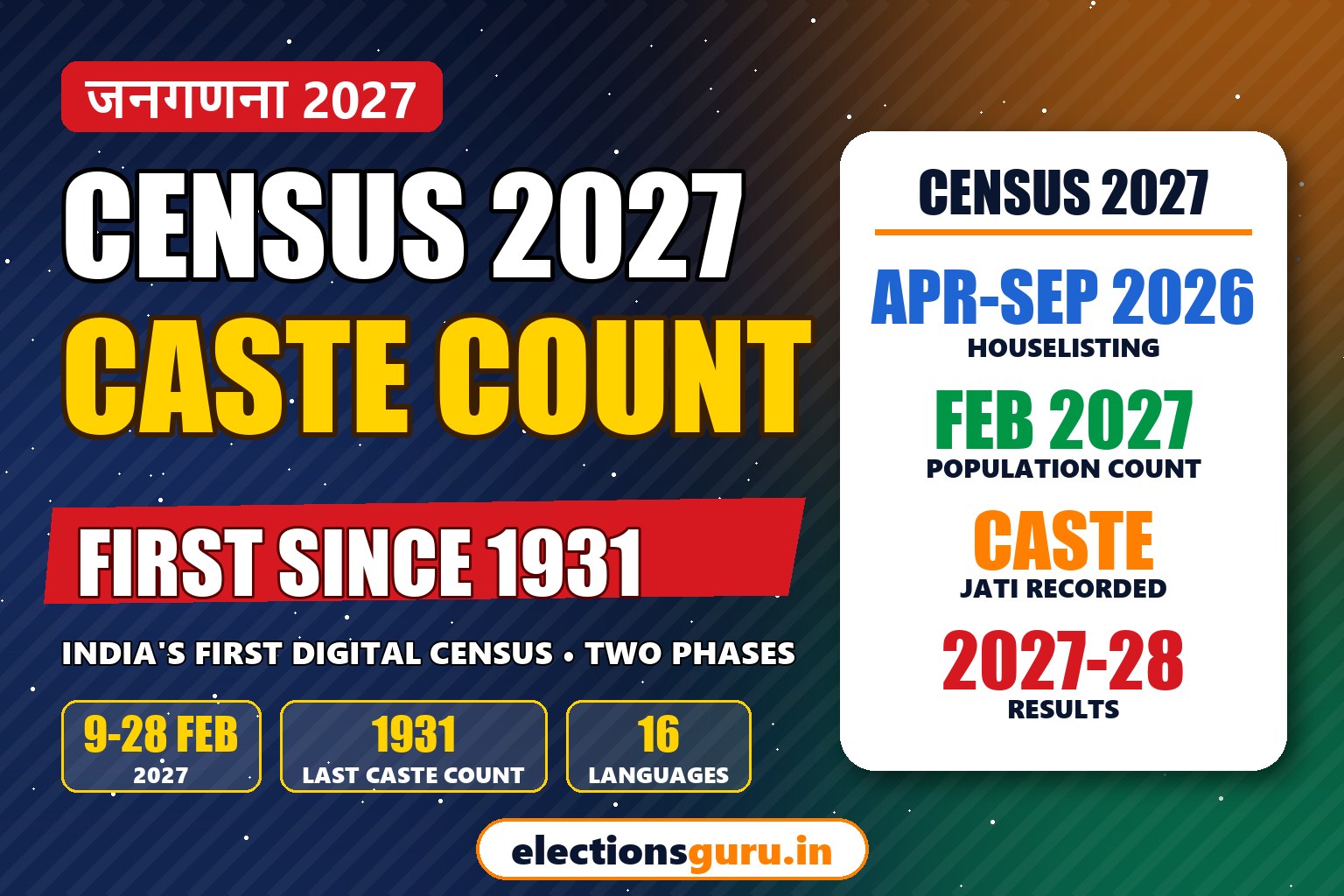
Census 2027 is one of the most important exercises India will undertake this decade. It will be India’s first fully digital census, the first to let people count themselves online, and – most significantly – the first to record caste for all citizens since the 1931 census under British rule. The houselisting phase ran from April to September 2026, and the main Population Enumeration is scheduled for 9 – 28 February 2027.
Census data will shape everything from welfare schemes to reservations, the next delimitation of Lok Sabha and Assembly seats, and the implementation of women’s reservation. This Election Guru guide explains Census 2027 in full: the dates, phases, self-enumeration process, questions, the caste count, the delays since 2021 and what it means for Indian politics.
Census 2027 at a Glance
| Detail | Information |
|---|---|
| Conducted by | Office of the Registrar General & Census Commissioner, India (Ministry of Home Affairs) |
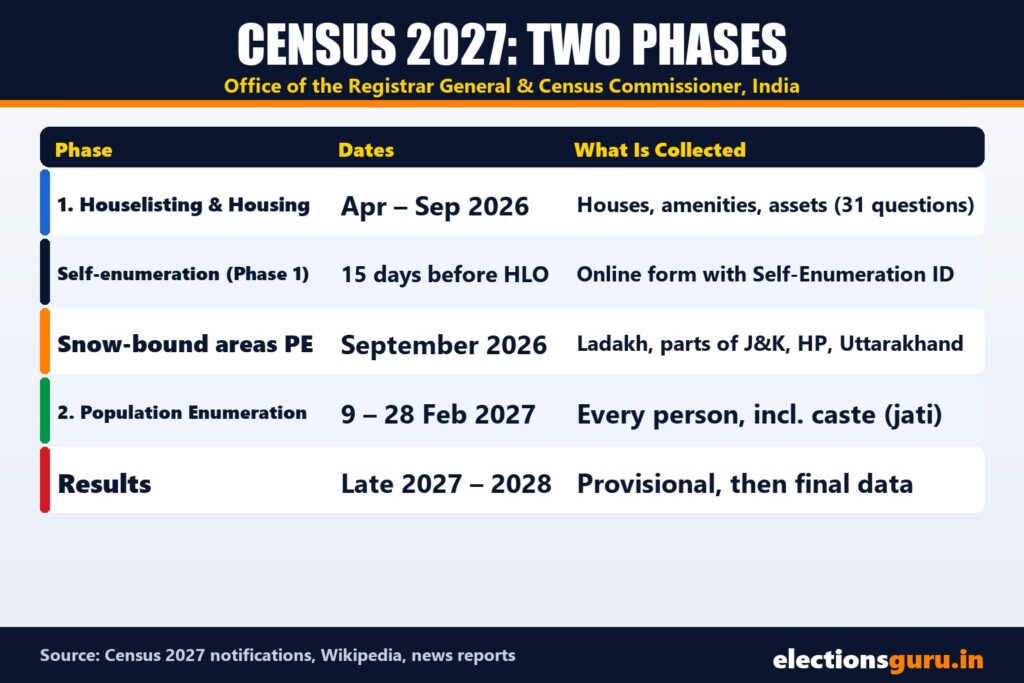
| Phase 1 | Houselisting & Housing Census: 1 April – 30 September 2026 (30 days in each state/UT) |
| Phase 2 | Population Enumeration: 9 – 28 February 2027 |
| Snow-bound areas | Population Enumeration in September 2026 (Ladakh and snow-bound parts of J&K, HP, Uttarakhand) |
| Mode | Digital – mobile app and portal in 16 languages |
| Self-enumeration | Yes – first time in India |
| Caste | Individual jati to be recorded – first full caste count since 1931 |
| Results | Provisional by late 2027, final reports by late 2028 (expected) |
Why Census 2027 Is Happening Six Years Late
India has held a census every ten years since 1881. The 2021 census was postponed because of the Covid-19 pandemic and was not held in 2022 either. The deadline for freezing administrative boundaries was extended several times. In June 2025, the government announced that houselisting would begin in April 2026 and population enumeration in February 2027. The last census, in 2011, counted India’s population at about 121 crore.
Phase 1: Houselisting and Housing Census (April – September 2026)
In the first phase, enumerators visited every building and household to record the condition of houses, amenities such as drinking water, electricity, toilets and cooking fuel, and assets like phones, vehicles and computers. Each state and union territory had a 30-day window for house-to-house work between 1 April and 30 September 2026. Reports said Phase 1 was largely completed across most states by October 2026.
Self-Enumeration: Count Yourself Online
For the first time, residents can fill in their own details online. In each state, a 15-day self-enumeration window opened just before the house-to-house operation. A person logs in to the census portal with a mobile number, fills in the form, and receives a Self-Enumeration ID. When the enumerator visits, the household shares this ID and the details are verified instead of being collected again. The portal is available in 16 languages.
Phase 2: Population Enumeration (9 – 28 February 2027)
The main headcount will take place from 9 to 28 February 2027. Enumerators will record details of every person – name, age, sex, relationship to the head of household, marital status, religion, mother tongue and languages known, education, occupation, migration and disability, among others. For the first time since 1931, the census will also record each person’s caste. In Ladakh and the snow-bound areas of Jammu & Kashmir, Himachal Pradesh and Uttarakhand, population enumeration was held in September 2026, with optional self-enumeration from 17 to 31 August 2026.
The Caste Census: Why It Matters
On 30 April 2025, the Cabinet Committee on Political Affairs decided to include caste enumeration in the census. Since Independence, the census has counted only Scheduled Castes and Scheduled Tribes. The last full caste count was in 1931. The 2011 Socio-Economic and Caste Census (SECC) collected caste data separately, but its caste figures were never fully released.
| Census Year | Caste Data Collected |
|---|---|
| 1881 – 1931 | Full caste enumeration under British rule |
| 1941 | Caste data collected but not published (World War II) |
| 1951 – 2011 | Only Scheduled Castes and Scheduled Tribes counted |
| 2011 SECC | Separate socio-economic caste survey; caste data not fully released |
| 2027 | Individual jati of all citizens to be recorded |
Census 2027 will record individual jati rather than broad categories such as OBC or “upper caste”. Respondents will declare whether they belong to a Scheduled Caste, Scheduled Tribe or another caste, as declared by them. The Anthropological Survey of India’s “People of India” project lists 4,635 communities – a sign of how complex the exercise will be. Opposition parties have criticised the open-text format for non-SC/ST castes, and the Tamil Nadu and Telangana Assemblies have passed resolutions against the method.
Lessons from the Bihar Caste Survey
Bihar’s caste survey, released in October 2023, found that Extremely Backward Classes formed 36.01% of the state’s population, Backward Classes 27.12%, Scheduled Castes 19.65%, Scheduled Tribes 1.68% and the unreserved category 15.52%. Those numbers reshaped Bihar politics and reservation debates – and a national caste count could have an even bigger impact.
Also Read: Elections in 2027: Full List of State and National Polls
Census 2027 and Delimitation
The number of Lok Sabha seats allotted to each state has been frozen on the basis of the 1971 census, and constituency boundaries are based on the 2001 census. Under the Constitution, this freeze lasts until the first census taken after 2026 is published. That means Census 2027 will be the basis for the next delimitation, which could change the number of seats for each state. Southern states fear losing representation because their population growth has been slower than the north’s.
Census 2027 and Women’s Reservation
The Constitution (106th Amendment) Act, 2023 – the Nari Shakti Vandan Adhiniyam – reserves one-third of seats in the Lok Sabha and state Assemblies for women. But it comes into force only after delimitation based on the first census held after the Act. So the timeline of Census 2027 and the following delimitation will decide when women’s reservation actually begins.
How Census 2027 Will Affect Politics
- Reservation debate: Caste data may strengthen demands to raise the 50% ceiling on reservations.
- Seat changes: Delimitation could shift Lok Sabha seats from southern to northern states.
- Welfare targeting: Updated data will reshape schemes for housing, food, health and education.
- Election strategies: Parties will rebuild their caste and community calculations for 2029 and beyond.
Key Facts About Census 2027
| Fact | Detail |
|---|---|
| First census since | 2011 |
| Census series | Held since 1881 |
| Languages for app and portal | 16 |
| Phase 1 questions | 31 (houselisting schedule) |
| Last full caste count | 1931 |
| Caste decision | CCPA, 30 April 2025 |
A Short History of India’s Census
India’s first census was conducted between 1865 and 1872 in different parts of the country, and the first synchronous census of British India was held in 1881. Since then, a census has been held every ten years – making India’s census one of the longest continuous series in the world. After Independence, the Census Act, 1948 gave the legal framework, and censuses were held from 1951 to 2011. The 2021 round was the first to be postponed.
| Census | Key Feature |
|---|---|
| 1872 | First, non-synchronous census |
| 1881 | First synchronous census of British India |
| 1931 | Last full caste enumeration |
| 1951 | First census of independent India |
| 2011 | 15th census since 1872; population 121 crore |
| 2027 | First digital census and caste count since 1931 |
Census 2011: Key Numbers to Compare
| Indicator | Census 2011 |
|---|---|
| Population | About 121.09 crore |
| Decadal growth (2001 – 2011) | 17.7% |
| Sex ratio | 943 females per 1,000 males |
| Literacy rate | 74.04% |
| Scheduled Castes | 16.6% of population |
| Scheduled Tribes | 8.6% of population |
Is Census Data Safe?
Yes. Under the Census Act, 1948, information collected from individuals is confidential. Section 15 of the Act says census records are not open to inspection and cannot be used as evidence in any civil proceeding. Census data is published only in aggregate form – by village, town, district and state – not as personal information.
Caste Data and the Reservation Debate
Reservation policies in India have long relied on estimates rather than fresh caste data. The Mandal Commission in 1980 estimated that Other Backward Classes formed about 52% of India’s population, using the 1931 census as its base. In the Indra Sawhney case of 1992, the Supreme Court upheld 27% OBC reservation in central jobs but set a 50% ceiling on total reservations, except in extraordinary situations. In 2019, a 10% quota for Economically Weaker Sections was added, which the Supreme Court upheld in 2022. Fresh caste data from Census 2027 is expected to intensify demands to revisit the 50% ceiling and sub-categorise OBC quotas.
| Milestone | Year |
|---|---|
| Mandal Commission report | 1980 |
| OBC reservation in central jobs announced | 1990 |
| Indra Sawhney judgment (50% ceiling) | 1992 |
| EWS 10% reservation | 2019 |
| Bihar caste survey published | 2023 |
| Caste enumeration approved for Census | 2025 |
Who Conducts the Census?
The census is conducted by the Office of the Registrar General and Census Commissioner, India, under the Ministry of Home Affairs. Lakhs of enumerators – mostly government school teachers and other staff – are trained to visit every household. For Census 2027, enumerators use a mobile app and can work offline, with data uploaded to central servers. Supervisors check the work, and the self-enumeration option reduces the burden on field staff.
Census 2027: Do’s and Don’ts for Citizens
- Answer all questions truthfully – it is your legal duty under the Census Act.
- Use only the official census portal for self-enumeration; beware of fake websites and calls.
- Keep your Self-Enumeration ID safe and share it with the enumerator during the visit.
- Census officials do not ask for bank details, OTPs or money – report anyone who does.
- Include every person who normally lives in your household on the reference date.
Delimitation: A Short History
Delimitation is the redrawing of boundaries of Lok Sabha and Assembly constituencies based on population. India has had Delimitation Commissions in 1952, 1963, 1973 and 2002. In 1976, the 42nd Amendment froze the number of seats allotted to each state on the basis of the 1971 census until after the 2001 census, to avoid penalising states that controlled population growth. The 84th Amendment in 2001 extended this freeze until the first census after 2026. The 2002 commission redrew boundaries using the 2001 census but did not change the number of seats per state.
| Delimitation Commission | Based On |
|---|---|
| 1952 | 1951 census |
| 1963 | 1961 census |
| 1973 | 1971 census |
| 2002 | 2001 census (boundaries only) |
Why Southern States Are Worried
States like Tamil Nadu, Kerala, Karnataka, Andhra Pradesh and Telangana have reduced their population growth faster than northern states such as Uttar Pradesh and Bihar. If Lok Sabha seats are redistributed purely by population after Census 2027, the share of southern states in Parliament could fall while northern states gain. Southern leaders have demanded that the freeze be extended or that a formula be found which does not punish states for controlling population.
Typical Population Enumeration Questions
| Category | Examples |
|---|---|
| Personal details | Name, relationship to head, sex, date of birth / age, marital status |
| Social details | Religion, Scheduled Caste / Scheduled Tribe / other caste |
| Language | Mother tongue, other languages known |
| Education | Literacy, highest educational level, attendance |
| Economic activity | Worker / non-worker, occupation, industry |
| Migration | Birthplace, last residence, reason for migration |
| Disability | Type of disability if any |
The final list of questions is notified by the Registrar General before the enumeration begins.
How Census Data Is Used
- Allocation of funds to states under schemes and Finance Commission formulas.
- Planning of schools, hospitals, roads and housing.
- Fixing reserved constituencies for SCs and STs.
- Targeting of welfare schemes like food security and housing.
- Research on population, migration and urbanisation.
Also Read: INDIA Bloc vs CEC Gyanesh Kumar: Vote Chori Row Explained
Census 2027 FAQ
When will Census 2027 be conducted?
Houselisting was done from April to September 2026, and the main Population Enumeration is scheduled for 9 – 28 February 2027.
Will Census 2027 count caste?
Yes. Census 2027 will record individual caste (jati) for all citizens – the first full caste count since 1931.
What is self-enumeration in Census 2027?
It allows people to fill in their own census details online using a mobile number and get a Self-Enumeration ID that the enumerator later verifies.
Why was the 2021 Census delayed?
The 2021 Census was postponed because of the Covid-19 pandemic and was not held in 2022; the new schedule was announced in June 2025.
When was caste last counted in India’s census?
The last full caste enumeration in India’s census was in 1931.
How will Census 2027 affect delimitation?
The freeze on seat allocation ends with the first census after 2026, so Census 2027 is expected to be the basis for the next delimitation of Lok Sabha and Assembly seats.
When will Census 2027 results come?
Provisional results are expected by late 2027 and final reports by late 2028.