
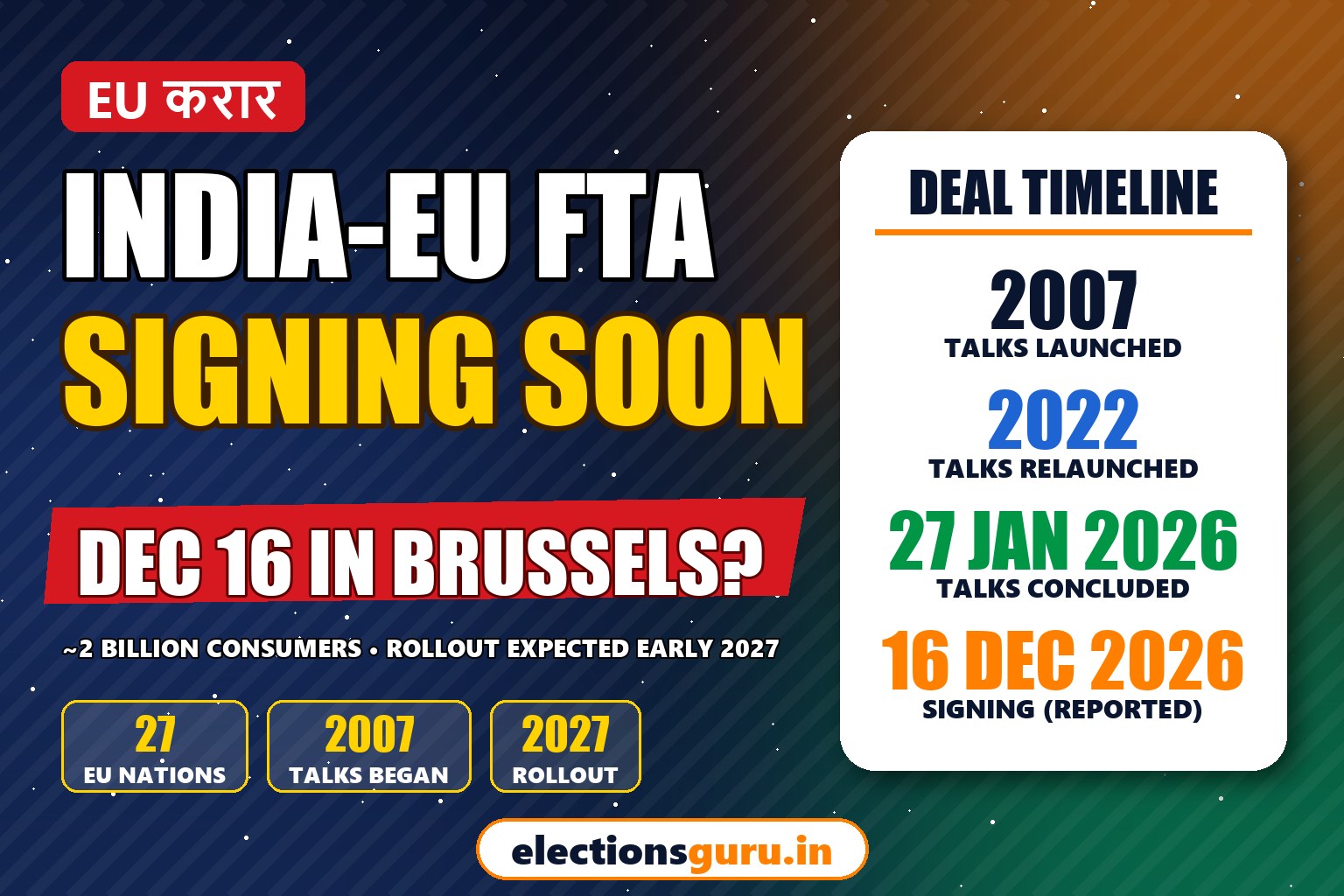
After nearly two decades of on-and-off negotiations, the India-European Union Free Trade Agreement (FTA) is close to the finish line. Talks were concluded on 27 January 2026 during the India-EU summit in New Delhi, and according to a report in The Hindu cited by trade trackers, the formal signing is expected on 16 December 2026 in Brussels. After that, the European Parliament must approve the deal, which could become operational in early 2027.
The deal will create one of the world’s largest free trade zones, covering nearly two billion consumers. A ThePrint opinion piece this week said India and the EU have “new reasons to engage” and that the real test comes after signing. In this Election Guru explainer we cover the timeline, what the deal covers, which Indian sectors gain, the approval process, concerns, and how it fits with India’s other recent trade deals.
India-EU FTA at a Glance
| Detail | Information |
|---|---|
| Parties | India and the 27-member European Union |
| Talks first launched | 2007 |
| Talks suspended | 2013 |
| Talks relaunched | June 2022 |
| Negotiations concluded | 27 January 2026 (India-EU summit, New Delhi) |
| Financial Services Annex | Finalised on 6 January 2026 |
| Formal signing | Reportedly expected on 16 December 2026, Brussels |
| Next step | European Parliament approval (about 1-2 months) |
| Expected rollout | Early 2027 |
| Market size | Nearly 2 billion consumers |
A Deal 19 Years in the Making
India and the EU first launched talks on a Broad-based Trade and Investment Agreement (BTIA) in 2007. Negotiations stalled in 2013 over differences on tariffs for cars, wines and spirits, dairy, data security status, intellectual property and the movement of professionals. They were relaunched in June 2022, along with separate talks on an investment protection agreement and geographical indications. The conclusion in January 2026 came as both sides sought to diversify trade amid global uncertainty.
| Year | Milestone |
|---|---|
| 2007 | BTIA negotiations launched |
| 2013 | Talks stall over key differences |
| 2021 | Leaders agree to resume talks |
| June 2022 | Formal relaunch of FTA negotiations |
| 6 Jan 2026 | Financial Services Annex finalised |
| 27 Jan 2026 | Negotiations concluded in New Delhi |
| 16 Dec 2026 (reported) | Formal signing in Brussels |
| Early 2027 | Expected entry into operation |
Was the Deal Signed in January?
Some reports described the January 2026 event as a “signing”, but most sources say it marked the conclusion of negotiations, with a formal signing to follow after legal scrubbing of the text and translation into EU languages. The formal signing is what the 16 December date refers to. Readers should treat that date as reported, pending official confirmation from the Commerce Ministry or the European Commission.
What the Deal Covers
| Area | What to Expect |
|---|---|
| Goods | Phased tariff reductions and expanded market access |
| Services | Better access for services firms |
| Financial services | Annex covering fintech, digital payments and cross-border financial services |
| Rules | Customs, standards, intellectual property and sustainability chapters |
Indian Sectors Expected to Gain
| Sector | Why It Benefits |
|---|---|
| Textiles and apparel | Lower EU duties make Indian garments more competitive against Bangladesh and Vietnam |
| Engineering goods | Large EU market for auto parts and machinery |
| Pharmaceuticals | Wider access for generics and APIs |
| Marine products | Shrimp and seafood exports can grow |
| Leather and footwear | Labour-intensive sector gains from tariff cuts |
| Fintech and IT services | Covered by the Financial Services Annex |
Concerns and Sensitive Issues
- Carbon border tax (CBAM): the EU’s carbon levy on steel, aluminium and other imports is a concern for Indian exporters
- Agriculture and dairy: India has traditionally protected these sectors in trade deals
- Automobiles, wines and spirits: long-standing EU demands for lower Indian tariffs
- Data and IP: EU standards on data protection and intellectual property
- Ratification: the deal still needs European Parliament approval
India’s Other Trade Deals in Force
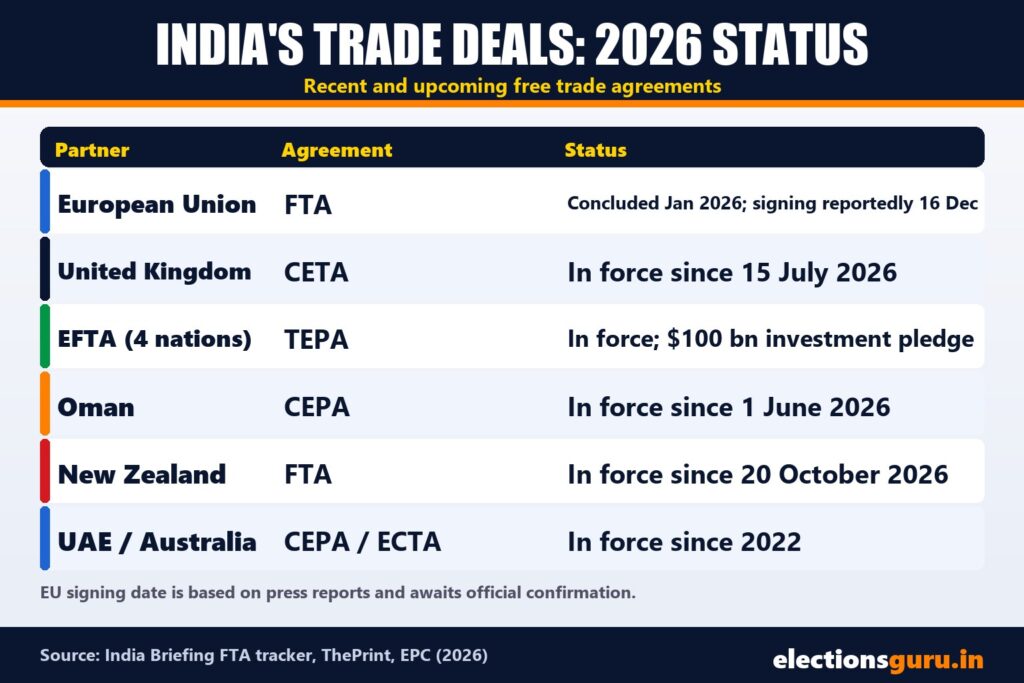
| Partner | Agreement | Key Point |
|---|---|---|
| UAE | CEPA (2022) | First of the new generation of deals |
| Australia | ECTA (2022) | Interim agreement |
| EFTA (Switzerland, Norway, Iceland, Liechtenstein) | TEPA | US$100 billion investment commitment |
| Oman | CEPA (in force 1 June 2026) | Duty-free access for 99.38% of India’s exports by value |
| United Kingdom | CETA (in force 15 July 2026) | Preferential access to about 99% of UK tariff lines |
| New Zealand | FTA (in force 20 October 2026) | NZ removes tariffs on 100% of lines; US$20 billion investment pledge |
Also Read: US Midterm Election Results 2026: Democrats Win House and Senate
Why the EU Deal Matters Geopolitically
Analysts say geopolitics, not just trade, finally sealed the EU-India deal. With global trade disrupted by tariffs and conflict, both sides want reliable partners. For India, the EU is one of its largest trading partners and a source of technology and investment. For the EU, India is a fast-growing market and a strategic partner in the Indo-Pacific. The deal also strengthens India’s position as an alternative manufacturing hub.
Political Angle at Home
The government presents its string of trade deals as proof of India’s rising economic profile. The opposition has questioned the impact of some deals on farmers and small industries, and the Congress has highlighted India’s record trade deficit with China. Expect the EU deal’s details, once public, to be debated in Parliament.
India-EU Trade: The Big Picture
The European Union, taken as a bloc, is one of India’s largest trading partners, with goods trade worth well over €100 billion a year. Major Indian exports to the EU include engineering goods, chemicals, pharmaceuticals, textiles, gems and jewellery, and petroleum products. Major imports from the EU include machinery, aircraft, chemicals and high-tech equipment. The EU is also one of the biggest sources of foreign direct investment into India.
| Indian Exports to EU | EU Exports to India |
|---|---|
| Engineering goods | Machinery and equipment |
| Chemicals and pharmaceuticals | Aircraft and parts |
| Textiles and apparel | Chemicals |
| Gems and jewellery | Electronics and high-tech products |
| Petroleum products | Automobiles and parts |
How an FTA Is Approved in the EU
| Step | Body |
|---|---|
| Negotiation | European Commission |
| Approval to sign | Council of the EU (member state governments) |
| Signing | EU and Indian leaders or ministers |
| Consent | European Parliament |
| Entry into force | After both sides complete procedures |
In India, trade agreements are approved by the Union Cabinet and do not require a parliamentary vote, although they are often discussed in Parliament.
What It Means for Indian Consumers
- Some European products may become cheaper over time as tariffs fall in phases
- More competition could improve quality and choice
- Jobs could grow in export sectors like textiles, leather and engineering
- Sensitive sectors such as agriculture and dairy are expected to be protected
Key Dates to Watch
| Date | Event |
|---|---|
| 16 December 2026 (reported) | Formal signing in Brussels |
| Early 2027 | European Parliament consent |
| Early 2027 | Expected entry into operation |
Carbon Border Tax: The Biggest Worry
The EU’s Carbon Border Adjustment Mechanism (CBAM) puts a carbon cost on imports of carbon-intensive goods such as steel, aluminium, cement, fertilisers, hydrogen and electricity. Indian steel and aluminium exporters are among the most exposed because Indian production is more carbon-intensive than that in many European plants. India has argued that CBAM is a trade barrier and unfair to developing countries. How the FTA deals with CBAM, and whether India gets any flexibility or recognition for its own carbon pricing, will be closely watched by Indian industry once the final text is public.
| Indian Sector | CBAM Exposure |
|---|---|
| Steel | High |
| Aluminium | High |
| Cement | Lower export volumes |
| Fertilisers | Moderate |
Opportunities for Indian Students and Professionals
Beyond goods, trade deals increasingly cover services and the movement of professionals. India has long sought easier access for its IT professionals, nurses and other skilled workers to European markets, while the EU has raised concerns about migration. Separate agreements on mobility, such as those India has signed with individual European countries like Germany and France, already help students and professionals. The FTA’s services chapters, along with these mobility agreements, could make it easier for Indian companies to provide services in Europe.
| Area | What Indians Could Gain |
|---|---|
| IT services | Better market access for Indian IT firms |
| Professionals | Easier temporary movement for business visits and contracts |
| Students | Existing mobility deals with EU countries continue |
| Start-ups and fintech | Financial Services Annex opens opportunities |
Election Guru Analysis
If signed in December, the India-EU FTA will be India’s biggest trade deal yet, opening a market of 27 countries to Indian goods and services. But as experts note, the real test comes after signing: whether Indian exporters can meet EU standards, how CBAM is handled, and whether small businesses benefit. For now, the key date to watch is 16 December, followed by the European Parliament vote in early 2027.
India-EU FTA 2026 FAQ
When were India-EU FTA negotiations concluded?
Negotiations were concluded on 27 January 2026 during the India-EU summit in New Delhi.
When will the India-EU FTA be signed?
According to reports, the formal signing is expected on 16 December 2026 in Brussels. Official confirmation is awaited.
When will the India-EU FTA come into force?
After signing, the European Parliament must approve it, which may take one to two months, so it could become operational in early 2027.
How many people does the India-EU FTA cover?
It covers nearly two billion consumers across India and the 27 EU member states.
Which Indian sectors will benefit?
Textiles, engineering goods, pharmaceuticals, marine products, leather and fintech are among the expected beneficiaries.
When did India-EU trade talks start?
Talks first began in 2007, stalled in 2013 and were relaunched in June 2022.
What other FTAs has India signed recently?
India has trade deals in force with the UAE, Australia, EFTA, Oman, the UK and New Zealand.