
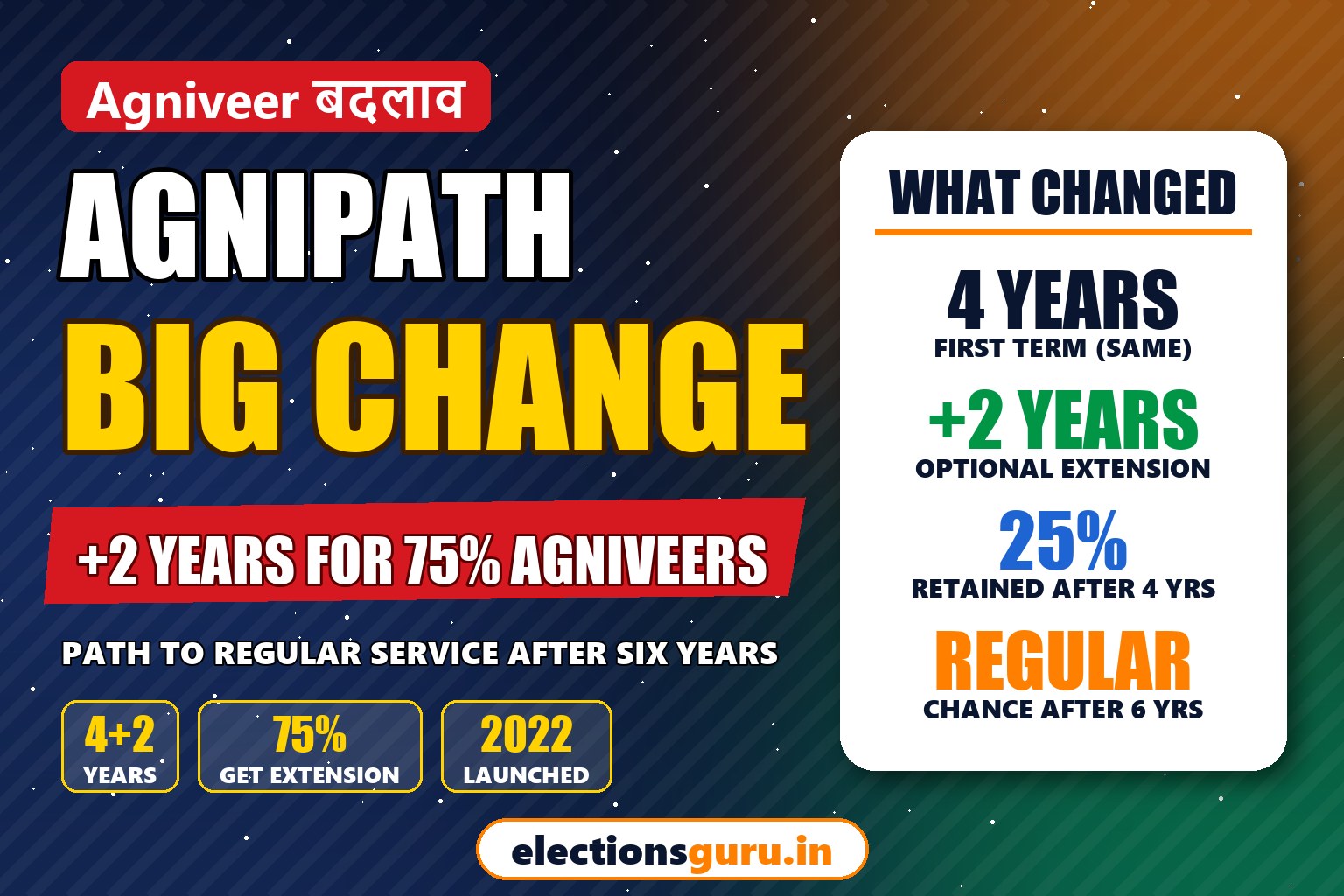
The government has made the biggest change yet to the Agnipath scheme, the short-term recruitment model for the Army, Navy and Air Force. The Union Cabinet has approved a two-year extension for the 75% of Agniveers who are not selected for regular service after their four-year term. After those two extra years, they can apply for regular enrolment if they meet the selection criteria.
The decision, reported on 4 November 2026, comes just before the first batch of Agniveers completes four years in service. Chief of Defence Staff Gen N.S. Raja Subramani said the scheme was never “set in stone”. In this Election Guru explainer we cover what has changed, who is eligible, pay and benefits, the original scheme, the controversy since 2022 and what the change means for youth and the armed forces.
Agnipath Scheme Change at a Glance
| Detail | Information |
|---|---|
| Decision by | Union Cabinet, on recommendation of the armed forces |
| Reported on | 4 November 2026 |
| Who benefits | 75% of Agniveers not retained after four years |
| Extension | Two more years of engagement, if willing |
| After six years | Can be enrolled as regular soldiers if willing and selected |
| Selection criteria cited | Physical fitness, adaptability and discipline |
| Pay in extension | Higher remuneration, enhanced Seva Nidhi, seniority benefits |
| Original four-year term | Unchanged |
| 25% retention after four years | Continues on merit |
What Exactly Has Changed
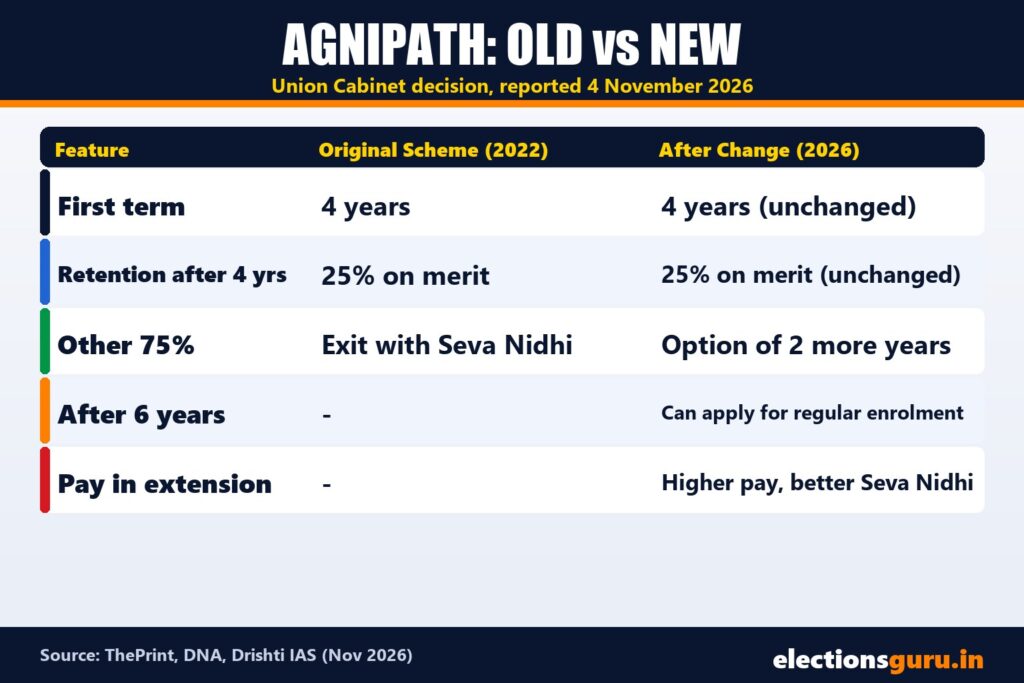
Under the original 2022 scheme, Agniveers served for four years, after which only 25% were selected for regular service on merit; the remaining 75% left with a lump-sum Seva Nidhi package. Under the change, these 75% can now choose to serve for two more years. At the end of six years, they can be enrolled as regular soldiers if they are willing and meet the criteria. ThePrint reported that this creates a pathway for potentially all Agniveers to become regular soldiers after six years, though enrolment is not automatic.
What the CDS and Defence Ministry Said
- CDS Gen N.S. Raja Subramani said the Cabinet approved the forces’ recommendations, which had been discussed for “the past three to four months”
- He said the scheme was never “set in stone” and performance was reviewed annually through a centralised database
- The Defence Ministry said an assessment found Agniveers showed high skill, motivation, physical fitness and technological adaptability
Original Agnipath Scheme: Key Features
| Feature | Detail |
|---|---|
| Launched | June 2022 |
| Services | Army, Navy and Air Force (below officer rank) |
| Age at entry | 17.5 to 21 years (one-time relaxation to 23 in the first year) |
| Term | 4 years, including training |
| Retention | Up to 25% selected for regular service on merit |
| Exit package | Seva Nidhi lump sum (about ₹11.71 lakh, tax-free) for those who leave |
| Pension | No pension for those who leave after four years |
| Aim | Lower the average age of the forces and create a younger, tech-savvy force |
Agniveer Pay Under the Original Scheme
| Year | Monthly Package | In-Hand (approx. 70%) |
|---|---|---|
| Year 1 | ₹30,000 | ₹21,000 |
| Year 2 | ₹33,000 | ₹23,100 |
| Year 3 | ₹36,500 | ₹25,580 |
| Year 4 | ₹40,000 | ₹28,000 |
The remaining 30% goes into the Seva Nidhi corpus, matched by the government. Exact pay for the two-year extension has not been officially detailed in the reports; one coaching site reported figures, but these could not be confirmed, so we have not included them.
Why the Change Now?
The first batches of Agniveers joined training around the end of 2022 and the start of 2023, which means they complete four years at the end of 2026. One report put the number completing their initial tenure in December 2026 at around 18,300. Without a change, three-quarters of them would have left the forces. The extension keeps trained soldiers in service longer and gives them a second chance at a permanent career.
The Controversy Since 2022
Agnipath faced strong protests when it was announced in June 2022, especially in Bihar, Uttar Pradesh, Haryana and Telangana, where youth preparing for regular Army recruitment felt the four-year model offered no job security. Opposition parties, including the Congress, promised to scrap the scheme, and it was a major issue in the 2024 Lok Sabha campaign. The government argued that the scheme would make the forces younger and give lakhs of youth discipline and skills.
| Year | Event |
|---|---|
| June 2022 | Scheme announced; protests in several states |
| Late 2022 – 2023 | First batches begin training |
| 2022 onwards | Reservation for ex-Agniveers announced in CAPFs and by several states |
| 2024 | Agnipath becomes a Lok Sabha campaign issue |
| November 2026 | Cabinet approves two-year extension for 75% |
| December 2026 | First batch completes four years |
Jobs for Ex-Agniveers
The central government announced reservation for ex-Agniveers in Central Armed Police Forces (CAPFs) and age relaxation, and several states announced quotas in police and other jobs. Haryana, for example, has announced a 20% quota in police and forest jobs, according to ThePrint. With the extension, many Agniveers may now choose to stay longer in the forces before using these options.
Also Read: Yogi Adityanath’s UP Election 2027 Strategy Meeting and SIR Row
Political Reactions
The Congress has consistently opposed Agnipath. ThePrint’s Shekhar Gupta wrote in a column this month that the government had failed the test of both “Jai Jawan” and “Jai Kisan” reforms, citing Agnipath and the farm laws. The government presents the extension as proof that the scheme is being reviewed and improved based on performance data.
What This Means for Youth
- A clearer path to a permanent military career for those not selected after four years
- Two more years of salary and service benefits for those who opt in
- Better Seva Nidhi and seniority benefits during the extension
- Still no guarantee: regular enrolment depends on selection
- Those who want to leave after four years can still do so with Seva Nidhi
How Agnipath Compares with Earlier Recruitment
| Feature | Before Agnipath | Agnipath (with 2026 change) |
|---|---|---|
| Service length | Long-term (around 15+ years for soldiers) | 4 years, optional +2, then possible regular service |
| Pension | Yes, after qualifying service | Only if enrolled as regular soldier |
| Entry age | Up to about 21-23 | 17.5-21 |
| Exit package | Pension and benefits | Seva Nidhi lump sum |
| Average age of forces | Higher | Target to reduce |
Concerns That Remain
- No pension for those who leave after four or six years
- Uncertainty for those not selected for regular service
- Questions over training time within a short term
- Job market readiness of ex-Agniveers
- Whether CAPF and state quotas are being fully implemented
Supporters say the extension shows the government is listening to feedback from the forces and youth. Critics say it is an admission that the original four-year model was flawed. Either way, the first batch’s exit in December 2026 will be the real test of how the scheme works in practice.
Agniveers in Numbers
Tens of thousands of Agniveers have been recruited each year across the Army, Navy and Air Force since 2022, with the Army taking the largest share. The first batch is now completing four years, and around 18,300 are reported to be completing their initial tenure in December 2026. Under the original model, about a quarter of each batch would have been retained; with the extension, most of the rest can now choose to stay for two more years.
| Service | Agniveer Recruitment |
|---|---|
| Army | Largest share of Agniveers |
| Navy | Includes women Agniveers |
| Air Force | Agniveervayu, including women |
All three services have inducted women Agniveers under the scheme, a notable change in the ranks below officers.
Election Guru Analysis
The two-year extension is a quiet but major rethink of Agnipath. It addresses the biggest criticism of the scheme, that 75% of young soldiers would be sent home after four years, without formally abandoning the model. For the government, it reduces a political liability before the 2027 state elections, especially in states like Uttar Pradesh, Punjab and Himachal Pradesh, which send large numbers of youth to the forces. For Agniveers, it means more security and a real chance at a permanent career.
Agnipath Scheme Change FAQ
What is the new change in the Agnipath scheme?
The Cabinet approved a two-year extension for the 75% of Agniveers who are not retained after four years, with a chance to apply for regular enrolment after six years.
Is regular enrolment guaranteed after six years?
No. Agniveers can be enrolled as regular soldiers if they are willing and meet selection criteria such as fitness, adaptability and discipline.
Has the four-year term changed?
No. The initial four-year term and the 25% retention on merit continue as before.
When was the Agnipath change approved?
The decision was reported on 4 November 2026.
What is Seva Nidhi?
A lump-sum exit package built from 30% of an Agniveer’s monthly package plus a matching government contribution; about ₹11.71 lakh after four years under the original scheme.
When does the first batch complete four years?
The first batches complete their four-year tenure around December 2026.
When was the Agnipath scheme launched?
The scheme was launched in June 2022.