
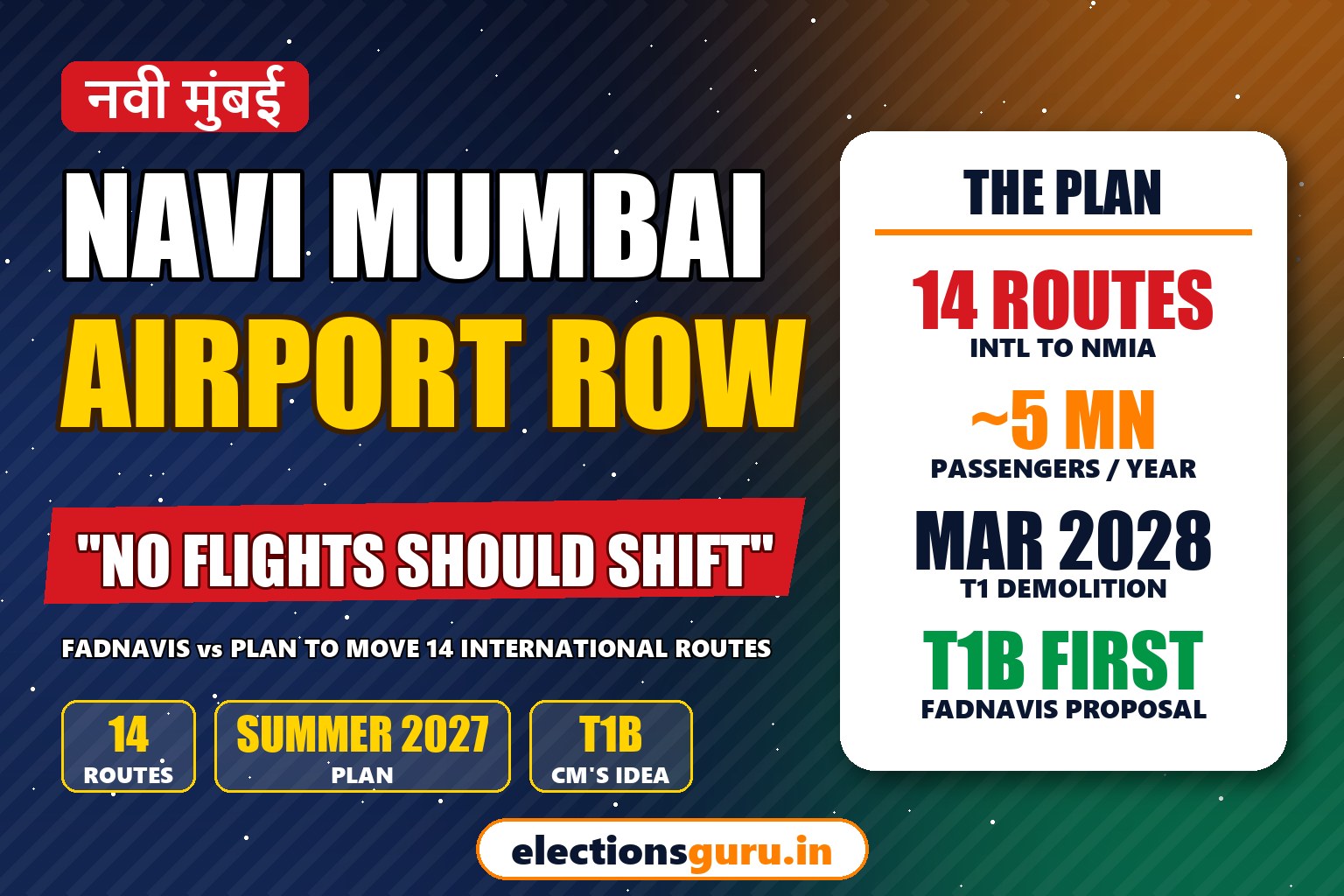
A tug-of-war has begun over Mumbai’s international flights. Maharashtra Chief Minister Devendra Fadnavis has written to the Union Civil Aviation Ministry saying that no international flight should be shifted from Chhatrapati Shivaji Maharaj International Airport (CSMIA) in Mumbai to the new Navi Mumbai International Airport (NMIA). The letter responds to a plan by the Adani-run Mumbai airport operator to move flights on 14 international routes to Navi Mumbai from the Summer 2027 schedule.
The move is linked to the redevelopment of Mumbai airport’s old Terminal 1, which is to be demolished. Fadnavis has proposed an alternative: build a new Terminal 1B first, shift operations there and only then demolish the old terminal. In this Election Guru explainer we cover the plan, Fadnavis’s objection, the impact on passengers and airlines, and the bigger picture of Mumbai’s two-airport system.
Navi Mumbai Airport Row at a Glance
| Detail | Information |
|---|---|
| Issue | Plan to shift some international flights from Mumbai to Navi Mumbai |
| Proposed by | Mumbai International Airport Ltd (MIAL), run by Adani Airport Holdings (74%) |
| Routes affected | 14 international routes |
| From | Summer 2027 schedule |
| Passengers affected | About 5 million a year (about 9% of CSMIA traffic) |
| Reason | Phased demolition and rebuilding of Terminal 1 |
| CM’s stand | No flight should be moved out of Mumbai |
| CM’s alternative | Build T1B first, shift 1A operations, then demolish 1A |
| Decision | Awaited from Union Civil Aviation Ministry |
What the Airport Operator Proposed
MIAL told airlines it cannot grant all their requested Summer 2027 slots at Mumbai. It says a temporary cut in international operations at Terminal 2 is needed to absorb about 5 million passengers a year who will be displaced when the first phase of Terminal 1 is demolished. Flights on 14 international routes would move to Navi Mumbai. Destinations named include Bahrain, Doha, Dhaka, Jeddah, Riyadh, Muscat, Kuwait City and Kathmandu. One IANS report described the plan as covering about a third of international operations, around 265 flights, though Business Today put the impact at about 9% of total CSMIA traffic.
What Fadnavis Said
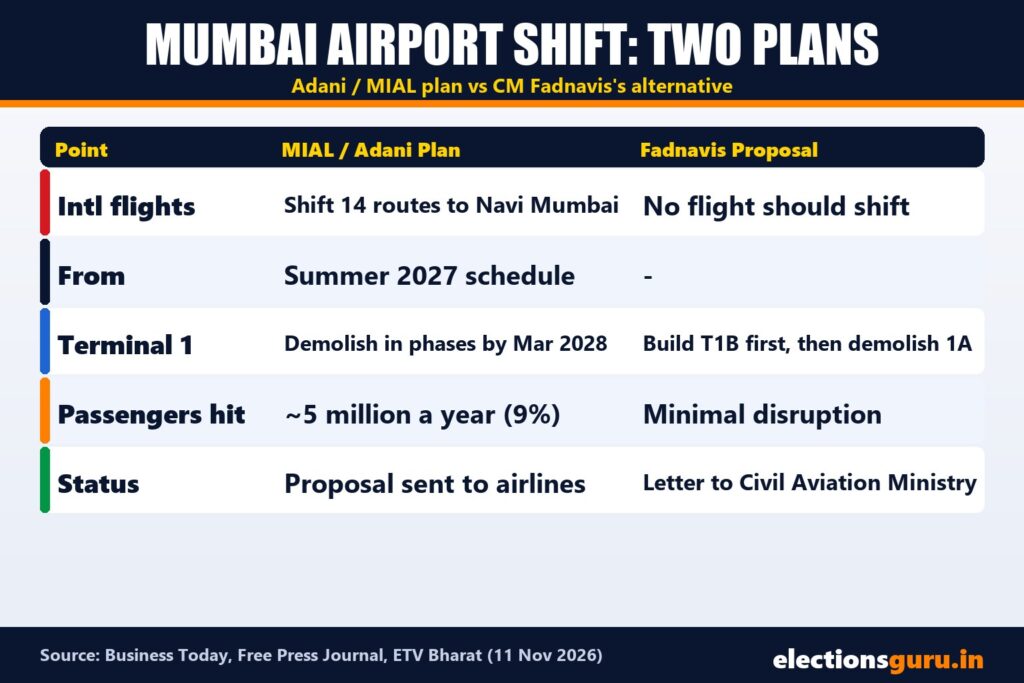
Fadnavis has said “no flights should be moved out of Mumbai.” In his letter to the Union Civil Aviation Ministry, he proposed building Terminal 1B first, moving the operations of the existing Terminal 1A there, and then demolishing 1A. This way, he argued, passenger facilities and flight operations would continue during construction and there would be no need to shift international flights to Navi Mumbai.
Who Will Be Affected
| Group | Impact |
|---|---|
| Passengers | Some Gulf and South Asia flights would operate from Navi Mumbai |
| Indian airlines | IndiGo, Air India and Akasa Air have announced plans to shift some services to NMIA |
| Foreign airlines | Many oppose moving; 39 of 50 international airlines would stay at Mumbai |
| Big foreign carriers | Emirates, Etihad, Singapore Airlines, British Airways, Lufthansa, Air France expected to stay at T2 |
| IATA | Opposes relocation; urges phased redevelopment |
Mumbai’s Terminal 1: Why It Is Being Rebuilt
Terminal 1, commissioned in 1964, handles about 15 million passengers a year and has structural and safety concerns. Under the existing plan, all of Terminal 1 is to be demolished by March 2028 and rebuilt, raising its capacity from 15 to 20 million passengers a year. Terminal 2, opened in 2014, handles international flights and most domestic traffic of some airlines.
| Terminal | Opened | Current Use | Plan |
|---|---|---|---|
| T1 (Santacruz) | 1964 | Domestic flights (~15 mn passengers a year) | Demolish by March 2028; rebuild for ~20 mn |
| T2 (Sahar) | 2014 | International and domestic | Continue |
Navi Mumbai International Airport: Key Facts
| Detail | Information |
|---|---|
| Location | Ulwe-Panvel area, Navi Mumbai |
| Developer | Adani Airport Holdings (74%) and CIDCO (26%) |
| Inaugurated | October 2025 by PM Narendra Modi |
| Commercial operations | Began December 2025 |
| Phase 1 capacity | About 20 million passengers a year |
| Final capacity | Planned up to 90 million passengers a year |
Navi Mumbai airport was built to ease congestion at Mumbai’s single-runway airport, one of the busiest in the world. Over time, the two airports are meant to work as a system, much like London’s Heathrow and Gatwick.
Why Fadnavis Is Against the Shift
- Mumbai’s status as India’s financial capital depends on strong international connectivity
- Passengers from South Mumbai and the western suburbs would face long travel to Navi Mumbai
- Business travellers and tourists may be inconvenienced
- Foreign airlines and IATA also oppose the move
- A phased construction plan could avoid any loss of capacity
Political Angle
Airports and Adani have both been sensitive political topics in Maharashtra. Opposition parties, including the Shiv Sena (UBT) and Congress, have often accused the government of favouring the Adani Group, which runs both Mumbai airports. By publicly opposing the operator’s plan, Fadnavis is positioning himself as protecting Mumbai’s interests and passengers. The final decision rests with the Union Civil Aviation Ministry.
Also Read: Adani Tarali Pumped Storage Project: 99% Cost Cut Row Explained
What Happens Next
| Step | Who |
|---|---|
| Decision on Fadnavis’s T1B proposal | Union Civil Aviation Ministry |
| Slot allocation for Summer 2027 | MIAL with airlines |
| Airline decisions on shifting | IndiGo, Air India, Akasa, foreign carriers |
| T1 demolition schedule | MIAL, subject to approvals |
Mumbai’s Airport Capacity Problem
Mumbai’s CSMIA is one of the busiest single-runway airports in the world, with two crossing runways that cannot be used at the same time at full capacity. It has been operating close to saturation for years, which is why the Navi Mumbai airport was planned more than two decades ago. With Navi Mumbai now operational, both airports must share traffic. The question is how to do that without hurting passengers or Mumbai’s status as a global gateway.
| Airport | Main Strength | Main Constraint |
|---|---|---|
| CSMIA (Mumbai) | Central location, established airline base | Single active runway, limited land |
| NMIA (Navi Mumbai) | Room for growth, new terminals | Distance from South and western Mumbai |
Connectivity to Navi Mumbai Airport
Access is the biggest concern for passengers. The Mumbai Trans Harbour Link (Atal Setu), opened in January 2024, has cut travel time from South Mumbai to Navi Mumbai. Metro and road links to the new airport are being expanded, including plans to connect it with Mumbai’s metro network. Until these links are fully ready, many passengers from the western suburbs may find Navi Mumbai harder to reach.
| Link | Status |
|---|---|
| Atal Setu (MTHL) | Open since January 2024 |
| Navi Mumbai Metro | Operational in parts |
| Metro link to Mumbai airport | Planned / under development |
Timeline of the Navi Mumbai Airport
| Year | Milestone |
|---|---|
| 1997-2000s | Second airport for Mumbai planned at Navi Mumbai |
| 2018 | Foundation stone laid by PM Modi |
| 2021 | Adani Group takes over Mumbai and Navi Mumbai airport projects |
| October 2025 | NMIA inaugurated |
| December 2025 | Commercial flights begin |
| Summer 2027 | Proposed shift of 14 international routes |
| March 2028 | Planned full demolition of Mumbai T1 |
The project took more than two decades because of land acquisition, environmental clearances and the need to level hills and divert rivers at the site.
Election Guru Analysis
The Navi Mumbai airport row is about more than flights: it is about how Mumbai manages growth without losing its edge. The airport operator wants to rebuild Terminal 1 quickly and fill its new Navi Mumbai airport. The Chief Minister, foreign airlines and IATA want Mumbai’s international links protected. A phased T1B-first approach, as Fadnavis suggests, may take longer but would avoid disruption. Passengers should watch for the Civil Aviation Ministry’s decision before booking Summer 2027 travel.
Navi Mumbai Airport Row FAQ
What did Fadnavis say about Navi Mumbai airport?
He wrote to the Union Civil Aviation Ministry saying no international flight should be shifted from Mumbai airport to Navi Mumbai.
How many international routes were proposed to shift?
The operator proposed moving flights on 14 international routes to Navi Mumbai from the Summer 2027 schedule.
Why are flights being shifted?
To absorb about 5 million passengers a year displaced by the phased demolition and rebuilding of Mumbai airport’s Terminal 1.
What is Fadnavis’s alternative?
Build Terminal 1B first, move Terminal 1A operations there, and then demolish 1A, so that operations continue without shifting flights.
Which airlines plan to move to Navi Mumbai?
IndiGo, Air India and Akasa Air have announced plans to shift some services; many foreign airlines oppose moving.
When will Mumbai Terminal 1 be demolished?
Under the current plan, Terminal 1 is to be fully demolished by March 2028 and rebuilt.
Who runs Mumbai and Navi Mumbai airports?
Adani Airport Holdings runs both, with 74% in Mumbai International Airport Ltd (AAI holds 26%) and 74% in Navi Mumbai airport (CIDCO holds 26%).