
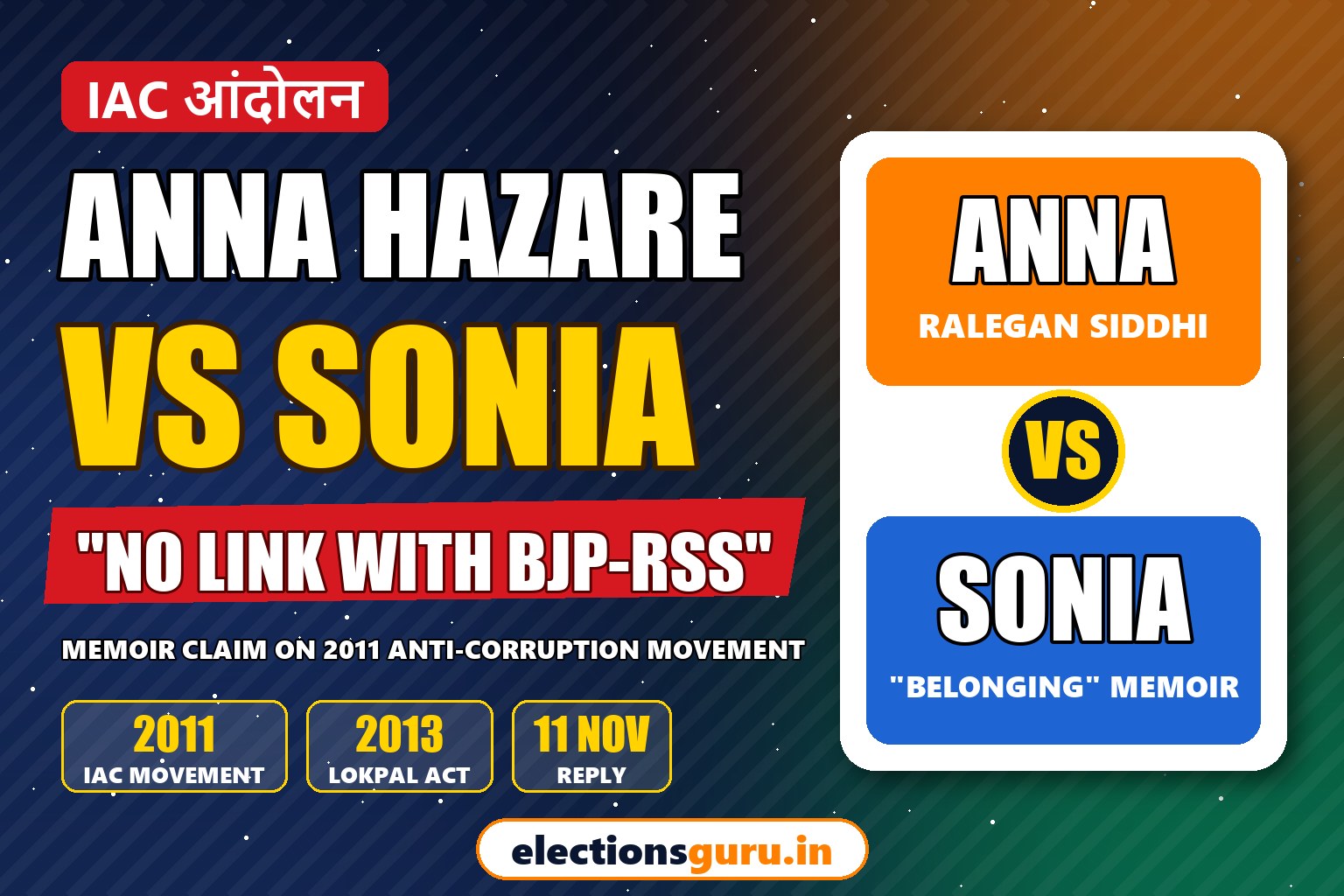
Social activist Anna Hazare, the face of the 2011 anti-corruption movement, has hit back at Congress leader Sonia Gandhi over a claim in her new memoir “Belonging: A Journey of Love”. In the book, Sonia Gandhi wrote that some prominent participants of the India Against Corruption (IAC) movement have since said it was “covertly organised and supported by the BJP and RSS” to dislodge the UPA government.
Speaking at his village Ralegan Siddhi in Maharashtra’s Ahilyanagar district on Wednesday, 11 November 2026, Hazare said: “This is wrong. I don’t have any connection with the BJP or RSS.” In this Election Guru explainer we cover what the memoir says, Hazare’s full reply, the history of the 2011 movement, who went where afterwards, and why the debate still matters.
Anna Hazare vs Sonia Gandhi at a Glance
| Detail | Information |
|---|---|
| Book | Belonging: A Journey of Love by Sonia Gandhi (released 10 Nov 2026) |
| Claim | Some prominent IAC participants say the movement was covertly organised and supported by BJP and RSS |
| Hazare’s reply | “This is wrong. I don’t have any connection with the BJP or RSS.” |
| Date of reply | Wednesday, 11 November 2026 |
| Place | Ralegan Siddhi, Ahilyanagar district, Maharashtra |
| Movement | India Against Corruption (2011-2012), demand for Jan Lokpal |
What Sonia Gandhi Wrote
According to the viral excerpt reported by PTI, Sonia Gandhi wrote that the movement drew large crowds and put heavy pressure on the UPA government, and that “some of its prominent participants have since stated” that it was “covertly organised and supported by the BJP and RSS”. She also wrote that once the goal of removing the UPA government was achieved, little more was heard about Hazare.
Anna Hazare’s Full Reply
- “This is wrong. I don’t have any connection with the BJP or RSS.”
- He said he does not take part in their programmes and has no links with any party; the country is his priority
- He said several people from the RSS and BJP, like people from other backgrounds, had left their homes to join the movement
- “What is the basis to claim that the Manmohan Singh-led government lost the (2014) elections due to my agitation?”
- “Neither has she seen Anna Hazare, nor have I seen her so far.”
- He said a responsible person should speak responsibly, and vague remarks diminish a person’s image
- He urged a focus on national issues and said he does not worry about what others write about him
Hazare also mentioned an upcoming book on his life, “Anna Hazare: Gram Yogi”.
Who Is Anna Hazare?
Kisan Baburao Hazare, popularly known as Anna Hazare, is a former Army driver who turned his drought-hit village Ralegan Siddhi into a model of watershed development and rural self-reliance. He led several agitations in Maharashtra that pushed for the Right to Information Act at the state level and action against corrupt ministers. He received the Padma Bhushan in 1992. In 2011 he became a national figure as the face of the Jan Lokpal movement.
The 2011 India Against Corruption Movement
The movement grew out of public anger over corruption scandals during UPA-II, such as the 2G spectrum case and the Commonwealth Games scam. Its central demand was a strong anti-corruption ombudsman, the Jan Lokpal.
| Date | Event |
|---|---|
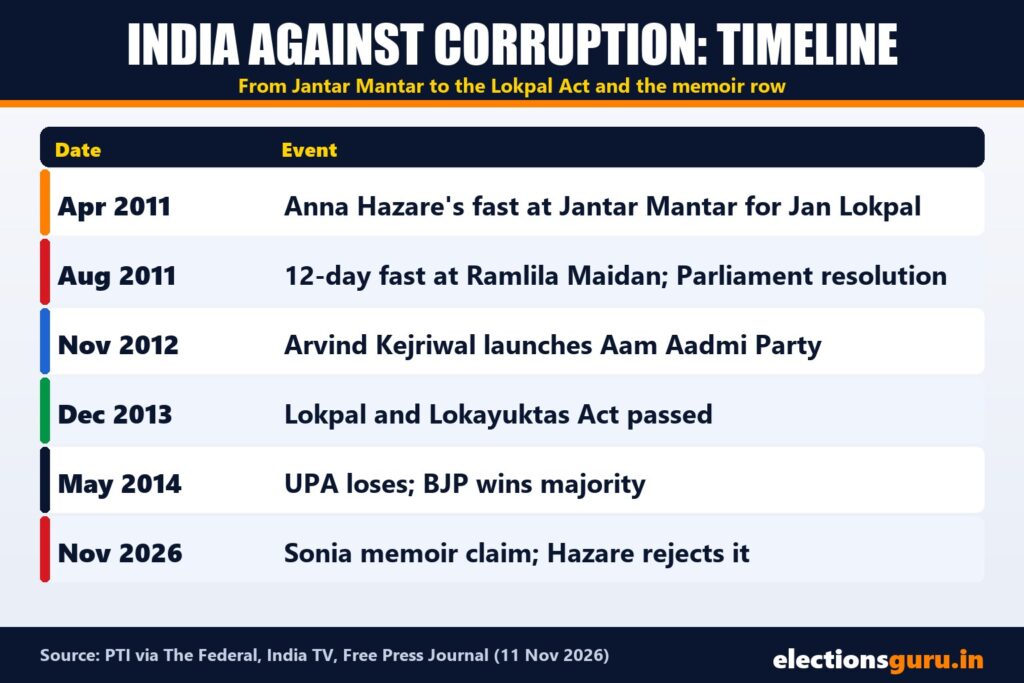
| 5 April 2011 | Anna Hazare begins fast at Jantar Mantar, Delhi |
| 9 April 2011 | Government agrees to a joint drafting committee; fast ends |
| 16 August 2011 | Hazare detained before planned fast; nationwide protests |
| August 2011 | 12-day fast at Ramlila Maidan; Parliament passes “sense of the House” resolution |
| December 2011 | Lokpal Bill passed in Lok Sabha but stalls in Rajya Sabha |
| 2012 | Movement splits over entering politics |
| 26 November 2012 | Arvind Kejriwal launches Aam Aadmi Party |
| December 2013 | Lokpal and Lokayuktas Act, 2013 passed |
| March 2019 | Justice Pinaki Chandra Ghose appointed first Lokpal |
Key Faces of the Movement and Where They Went
| Leader | Role in IAC | Later Path |
|---|---|---|
| Anna Hazare | Face of the movement | Stayed out of party politics |
| Arvind Kejriwal | Chief organiser | Founded AAP; Delhi Chief Minister |
| Kiran Bedi | Core member | Joined BJP in 2015; later Puducherry Lt Governor |
| Gen. V.K. Singh | Joined protests after retirement | Joined BJP; Union minister |
| Prashant Bhushan | Core member | Co-founded AAP, later expelled; activist lawyer |
| Manish Sisodia | Core organiser | AAP leader; Delhi Deputy CM |
| Baba Ramdev | Parallel anti-black-money protests | Yoga guru, Patanjali |
The claim that the movement had backing from the RSS and BJP is not new. Some former participants have made similar statements over the years; for example, Prashant Bhushan said in a 2020 interview that the movement had been propped up by the BJP and RSS. Hazare has consistently rejected this.
Did the Movement Defeat the UPA in 2014?
This is the core of the dispute. Supporters of Sonia Gandhi’s view argue that the movement destroyed the UPA’s credibility and created the mood that helped the BJP win a majority in 2014. Hazare questions this link, asking what the basis is for saying the Manmohan Singh government lost because of his agitation. Many analysts say the 2014 result had several causes, including inflation, policy paralysis, scams and the Narendra Modi campaign, with the anti-corruption movement as one important factor.
| Party | 2009 Lok Sabha Seats | 2014 Lok Sabha Seats |
|---|---|---|
| Congress | 206 | 44 |
| BJP | 116 | 282 |
Also Read: Sonia Gandhi Memoir Belonging: Biggest Revelations Explained
Political Reactions
- BJP: has used the memoir row to attack the Congress for blaming others for its 2014 defeat
- Congress: stands by the memoir, which reflects Sonia Gandhi’s personal view
- AAP: born from the movement, has avoided getting drawn into the row
Ralegan Siddhi: Anna Hazare’s Model Village
Before he became a national figure, Anna Hazare was known for transforming Ralegan Siddhi, a village in what is now Ahilyanagar district of Maharashtra. Starting in the 1970s, he led efforts on watershed development, water conservation, a ban on liquor, grain banks and community labour. The village became a model studied across India for rural development, and Hazare’s methods inspired similar work in other drought-prone villages.
Anna Hazare’s Earlier Agitations
| Period | Agitation | Result |
|---|---|---|
| 1990s | Against corruption in Maharashtra departments | Several officials and ministers faced action |
| 2000-2003 | For a strong Right to Information law in Maharashtra | Maharashtra passed its RTI law in 2003 |
| 2011 | Jan Lokpal movement in Delhi | Parliament resolution; Lokpal Act in 2013 |
| 2018-2019 | Fasts demanding Lokpal appointment | First Lokpal appointed in March 2019 |
Why the Memoir Claim Hurts
Anna Hazare’s public image rests on being a non-political Gandhian activist. A claim that his movement was covertly backed by the BJP and RSS challenges that image. At the same time, Sonia Gandhi’s memoir does not directly accuse Hazare himself; it says some participants have since made that claim. Hazare’s reply focuses on his personal independence, saying he has no links with any party.
Other Reactions to the Memoir
| Who | Reaction |
|---|---|
| JD(U) | Rejected her account of Nitish Kumar’s INDIA bloc exit |
| Sharmistha Mukherjee | Responded to references to Pranab Mukherjee’s PM ambition |
| Anna Hazare | Rejected the BJP-RSS backing claim |
| Rohit Pawar (NCP-SP) | Praised Sonia Gandhi’s compassion |
Lokpal: What It Is and How It Works
The Lokpal is an independent anti-corruption ombudsman at the national level, created under the Lokpal and Lokayuktas Act, 2013, the law that came out of the Hazare movement. It can inquire into allegations of corruption against public servants, including the Prime Minister (with safeguards), Union ministers, MPs and central government officials. States are required to set up Lokayuktas. Critics, including Hazare, have often said that the Lokpal has not been as effective as the movement had hoped, with relatively few prosecutions in its early years.
| Feature | Detail |
|---|---|
| Law | Lokpal and Lokayuktas Act, 2013 |
| Chairperson | Former Chief Justice or SC judge, or eminent person |
| Members | Up to eight, half of them judicial |
| Covers | PM (with safeguards), ministers, MPs, central officials |
| First Lokpal | Justice Pinaki Chandra Ghose (2019) |
How the IAC Movement Changed Indian Politics
Whatever its origins, the 2011 movement had lasting effects. It brought lakhs of middle-class Indians onto the streets, made corruption the central political issue before 2014, and gave birth to the Aam Aadmi Party, which went on to govern Delhi and win Punjab in 2022. It also produced the Lokpal law, even though its working has been criticised. Several leaders who came to prominence during the movement later joined different parties, which is one reason the debate over who backed it has never fully ended.
| Outcome | Detail |
|---|---|
| New party | Aam Aadmi Party (2012) |
| Delhi government | AAP formed governments in Delhi in 2013, 2015 and 2020 |
| Punjab government | AAP won Punjab in 2022 |
| Law | Lokpal and Lokayuktas Act, 2013 |
| Politics | Corruption became the central issue before the 2014 election |
Election Guru Analysis
The Anna Hazare-Sonia Gandhi exchange reopens one of the most important chapters of modern Indian politics. For the Congress, it is part of a long-held view that the movement was used to bring down the UPA. For Hazare, it is an attack on his credibility as a non-political activist. With “Belonging” already causing friction with JD(U), this row shows how a single memoir can stir debates across parties and years.
Anna Hazare vs Sonia Gandhi FAQ
What did Sonia Gandhi say about Anna Hazare’s movement?
In her memoir, she wrote that some prominent participants of the India Against Corruption movement have since said it was covertly organised and supported by the BJP and RSS.
How did Anna Hazare respond?
He said, “This is wrong. I don’t have any connection with the BJP or RSS,” and said he has no links with any party.
When and where did Anna Hazare respond?
He responded on Wednesday, 11 November 2026, at his village Ralegan Siddhi in Ahilyanagar district, Maharashtra.
What was the India Against Corruption movement?
It was the 2011-12 anti-corruption movement led by Anna Hazare demanding a strong Jan Lokpal law, with major protests at Jantar Mantar and Ramlila Maidan.
When was the Lokpal Act passed?
The Lokpal and Lokayuktas Act was passed in December 2013. The first Lokpal, Justice P.C. Ghose, was appointed in March 2019.
Which party came out of the movement?
Arvind Kejriwal launched the Aam Aadmi Party on 26 November 2012.
Is Anna Hazare writing a book?
He mentioned an upcoming book on his life titled “Anna Hazare: Gram Yogi”.