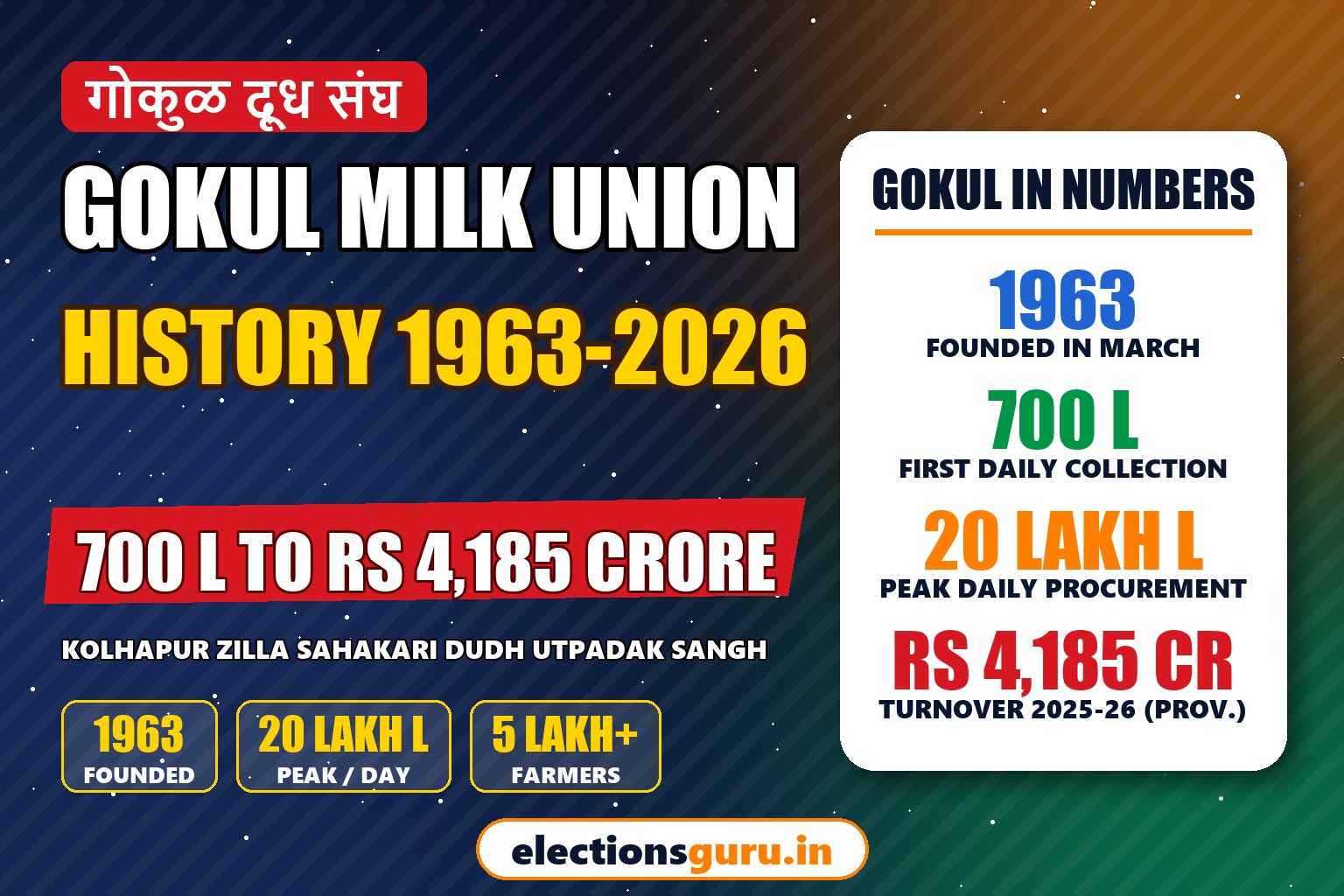
Gokul Milk Union – officially the Kolhapur Zilla Sahakari Dudh Utpadak Sangh Ltd. – is not just a dairy. For Kolhapur district it is an economy, a brand and a political battleground rolled into one. Started in 1963 with about 700 litres of milk a day, Gokul today reports a turnover of ₹4,185 crore (provisional, 2025-26) and peak procurement of more than 20 lakh litres a day.
This Election Guru guide covers Gokul’s history, its numbers, how its board is elected, and why every major Kolhapur leader wants control of Gokul.
Gokul Milk Union at a Glance
| Detail | Information |
|---|---|
| Official name | Kolhapur Zilla Sahakari Dudh Utpadak Sangh Ltd. |
| Brand | Gokul |
| Founded | March 1963 |
| Headquarters | Gokul Shirgaon, Kolhapur |
| Milk producers | About 5 to 5.6 lakh farmers |
| Affiliated societies | About 7,500 village milk societies (as per industry reports) |
| Peak procurement | Over 20 lakh litres per day |
| Turnover | ₹4,185 crore in 2025-26 (provisional) |
| Chairman (Nov 2026) | Rajesh Narsingrao Patil |
Gokul Milk Union History
1963: A Small Beginning
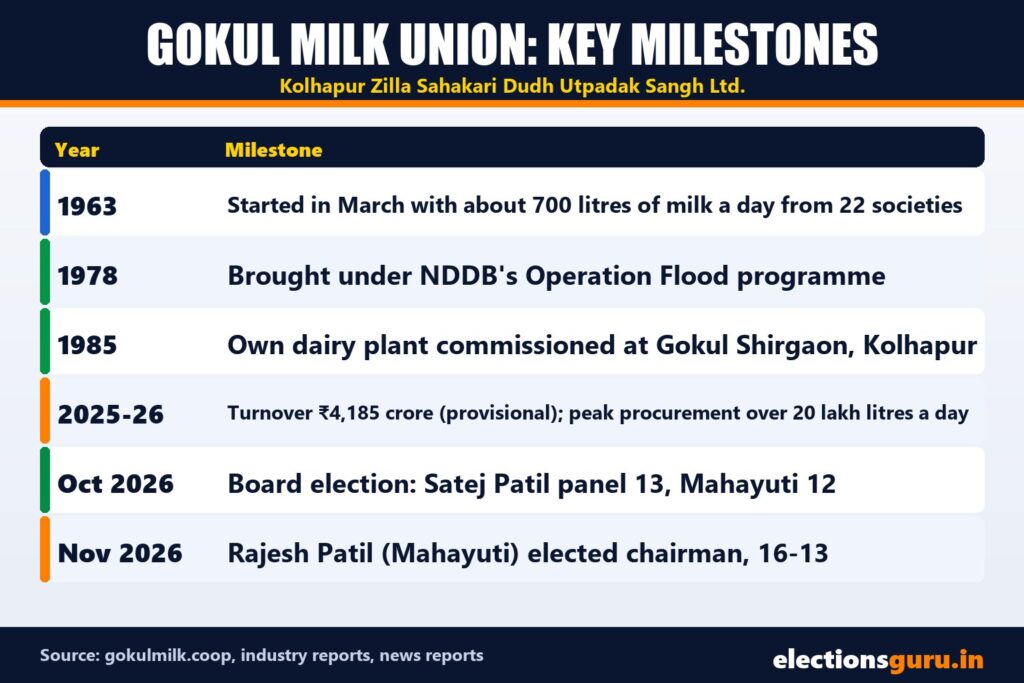
Gokul began in March 1963 as a Kolhapur cooperative dairy project, collecting about 700 litres of milk a day from 22 village societies. Farmers pooled their milk through village cooperatives – a model that would later define Kolhapur’s rural economy.
1978: Operation Flood
In 1978 the National Dairy Development Board brought Gokul under its Operation Flood programme, which helped it expand procurement, chilling and processing across the district.
1985: Own Dairy Plant
Gokul’s own full-fledged dairy plant was commissioned at Gokul Shirgaon, Kolhapur in 1985. Since then the union has added automation and bulk milk coolers at the village level.
Gokul Products and Markets
Gokul sells milk and milk products in Kolhapur, Pune, Mumbai and other markets. Its range includes cow milk (including “Satvik” cow milk for Mumbai and Pune), ghee, table and cooking butter, dahi, paneer, lassi, basundi and shrikhand.
Also Read: Gokul Election Result 2026: All 25 Winning Directors List
How the Gokul Board Is Elected
Gokul’s voters are not individual farmers but delegates of affiliated village milk societies. In 2026 there were 5,418 such voters, and turnout was 99.96%. They elect 25 directors: 20 in the general group, 2 women, and one each for OBC, Scheduled Caste and VJ/NT. The directors then elect the chairman, which needs a quorum of 14.
Why Gokul Is Kolhapur’s Biggest Political Prize
- Reach: Gokul’s network touches almost every village in Kolhapur district.
- Money: With a turnover of about ₹4,000 crore, it is one of the largest cooperatives in Maharashtra.
- Votes: Lakhs of milk-producing families make Gokul a direct link to rural voters before any Lok Sabha or Assembly election.
- Leaders: Satej Patil, Hasan Mushrif, the Mahadik family and Chandrakant Patil have all fought for influence in Gokul.
Also Read: Gokul Chairman Election 2026: Rajesh Patil Wins 16-13
Gokul in 2026: Election, Deadlock and New Chairman
In October 2026, Satej Patil’s panel won 13 seats and Mahayuti 12. A quorum deadlock followed, the state issued an ordinance for nominated directors with voting rights, and on 10 November 2026 Mahayuti’s Rajesh Patil became chairman 16-13. The matter is now before the Bombay High Court.
Also Read: Gokul Ordinance Controversy: Section 73AAA and Voting Rights
Gokul Milk Union History FAQ
What is the full name of Gokul Milk Union?
Gokul’s official name is Kolhapur Zilla Sahakari Dudh Utpadak Sangh Ltd. (Kolhapur District Cooperative Milk Producers’ Union).
When was Gokul Milk Union started?
Gokul started in March 1963 with about 700 litres of milk a day from 22 village societies.
What is the turnover of Gokul?
Gokul reported a provisional turnover of ₹4,185 crore for 2025-26.
How much milk does Gokul collect daily?
Gokul’s peak procurement has crossed 20 lakh litres a day, according to the union.
Who is the chairman of Gokul in 2026?
Former Chandgad MLA Rajesh Narsingrao Patil was elected Gokul chairman on 10 November 2026.