
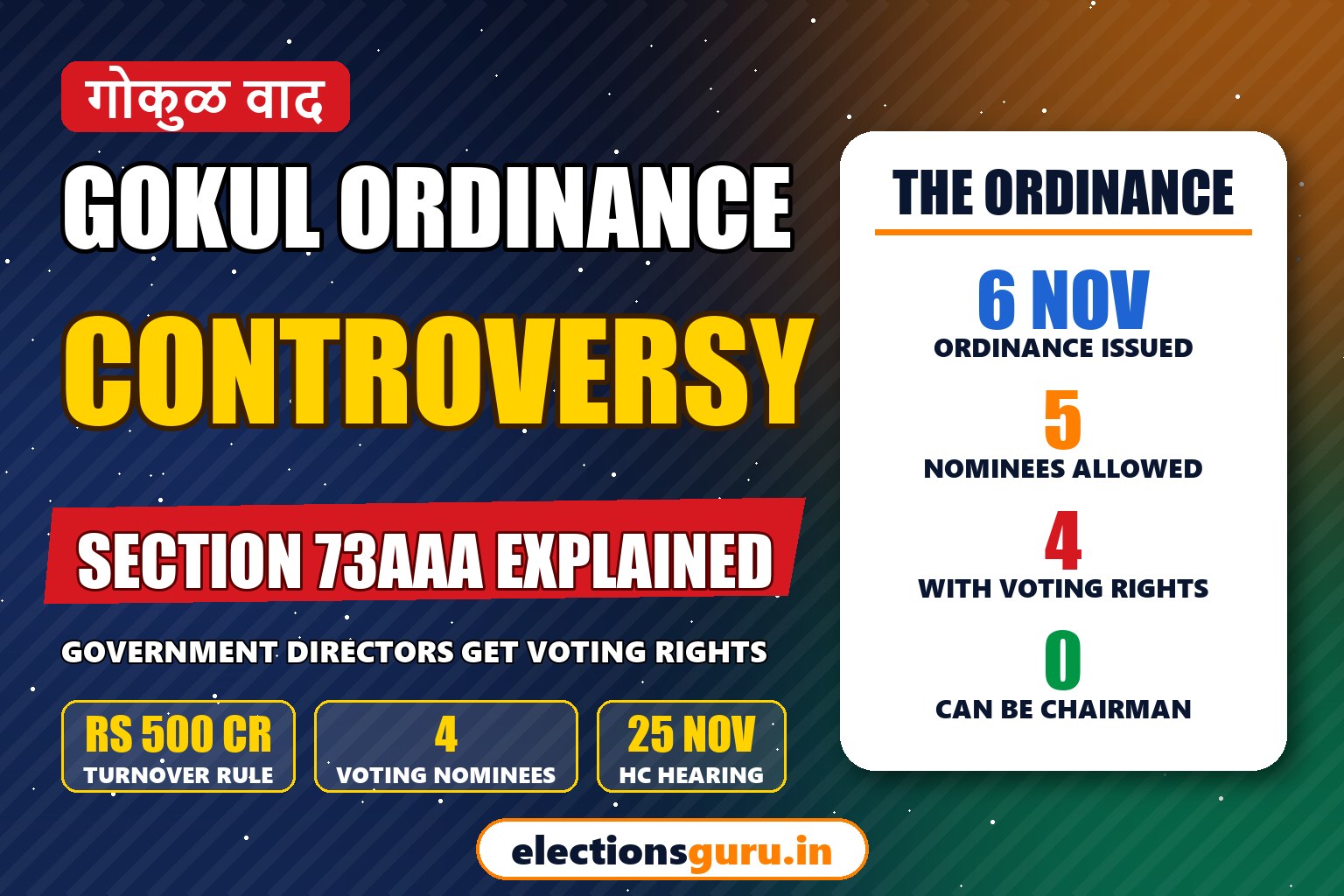
The Gokul Ordinance Controversy has turned a dairy cooperative election into a statewide political and legal fight. In November 2026 the Maharashtra government issued an ordinance that lets large cooperatives have government-nominated directors with voting rights. Within days, four such directors were appointed to Gokul – and their votes decided who became chairman.
What exactly does the ordinance say, why is it controversial, and what did the Bombay High Court order? Here is the complete explainer.
Gokul Ordinance at a Glance
| Detail | Information |
|---|---|
| Law amended | Section 73AAA(2), Maharashtra Co-operative Societies Act, 1960 |
| Ordinance date | 6 November 2026 (as per reports) |
| Applies to | Federal cooperatives with annual turnover above ₹500 crore |
| Nominees allowed | 5 – one government officer without vote + four experts with vote |
| Restriction | Nominees cannot contest chairman or vice-chairman posts |
| First use | Gokul Milk Union, Kolhapur (turnover about ₹4,000 crore) |
| Legal status | Challenged in Bombay High Court; next hearing 25 November 2026 |
Why Was the Ordinance Brought?
In the October 2026 Gokul board election, Satej Patil’s panel won 13 seats and Mahayuti 12. A chairman election needs a quorum of 14. On 29 October all 12 Mahayuti directors stayed away and the meeting was adjourned. Minister Hasan Mushrif said the government’s move was meant to end the administrative deadlock and avoid a fresh election, not to take over the cooperative.
Also Read: Gokul Quorum Controversy: 29 October Walkout and Parallel Chairman Claim
What the Ordinance Changes
- Large federal cooperatives with turnover above ₹500 crore can now have five government nominees on the board.
- One nominee is a government officer without voting rights.
- Four nominees are described as experts and have voting rights on the board.
- Nominees cannot become chairman or vice-chairman – only elected directors can.

Why the Opposition Calls It Unfair
Opponents say the ordinance was tailor-made for Gokul. Satej Patil called it an attack on democratic values that bypasses the elected board. Congress leader Pawan Khera said it was an attempt to change the democratic mandate, and Shiv Sena leader and former Pune MLA Ravindra Dhangekar said voting rights for nominees could weaken cooperative autonomy. Satej Patil also asked why, if quorum was the problem, the government did not simply change the quorum rule.
Also Read: Gokul Nominated Directors 2026: Who Are the 4 Government Directors?
Bombay High Court Order
Satej Patil’s side, represented by senior advocate Ashutosh Kumbhakoni, argued that the appointments were illegal. On 9 November 2026 a vacation bench of the Bombay High Court refused to stay the chairman election but ordered that:
- the nominated directors’ votes be kept in a separate ballot box,
- the entire process be video-recorded, and
- the result remain subject to the final decision in the petition.
The next hearing was listed for 25 November 2026. If the court strikes down the voting rights, the four separate votes could be excluded – which would change the 16-13 result.
Also Read: Gokul Chairman Election 2026: Rajesh Patil Wins 16-13
Government’s Defence
Mahayuti leaders say the nominees are experts, the law applies to all large cooperatives, and the step was needed to break a deadlock created by the quorum rule. BJP MP Dhananjay Mahadik accused the opposition of spreading a false narrative and credited Chief Minister Devendra Fadnavis with resolving the impasse.
Gokul Ordinance Controversy FAQ
What is the Gokul ordinance?
It is a November 2026 state ordinance amending Section 73AAA(2) of the Maharashtra Co-operative Societies Act, 1960, allowing large cooperatives with turnover above ₹500 crore to have government nominees, four of whom can vote.
Why is the Gokul ordinance controversial?
The opposition says it was brought to overturn the 13-12 board verdict in Satej Patil’s favour, because the four nominees’ votes helped Mahayuti win the chairman election 16-13.
What did the High Court say about the Gokul ordinance?
On 9 November 2026 the Bombay High Court refused a stay but ordered the nominees’ votes to be kept in a separate ballot box and the result to be subject to its final decision.
Can government-nominated directors become Gokul chairman?
No. Under the ordinance they can vote but cannot contest the chairman or vice-chairman posts.
When is the next hearing in the Gokul case?
The next hearing in the Bombay High Court was listed for 25 November 2026.