
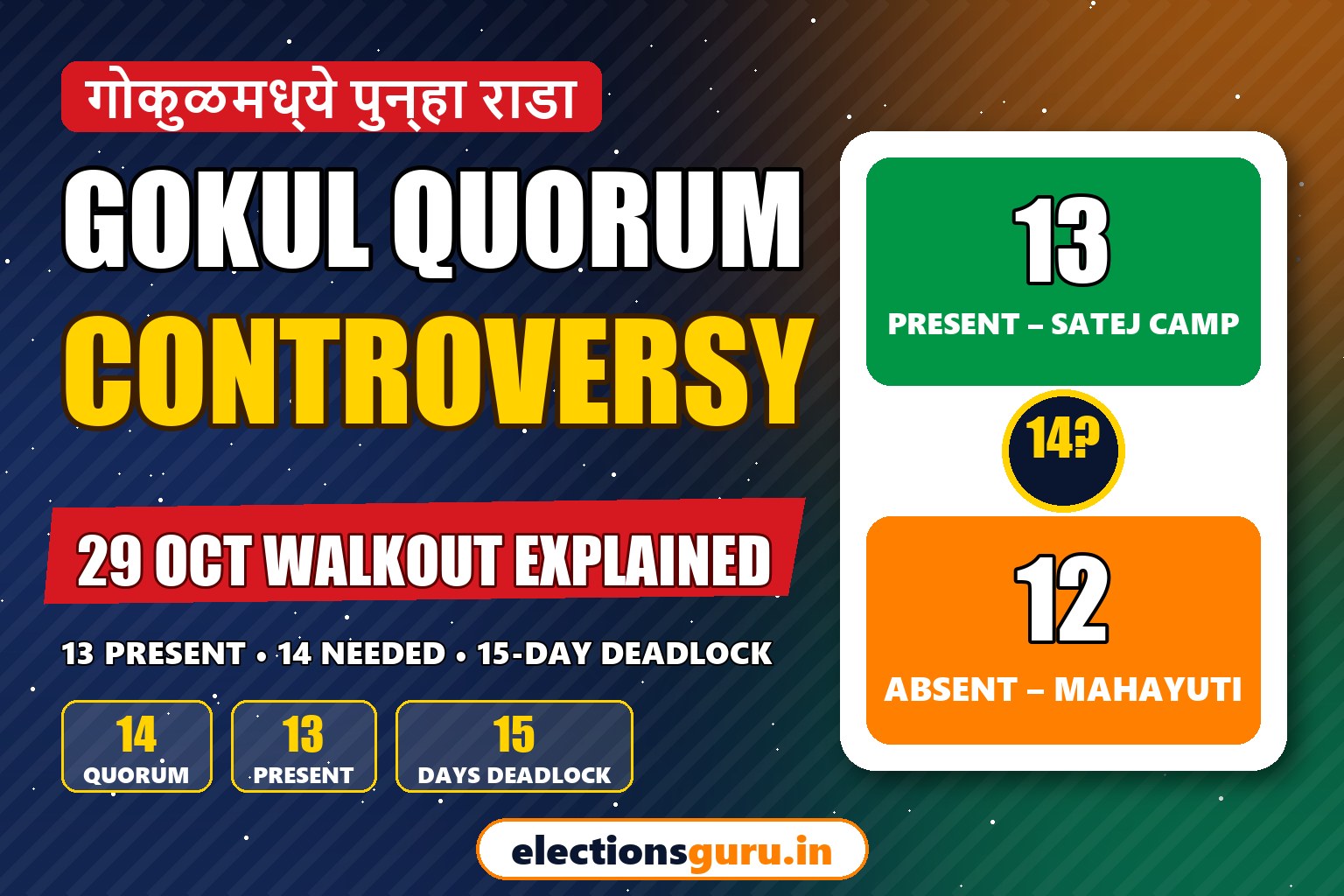
The Gokul Quorum Controversy is the reason a 13-12 election result turned into a 16-13 defeat for the winning side. On 29 October 2026, the meeting to elect Gokul’s chairman collapsed because the quorum of 14 directors was not met. What followed – a parallel “chairman”, a High Court order, an ordinance and a 15-day deadlock – is one of the most dramatic episodes in Maharashtra’s cooperative history.
Gokul Quorum Controversy at a Glance
| Detail | Information |
|---|---|
| Board size | 25 elected directors |
| Quorum for chairman election | 14 directors |
| Satej Patil panel | 13 directors |
| Mahayuti panel | 12 directors |
| Failed meeting | 29 October 2026 |
| Deadlock length | About 15 days |
| Resolved | 10 November 2026 – Rajesh Patil elected 16-13 |
Why 13 Was Not Enough
Under the rules, the chairman election meeting needs at least 14 of the 25 directors present. Satej Patil’s Samvichari Aghadi had a majority of 13, but one short of the quorum. That gave the 12-member Mahayuti group a way to block the election simply by staying away.
Also Read: Gokul Election Result 2026: All 25 Winning Directors List
What Happened on 29 October 2026
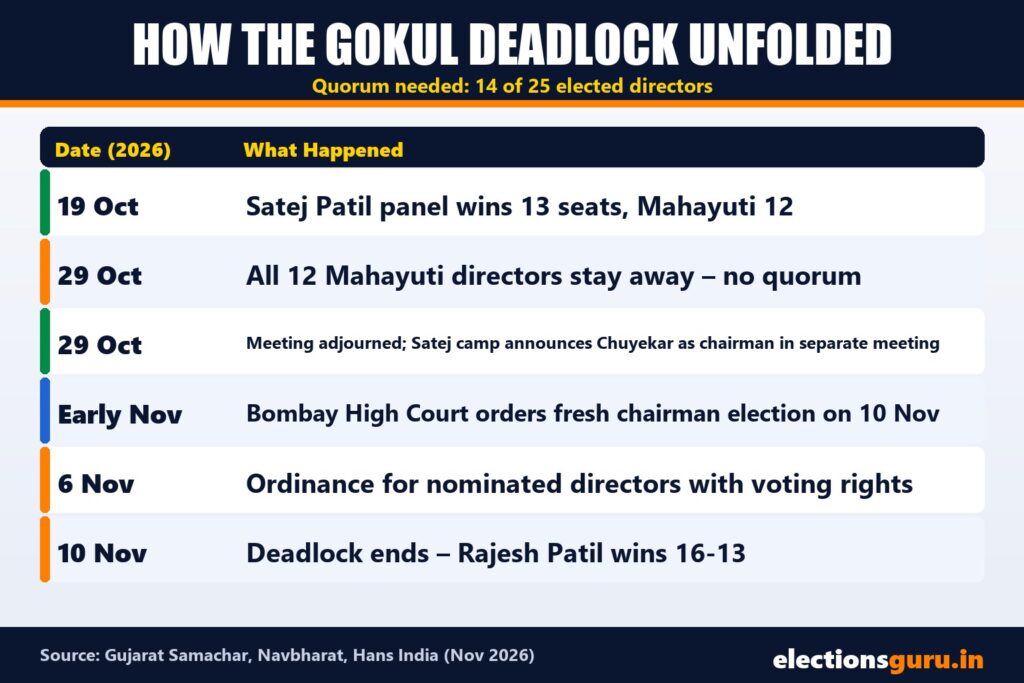
On 29 October, Satej Patil’s 13 directors reached the Gokul office at around 10:30 am. All 12 Mahayuti directors stayed away. With only 13 present, the returning officer adjourned the meeting for want of quorum.
The Parallel Chairman Claim
After the adjournment, the Satej Patil camp held a separate meeting and announced Shashikant Patil-Chuyekar as chairman. Mahayuti rejected this, and the claim triggered a fresh legal dispute. The Bombay High Court later ordered a fresh chairman election to be held on 10 November 2026.
Satej Patil’s Question on the Quorum Rule
On 7 November, Satej Patil asked Chief Minister Devendra Fadnavis why, if the quorum rule was causing a deadlock, the government did not simply amend it. Instead, the government issued an ordinance that allowed nominated directors with voting rights – which the opposition says was designed to change the result rather than fix the rule.
Also Read: Gokul Ordinance Controversy: Section 73AAA and Voting Rights
How the Deadlock Ended
With four government-nominated directors added, Mahayuti’s strength rose to 16 and the quorum problem disappeared. On 10 November, with more than 600 police on duty, Rajesh Patil won 16-13. Reports described this as breaking a 15-day impasse caused by the lack of quorum.
Also Read: Gokul Chairman Election 2026: Rajesh Patil Wins 16-13
Key Questions Still Open
- Will the High Court uphold the four nominated directors’ votes kept in a separate ballot box?
- Will the quorum rule for cooperatives be changed after the Gokul episode?
- Will Mahayuti’s one-year rotation formula hold for the rest of the term?
Gokul Quorum Controversy FAQ
What is the Gokul quorum controversy?
In 2026 the Gokul chairman election needed 14 of 25 directors present. Satej Patil’s panel had 13, and when Mahayuti’s 12 directors stayed away on 29 October, the meeting was adjourned for lack of quorum.
What happened on 29 October 2026 at Gokul?
The 13 Satej Patil panel directors attended but the 12 Mahayuti directors stayed away, so the returning officer adjourned the chairman election meeting.
Was Shashikant Patil-Chuyekar declared Gokul chairman?
The Satej Patil camp announced him as chairman at a separate meeting on 29 October, but it was not accepted and the High Court ordered a fresh election on 10 November.
How many directors are needed for quorum in Gokul?
A quorum of 14 directors is needed to elect the chairman.
How did the Gokul deadlock end?
After four government-nominated directors with voting rights were appointed, Mahayuti had 16 votes and Rajesh Patil was elected chairman 16-13 on 10 November 2026.