

Maharashtra is the latest state to move towards a Uniform Civil Code (UCC), and the debate has turned fierce. On 10 November 2026, AIMIM president Asaduddin Owaisi told a press conference in Mumbai that the Fadnavis government’s proposed UCC is an attempt to impose a “Hindu Civil Code” on non-Hindus. The next day, Chief Minister Devendra Fadnavis hit back, saying “The Constitution itself has directed us to do this.”
The state government has issued a questionnaire to gather public opinion as part of the drafting process. In this Election Guru explainer we cover what Owaisi and Fadnavis said, what the UCC is, Article 44, how Uttarakhand implemented it, which other states are moving, and what a Maharashtra UCC could mean for marriage, divorce, inheritance and politics.
Maharashtra UCC at a Glance
| Detail | Information |
|---|---|
| Proposal | Uniform Civil Code for Maharashtra |
| Government | BJP-led Mahayuti government, CM Devendra Fadnavis |
| Stage | Drafting and public consultation (questionnaire issued) |
| Constitutional basis cited | Article 44, Directive Principles of State Policy |
| Main critic | AIMIM chief Asaduddin Owaisi |
| Owaisi’s charge | “Hindu Civil Code” being imposed on non-Hindus |
| Fadnavis’s reply | “The Constitution itself has directed us to do this.” |
| Bill status | No bill passed yet |
What Owaisi Said
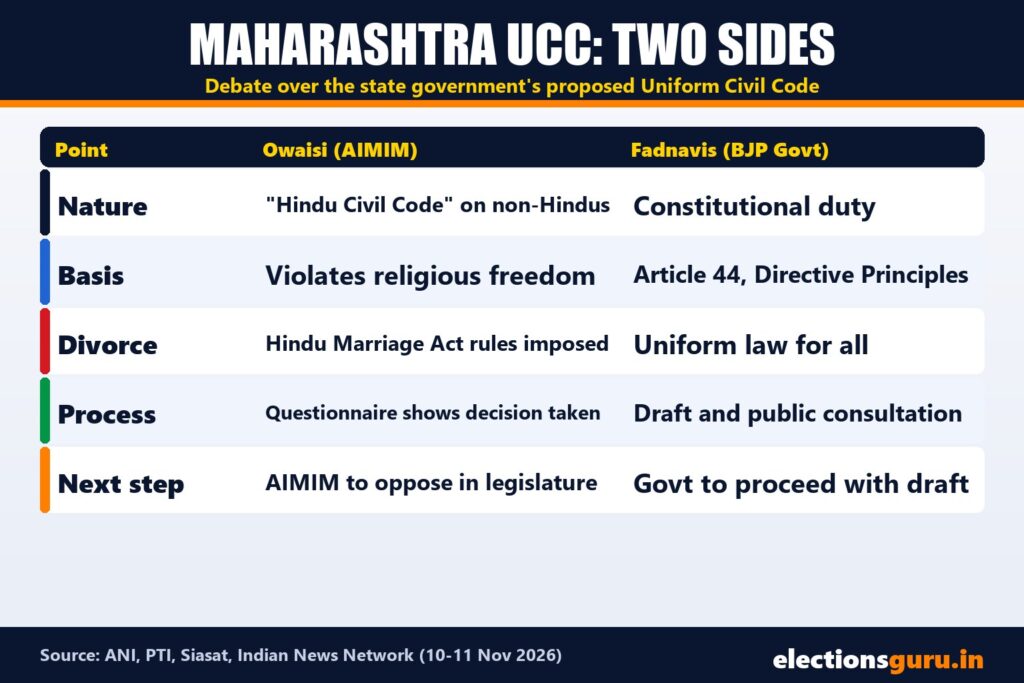
- “It is evident that the Devendra Fadnavis government will implement UCC.”
- The questionnaire shows the government has already decided, but it does not define what “uniform” means
- The questionnaire is silent on the Hindu Undivided Family (HUF) tax benefit
- Divorce would follow the Hindu Marriage Act, including a one-year judicial separation
- In Islam, “marriage is a contract,” and women have the right of “khula” (divorce)
- “It is an attempt to snatch our main religious practices which have the protection of fundamental rights.”
- Similar moves in Gujarat, Assam, Madhya Pradesh and Uttarakhand are not truly uniform, he argued
- AIMIM will oppose the UCC in the state legislature and its implementation
What Fadnavis Said
Chief Minister Fadnavis defended the draft, saying the Constitution directs states to work towards a UCC through the Directive Principles. “If Owaisi had read the Constitution a little, he would not have said that we are bringing this outside its framework,” he said. He also accused the opposition of trying to provoke street protests and said the government would respond firmly if disagreements were taken to the streets.
What Is a Uniform Civil Code?
A Uniform Civil Code means one set of personal laws for all citizens, regardless of religion, on matters such as marriage, divorce, maintenance, adoption, inheritance and succession. At present, these matters are governed largely by religion-based personal laws.
| Community | Main Personal Laws Today |
|---|---|
| Hindus, Sikhs, Jains, Buddhists | Hindu Marriage Act 1955, Hindu Succession Act 1956, Hindu Adoptions and Maintenance Act 1956 |
| Muslims | Muslim Personal Law (Shariat) Application Act 1937, Dissolution of Muslim Marriages Act 1939 |
| Christians | Indian Christian Marriage Act 1872, Indian Divorce Act 1869 |
| Parsis | Parsi Marriage and Divorce Act 1936 |
| Inter-faith / civil marriages | Special Marriage Act 1954 |
Article 44 of the Constitution
Article 44 says: “The State shall endeavour to secure for the citizens a uniform civil code throughout the territory of India.” It is part of the Directive Principles of State Policy, which are not enforceable in court but are meant to guide governments. Supporters cite Article 44 as a constitutional mandate; critics point to Article 25, which protects freedom of religion, and to the diversity of customs, including tribal practices.
Uttarakhand: The First State to Implement UCC
Uttarakhand became the first state after Independence to implement a UCC, which came into force on 27 January 2025. Goa already had a common civil code dating back to Portuguese rule. Key features of the Uttarakhand law include:
| Area | Uttarakhand UCC Provision |
|---|---|
| Polygamy | Banned for all |
| Marriage age | Uniform minimum age (21 for men, 18 for women) |
| Registration | Compulsory registration of marriages and divorces |
| Live-in relationships | Must be registered |
| Inheritance | Equal rights for sons and daughters |
| Exemption | Scheduled Tribes are excluded |
Other States Moving on UCC
| State | Status (as reported) |
|---|---|
| Goa | Common civil code from Portuguese era (1867) |
| Uttarakhand | UCC in force since 27 January 2025 |
| Gujarat | Has moved towards a UCC through a committee process |
| Assam | Steps on polygamy and related laws |
| Madhya Pradesh | Leaders have announced intent |
| Maharashtra | Draft and public questionnaire stage |
Law Commission’s View
In 2018, the 21st Law Commission said a UCC was “neither necessary nor desirable at this stage” and suggested reforming existing personal laws instead. In June 2023, the 22nd Law Commission sought fresh views from the public and religious organisations on a UCC. The national debate has continued, with the BJP including UCC in its manifestos.
Also Read: Maharashtra SIR 2026: Final Voter List on November 30
What a Maharashtra UCC Could Change
| Area | Possible Change |
|---|---|
| Marriage | Uniform age, compulsory registration, ban on polygamy |
| Divorce | Common grounds and procedure for all communities |
| Inheritance | Equal shares for sons and daughters across religions |
| Adoption | Uniform adoption rights |
| Live-in relationships | Possible registration requirement, as in Uttarakhand |
The final content will depend on the draft that emerges after consultation. The government has not yet released the bill text.
Politics of the UCC in Maharashtra
- BJP and Mahayuti: present it as constitutional duty and gender justice
- AIMIM: strongest opponent; calls it a “Hindu Civil Code”
- Congress, Shiv Sena (UBT), NCP (SP): expected to question the timing and process
- Muslim organisations: likely to oppose changes to personal law
- Tribal groups: will watch whether customary practices are protected
Key Arguments For and Against a UCC
| Arguments For | Arguments Against |
|---|---|
| Equality before law for all citizens | Threat to religious freedom under Article 25 |
| Gender justice in marriage, divorce and inheritance | Diversity of customs, including tribal and regional practices |
| Simplifies the legal system | Fear of majority customs being imposed |
| Constitutional directive under Article 44 | Reform within each community is a better route |
| National integration | Lack of a clear draft creates mistrust |
Important Court Cases on Personal Law
| Case | Year | Significance |
|---|---|---|
| Shah Bano | 1985 | SC upheld maintenance for a divorced Muslim woman; called for UCC |
| Sarla Mudgal | 1995 | SC on conversion to Islam to contract a second marriage |
| Shayara Bano | 2017 | SC struck down instant triple talaq |
| Triple talaq law | 2019 | Parliament made instant triple talaq a criminal offence |
Maharashtra’s Political Context
The BJP-led Mahayuti won a big majority in the November 2024 Maharashtra Assembly election, and Devendra Fadnavis returned as Chief Minister in December 2024. Since then, the government has taken up several issues close to the BJP’s core agenda. Owaisi’s AIMIM has a base in Maharashtra cities such as Chhatrapati Sambhajinagar, Malegaon and parts of Mumbai, and the UCC debate is likely to sharpen political lines ahead of future civic and state elections.
How You Can Take Part in the Consultation
- Watch for the official questionnaire and notice from the Maharashtra government
- Responses can usually be submitted online or by post within the deadline given
- Community organisations and legal experts often submit detailed suggestions
- Check official government websites rather than social media forwards for the exact process
What Happens After the Questionnaire
Typically, a state preparing a UCC first collects public opinion, then a committee or the law department prepares a draft, which is examined by the Cabinet before a bill is introduced in the Legislative Assembly and Legislative Council. Because marriage, divorce and succession are in the Concurrent List of the Constitution, states can legislate on them, but a state law that conflicts with a central law needs the President’s assent to prevail in that state. Uttarakhand’s UCC went through a similar route, including an expert committee and presidential assent.
| Step | Body |
|---|---|
| Public consultation | State government (questionnaire) |
| Draft preparation | Committee / law department |
| Approval of draft | State Cabinet |
| Passage | Maharashtra Legislative Assembly and Council |
| Assent | Governor; President where central laws conflict |
Uttarakhand UCC: Early Experience
Since Uttarakhand’s UCC came into force in January 2025, the state has run an online portal for registration of marriages, divorces and live-in relationships. Supporters say it has improved documentation and protected women’s rights. Critics have challenged parts of the law, especially compulsory registration of live-in relationships, in the Uttarakhand High Court on privacy grounds. Maharashtra is expected to study Uttarakhand’s experience while drafting its own law, and both supporters and opponents in Maharashtra are already citing it.
| Uttarakhand Feature | Debate |
|---|---|
| Live-in registration | Privacy concerns raised in court |
| Marriage registration | Seen as helping women prove marriage |
| Polygamy ban | Supported as gender justice; opposed by some groups |
| Tribal exemption | Raises the question of how uniform the code is |
Election Guru Analysis
Maharashtra’s UCC move turns a long-running national debate into a live state issue. Fadnavis is framing it as a constitutional obligation, while Owaisi is framing it as an attack on minority rights. The real test will come when the draft bill is released: whether it is genuinely uniform, how it treats customary and tribal practices, and whether it protects women’s rights across communities. Expect the UCC to be a major theme in Maharashtra politics in the coming months.
Maharashtra Uniform Civil Code FAQ
What did Owaisi say about the Maharashtra UCC?
Owaisi said the proposed UCC is an attempt to impose a “Hindu Civil Code” on non-Hindus and that AIMIM will oppose it in the legislature.
What did CM Fadnavis say in reply?
Fadnavis said “The Constitution itself has directed us to do this,” citing the Directive Principles of State Policy.
Has Maharashtra passed a UCC law?
No. The UCC is at the drafting and public consultation stage, and no bill has been passed yet.
What is Article 44?
Article 44 says the State shall endeavour to secure a uniform civil code for citizens throughout India. It is a Directive Principle, not enforceable in court.
Which state first implemented UCC after Independence?
Uttarakhand, where the UCC came into force on 27 January 2025. Goa has had a common civil code since Portuguese rule.
What does a UCC cover?
Personal matters such as marriage, divorce, maintenance, adoption, inheritance and succession.
What did the Law Commission say about UCC?
The 21st Law Commission said in 2018 that a UCC was neither necessary nor desirable at that stage; the 22nd Law Commission sought fresh views in 2023.