
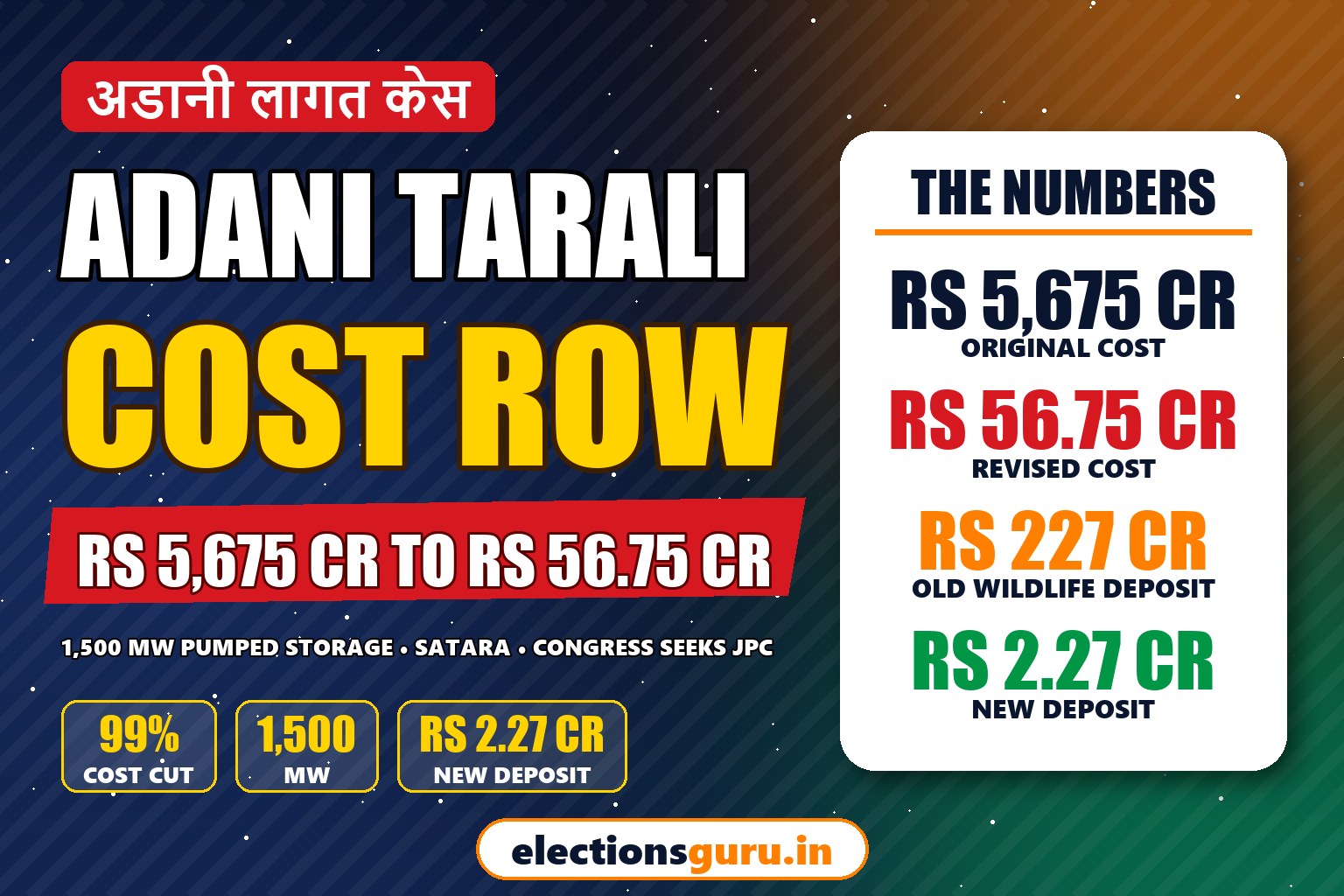
A Maharashtra power project has become the latest flashpoint between the Congress and the Adani Group. According to documents reviewed by The Indian Express, Adani Green Energy revised the stated cost of its 1,500 MW Tarali Pumped Storage Project in Satara district from ₹5,675 crore to ₹56.75 crore, a cut of 99%. Because the wildlife conservation contribution is calculated as a percentage of project cost, the deposit fell from about ₹227 crore to about ₹2.27 crore.
On 13 November 2026, the Congress renewed its demand for a Joint Parliamentary Committee (JPC) probe, with Jairam Ramesh calling it a scandal of “gigantic proportions”. The Union environment ministry has asked Maharashtra’s forest department to investigate. The Adani Group says the project is on private, non-forest land. In this Election Guru explainer we cover the project, the numbers, the timeline, the claims on both sides and what a pumped storage project is.
Tarali Project Cost Row at a Glance
| Detail | Information |
|---|---|
| Developer | Adani Green Energy |
| Project | 1,500 MW Tarali Pumped Storage Project |
| Location | Nivade, Tondoshi, Kalambe and Jalu villages, Patan taluka, Satara district |
| Land | 150.74 hectares of non-forest land around Tarali dam reservoir |
| Sensitive zone | Deemed eco-sensitive zone of Koyna Wildlife Sanctuary (Sahyadri Tiger Reserve) |
| Original stated cost | ₹5,675 crore |
| Revised stated cost | ₹56.75 crore (via affidavit, 8 September 2026) |
| Conservation contribution (4%) | ₹227 crore originally; about ₹2.27 crore now |
| Paid so far | ₹56.75 lakh (1% of revised cost) |
| Probe | Union environment ministry asked state to investigate |
How the Cost Was Revised
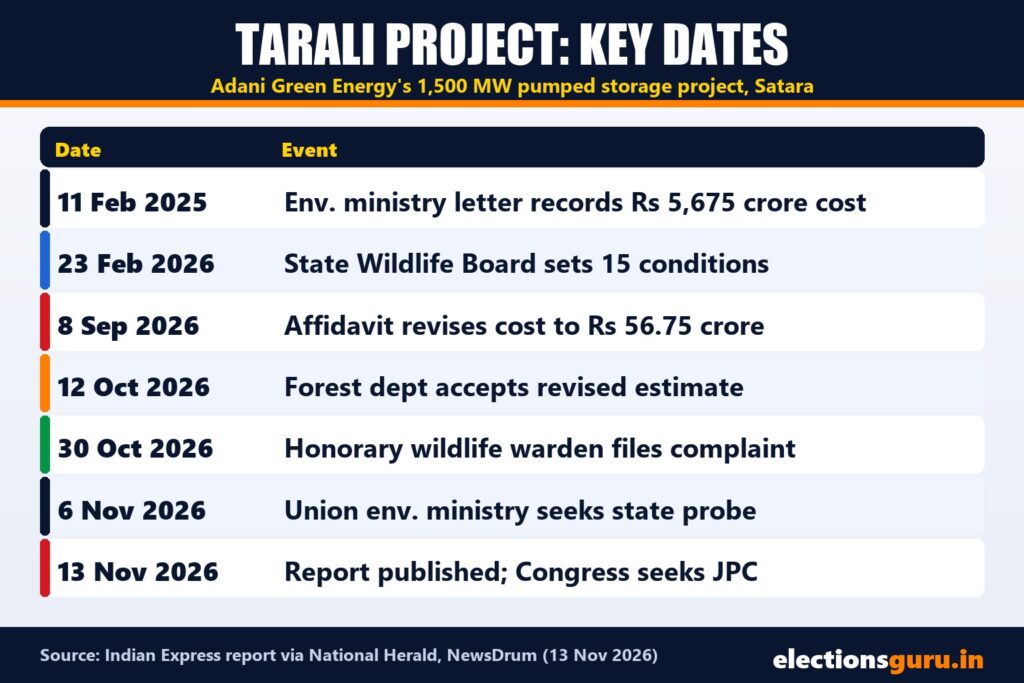
An environment ministry letter dated 11 February 2025, which recommended prior environmental clearance, recorded the project cost as ₹5,675 crore. On 23 February 2026, the State Board for Wildlife imposed 15 conditions, including a conservation contribution of 4% of project cost. In March 2026, the Principal Chief Conservator of Forests (Wildlife), M. Srinivas Reddy, sought ₹227 crore.
On 8 September 2026, Adani Green Energy submitted a notarised affidavit putting the cost at ₹56.75 crore. A letter from its chief operating officer said part of the earlier figure had been arrived at through “analogous estimation” based on comparable projects. On 12 October, the forest department accepted the affidavit and asked for 1% of the revised cost immediately. The company paid ₹56.75 lakh to the Sahyadri Tiger Reserve, whose field director confirmed the receipt.
The Complaint and the Probe
| Date | Action |
|---|---|
| 30 October 2026 | Satara honorary wildlife warden Rohan Bhate complains on the PM’s grievance portal and Maharashtra’s Aaple Sarkar platform |
| 5 November 2026 | State asks deputy director of Koyna Wildlife Sanctuary to examine the complaint |
| 6 November 2026 | Union environment ministry asks state authorities to investigate promptly |
The key questions, as reported, are how the lower estimate was calculated, why it was accepted, and whether the reduced conservation contribution is justified. The documents reviewed did not explain how the new figure was arrived at.
Congress’s Allegation
Congress general secretary Jairam Ramesh described the revision as a scandal of “gigantic proportions” and used the term “Modani” to allege close ties between the government and the Adani Group. The Congress has been demanding a JPC inquiry into the Adani Group since March 2023, after the Hindenburg Research report, and says this case adds to that demand. A separate report asked whether the company “saved” about ₹225 crore in wildlife dues.
Adani Group’s Response
An Adani Group spokesperson said the project components are on privately owned land and involve no forest land, and that pumped storage operations would not harm downstream ecology or wildlife. The spokesperson did not answer the specific question about the revised cost. It is important to note that the change is in the declared project cost; it does not establish that the actual construction expenditure has fallen by 99%.
What Is a Pumped Storage Project?
A pumped storage project works like a giant water battery. It has two reservoirs at different heights. When electricity is cheap or surplus, for example from solar plants during the day, water is pumped up to the upper reservoir. When demand is high, the water is released down through turbines to generate electricity. Such projects are key for storing renewable energy and stabilising the grid.
| Feature | Detail |
|---|---|
| Purpose | Store surplus electricity and release it at peak demand |
| Components | Upper and lower reservoirs, tunnels, pump-turbines |
| Benefit | Helps integrate solar and wind power |
| India’s plans | Large pumped storage capacity planned to support renewable targets |
| Maharashtra | Several projects proposed in the Sahyadri hills |
Why the Location Matters: Koyna and Sahyadri Tiger Reserve
The project lies within the deemed eco-sensitive zone of the Koyna Wildlife Sanctuary, part of the Sahyadri Tiger Reserve in the Western Ghats, a global biodiversity hotspot. A senior forest official said the sanctuary’s eco-sensitive zone has not been formally notified, so a 10-km area around it is treated as a deemed eco-sensitive zone under Supreme Court directions. That is why the State Board for Wildlife imposed conditions, including the conservation contribution.
Adani Group and the JPC Demand: Background
| Year | Event |
|---|---|
| January 2023 | Hindenburg Research report on Adani Group |
| March 2023 | Congress begins demanding JPC probe |
| 2023-24 | Supreme Court-appointed expert panel and SEBI probe |
| November 2024 | US indictment of Adani executives reported; group denied charges |
| November 2026 | Tarali cost revision report; Congress renews JPC demand |
Also Read: Rahul Gandhi Phone Tapping Allegation Against PM Modi Explained
What Happens Next
- Maharashtra forest department to investigate the cost revision and complaint
- National Board for Wildlife approval pending; remaining 3% deposit due after it
- Congress likely to raise the issue in Parliament’s winter session
- Adani Group may clarify the basis of the revised cost
- Environmental groups may approach courts if they see violations
How Project Cost Affects Environmental Payments
Many environmental and wildlife conditions in India are linked to project cost. For projects in or near protected areas, state wildlife boards often require developers to pay a percentage of the project cost into a conservation fund. In this case, the State Board for Wildlife set the contribution at 4% of project cost. That is why the stated cost matters so much: a lower stated cost directly reduces the amount paid for wildlife conservation. Experts say regulators should verify cost estimates independently rather than rely only on developers’ affidavits.
| Stated Cost | 4% Conservation Contribution |
|---|---|
| ₹5,675 crore (original) | About ₹227 crore |
| ₹56.75 crore (revised) | About ₹2.27 crore |
| Difference | About ₹225 crore |
Pumped Storage Boom in India
India has set ambitious targets for renewable energy, and storing solar and wind power is becoming critical. Pumped storage projects are seen as one of the most reliable ways to do this, and several private companies, including Adani Green, JSW, Torrent and Greenko, have announced large projects. Maharashtra’s Sahyadri hills, with their natural height differences and existing dams, are attractive for such projects, but they are also ecologically sensitive. Balancing clean energy with forest and wildlife protection is the central challenge highlighted by the Tarali case.
| Benefit | Concern |
|---|---|
| Stores renewable energy for peak demand | Can affect forests and wildlife corridors |
| Uses existing reservoirs in some cases | Construction impacts in eco-sensitive zones |
| Long life, large capacity | Needs transparent cost and clearance process |
Questions the Probe Must Answer
- How was the original ₹5,675 crore estimate prepared, and by whom?
- What method produced the revised ₹56.75 crore figure?
- Why did the forest department accept the affidavit without independent verification?
- Does the revised figure cover the full project or only a part of it?
- Should the conservation contribution be recalculated?
Answers to these questions will decide whether the case is seen as an accounting correction or a deliberate under-declaration. Until the investigation is complete, both the company’s explanation and the opposition’s allegations remain claims.
Election Guru Analysis
The Tarali case is about a simple but powerful number: a stated cost cut by 99%, which reduced a wildlife deposit from crores to lakhs. Whether this was a legitimate correction or something more serious is for the investigation to decide. Politically, it gives the Congress fresh material for its long campaign against the Adani Group, and it puts the Maharashtra government under pressure to explain why the revised estimate was accepted. Expect the issue to come up in Parliament and in Maharashtra politics in the coming weeks.
Adani Tarali Pumped Storage Project 99% Cost Cut Row FAQ
What is the Adani Tarali project?
It is a 1,500 MW pumped storage hydropower project by Adani Green Energy in Patan taluka of Satara district, Maharashtra.
How much was the project cost revised?
The stated cost was revised from ₹5,675 crore to ₹56.75 crore through an affidavit dated 8 September 2026.
How did the revision affect the wildlife deposit?
The 4% conservation contribution fell from about ₹227 crore to about ₹2.27 crore. The company has paid ₹56.75 lakh so far.
What is the Congress demanding?
The Congress has renewed its demand for a Joint Parliamentary Committee (JPC) probe into the Adani Group.
Has the government ordered a probe?
The Union environment ministry has asked Maharashtra’s forest department to investigate the complaint promptly.
What did the Adani Group say?
A spokesperson said the project is on private, non-forest land and will not harm downstream ecology, but did not explain the revised cost.
What is a pumped storage project?
A project that pumps water to an upper reservoir when power is surplus and releases it through turbines to generate electricity when demand is high.