
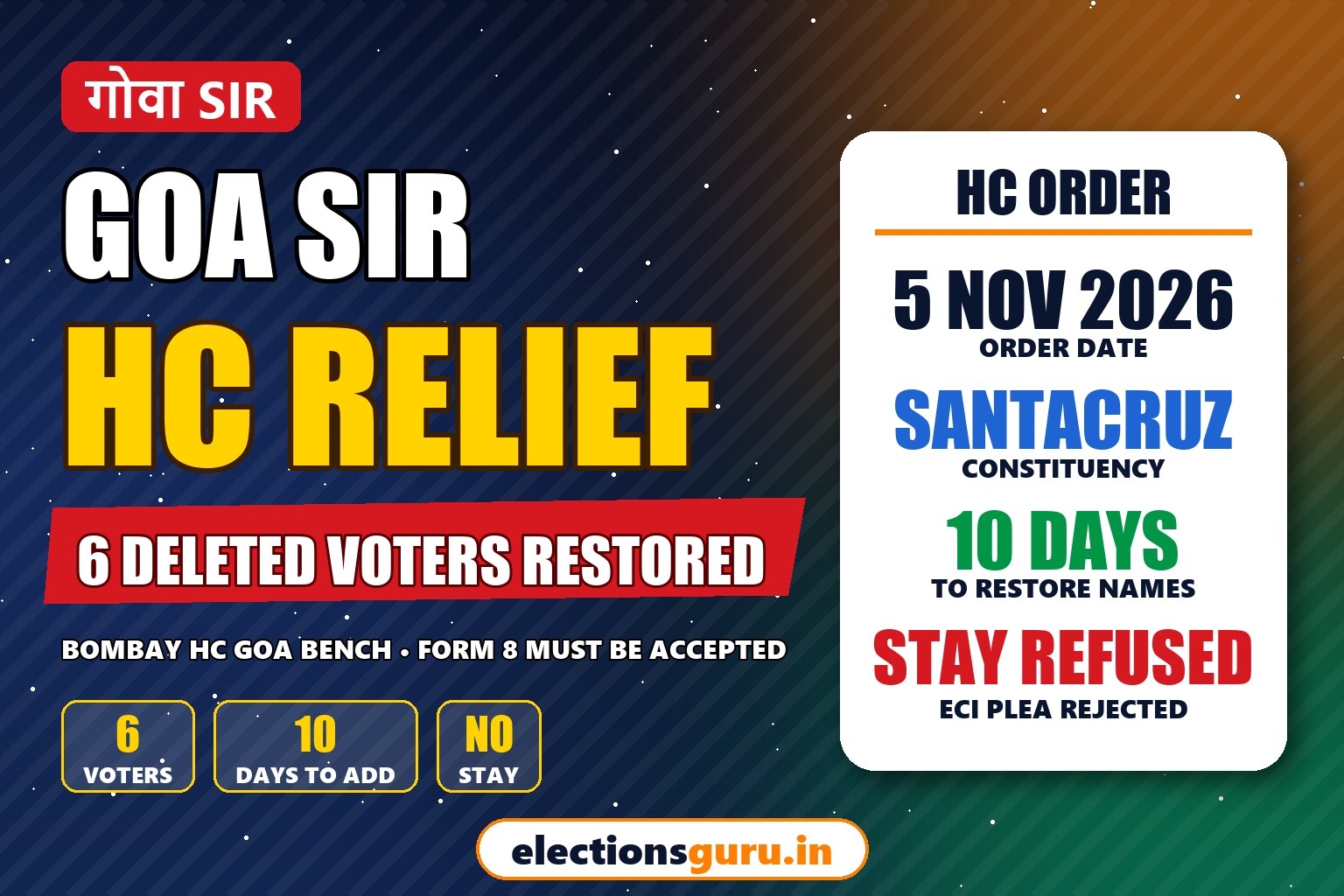
In a significant order on the Special Intensive Revision (SIR) of electoral rolls, the Bombay High Court’s Goa bench has directed the Election Commission of India (ECI) to restore the names of six voters from one family in Goa’s Santacruz Assembly constituency who were deleted from the final electoral roll. The bench of Justices Valmiki Menezes and Amit Jamsandekar passed the order on 5 November 2026 and refused the ECI’s request for a stay.
The core issue was simple: the family had filed Form 8 to change their address, but the ECI rejected it because they had not filed a pre-filled enumeration form, and told them to apply as new voters using Form 6. The court called this a “catch-22”. In this Election Guru explainer we cover the case, the arguments, the court’s reasoning, the forms involved and what the order could mean for voters in other SIR states, including Maharashtra.
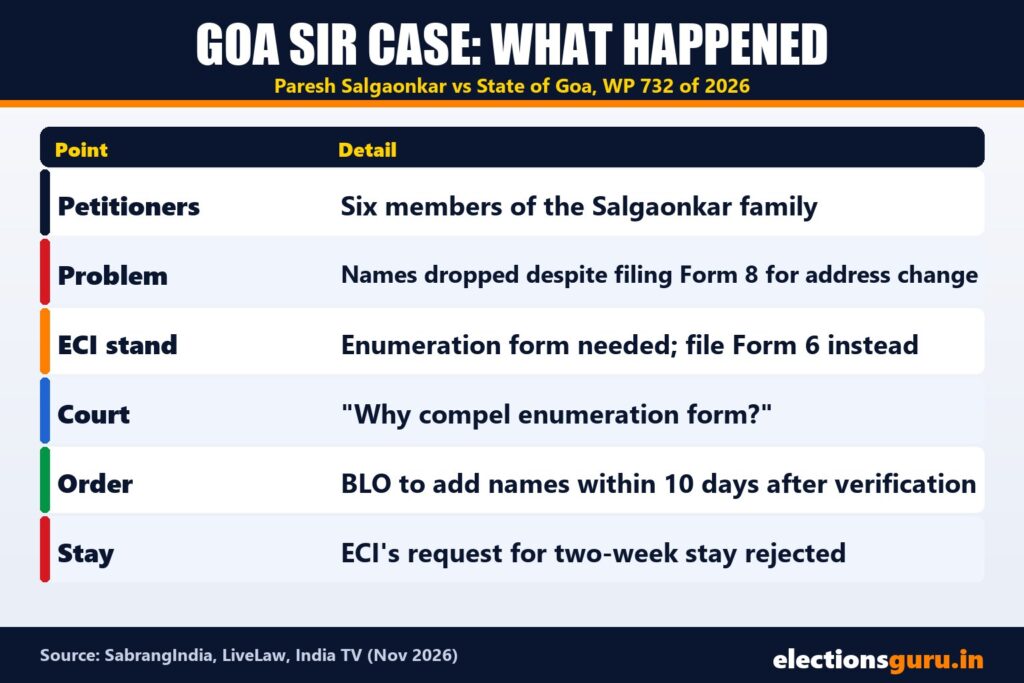
Goa SIR High Court Case at a Glance
| Detail | Information |
|---|---|
| Court | Bombay High Court, Goa bench |
| Bench | Justices Valmiki Menezes and Amit Jamsandekar |
| Case | Paresh Salgaonkar vs State of Goa, Writ Petition 732 of 2026 |
| Date of order | 5 November 2026 |
| Petitioners | Six members of the Salgaonkar family |
| Constituency | Santacruz, Goa |
| Direction | BLO to include names within 10 days after verifying residence |
| ECI’s request | Two-week stay to approach Supreme Court – rejected |
What Happened to the Salgaonkar Family
The family members had moved house and filed Form 8, the form used to shift an entry to a new address. During the SIR, their names were dropped from the final electoral roll. Their Form 8 applications were rejected because they had not submitted the pre-filled enumeration forms that were distributed during the SIR. Election officials told them to file Form 6, which is meant for new voters. The family challenged both the deletion and the rejection in the High Court.
ECI’s Arguments
- Under SIR guidelines, voters had to submit the pre-filled enumeration form along with Form 8
- Because the petitioners did not submit enumeration forms, they had to apply afresh through Form 6
- Senior Advocate Ashutosh Kumbhakoni argued that the SIR draft roll was prepared afresh (de novo), so voters missing from it could not use Form 8 to amend an entry
- The ECI asked the court to defer the case until the Supreme Court decides wider challenges to the SIR
What the Court Said
The bench questioned why voters who had moved should be made to sign a pre-filled form that declared they still lived at their old address, which, it noted, would push them towards making a false declaration. Justice Menezes said that if a voter comes with Form 8 saying he has changed his address, officials “just cannot tell that person” to do something else, and asked: “Why compel enumeration form?”
The court described a “catch-22 situation”, where Form 8 applicants were rejected and pushed to Form 6, which could make it harder for them to establish their registration. It asked why the Form 8 applications were rejected rather than kept pending for verification, and said the case was not really about the SIR process itself. It therefore rejected the ECI’s request to wait for the Supreme Court.
On the stay request, the court said: “We decline to stay the directions given in this order since they pertain to the inclusion of the names of the petitioners as voters in the voting list. Request is rejected.”
Form 6 vs Form 7 vs Form 8: What’s the Difference?
| Form | Purpose | Why It Matters in This Case |
|---|---|---|
| Form 6 | New registration / inclusion of name | ECI told the family to apply as new voters |
| Form 7 | Objection to inclusion or request for deletion | Used to remove dead, shifted or duplicate entries |
| Form 8 | Correction of entries, shifting of residence, replacement EPIC | Family used this for address change; court said it must be considered |
Applying through Form 6 can mean being treated as a new voter, which may require fresh documents and can affect continuity of the voter’s record. That is why the court saw the ECI’s approach as unfair to people who had simply moved.
Why This Order Matters Beyond Goa
Goa was part of SIR Phase II. Millions of voters across SIR states have been left out of rolls, many because they shifted homes or did not fill enumeration forms. The court’s reasoning that a voter who moves should be able to use Form 8, and that officials cannot force a false declaration, could be cited by voters and parties in other states. The order applies to the six petitioners, and the detailed written order was still awaited, but it adds to the legal scrutiny of how the SIR is being implemented.
| SIR Phase | States / UTs (examples) |
|---|---|
| Phase I (2025) | Bihar |
| Phase II (from Oct 2025) | UP, West Bengal, Tamil Nadu, Kerala, Gujarat, Goa, Rajasthan, MP, Chhattisgarh, Puducherry and others |
| Phase III (from May 2026) | Maharashtra, Delhi, Karnataka, Andhra Pradesh, Telangana, Punjab, Haryana and others |
Also Read: Maharashtra SIR 2026: Final Voter List on November 30
Other Court Interventions on SIR
- The Supreme Court has heard several petitions challenging the SIR since 2025, including on the documents required
- The Supreme Court earlier pushed the ECI to accept Aadhaar among identity documents
- In West Bengal, judicial officers were deployed to decide large numbers of disputed cases
- Reports say the Supreme Court recently asked the ECI not to impose rigid deadlines, leading to revised schedules in several states
What Voters Should Do If Their Name Is Missing
- Search your name on voters.eci.gov.in or the Voter Helpline App
- If you have shifted, file Form 8 with proof of your new address
- If your name is completely missing, file Form 6 to be added
- Keep acknowledgement numbers and copies of all forms
- If a valid application is rejected, appeal to the authorities, and as this case shows, courts can intervene
Political Reactions
Opposition parties have pointed to the order as proof that the SIR is causing wrongful deletions, while the ECI maintains that the revision is cleaning up outdated rolls. The case has been widely shared by civil society groups working on voter rights. The ECI may still approach the Supreme Court against the order.
Also Read: INDIA Bloc vs CEC Gyanesh Kumar: Vote Chori Row Explained
Why Shifted Voters Are Most at Risk in SIR
The SIR asks every elector to fill an enumeration form during a house-to-house visit, linked to their entry in older rolls. Voters who have moved homes face a problem: the form is pre-filled with their old address, but they no longer live there. If they are not found at the old address, they may be marked as “shifted” and deleted. If they file Form 8 for their new address, as the Goa family did, officials may still insist on the enumeration form. The Goa ruling recognises this gap and says honest applicants should not be penalised for it.
| Voter Situation | Risk Under SIR | Suggested Action |
|---|---|---|
| Living at same address | Low, if form submitted | Submit enumeration form |
| Moved within constituency | Medium | File Form 8 with new address proof |
| Moved to another constituency | High | File Form 8 (shifting) or Form 6 at new place |
| Name missing entirely | High | File Form 6 with documents |
Goa’s Political Context
Goa has 40 Assembly seats and two Lok Sabha seats, North Goa and South Goa. The BJP has governed the state since 2012, with Pramod Sawant as Chief Minister since 2019. The next Goa Assembly election is due in early 2027, which makes voter roll accuracy especially important. Small Goa constituencies are often decided by a few hundred or a few thousand votes, so even small numbers of wrongful deletions can matter.
Timeline of the Goa SIR Case
| Stage | Event |
|---|---|
| SIR Phase II | Goa’s electoral roll revised; enumeration forms distributed |
| Before final roll | Salgaonkar family files Form 8 for address change |
| Final roll | Six names deleted; Form 8 rejected |
| Petition | Family approaches Bombay High Court at Goa |
| 5 November 2026 | Court orders restoration within 10 days; stay refused |
Election Guru Analysis
The Goa order is small in numbers, just six voters, but big in principle. It says that a voter who honestly reports a change of address cannot be pushed out of the roll on a technicality, and that officials cannot demand declarations that are untrue. As SIR final rolls are published in Maharashtra, Delhi and other states over the next few weeks, this reasoning could shape how claims and objections are handled and how courts view similar cases.
Goa SIR FAQ
What did the Bombay High Court order in the Goa SIR case?
It directed the Election Commission to restore the names of six voters of the Salgaonkar family in Santacruz, Goa, within 10 days after verifying their residence.
Which judges passed the order?
Justices Valmiki Menezes and Amit Jamsandekar of the Bombay High Court’s Goa bench, on 5 November 2026.
Why were the voters deleted?
They had filed Form 8 for an address change but did not submit the pre-filled SIR enumeration form, so their names were dropped and they were told to file Form 6.
What did the court say about the enumeration form?
The court questioned why voters who had moved should be compelled to sign a form declaring their old address, asking “Why compel enumeration form?”
Did the court stay its order?
No. It rejected the ECI’s request for a two-week stay because the order concerns inclusion of voters’ names.
What is Form 8 used for?
Form 8 is used to correct entries, shift residence within or outside a constituency, or get a replacement voter ID.
Does this order apply to all voters?
The order is specific to the six petitioners, but its reasoning may be cited in similar cases in other SIR states.