
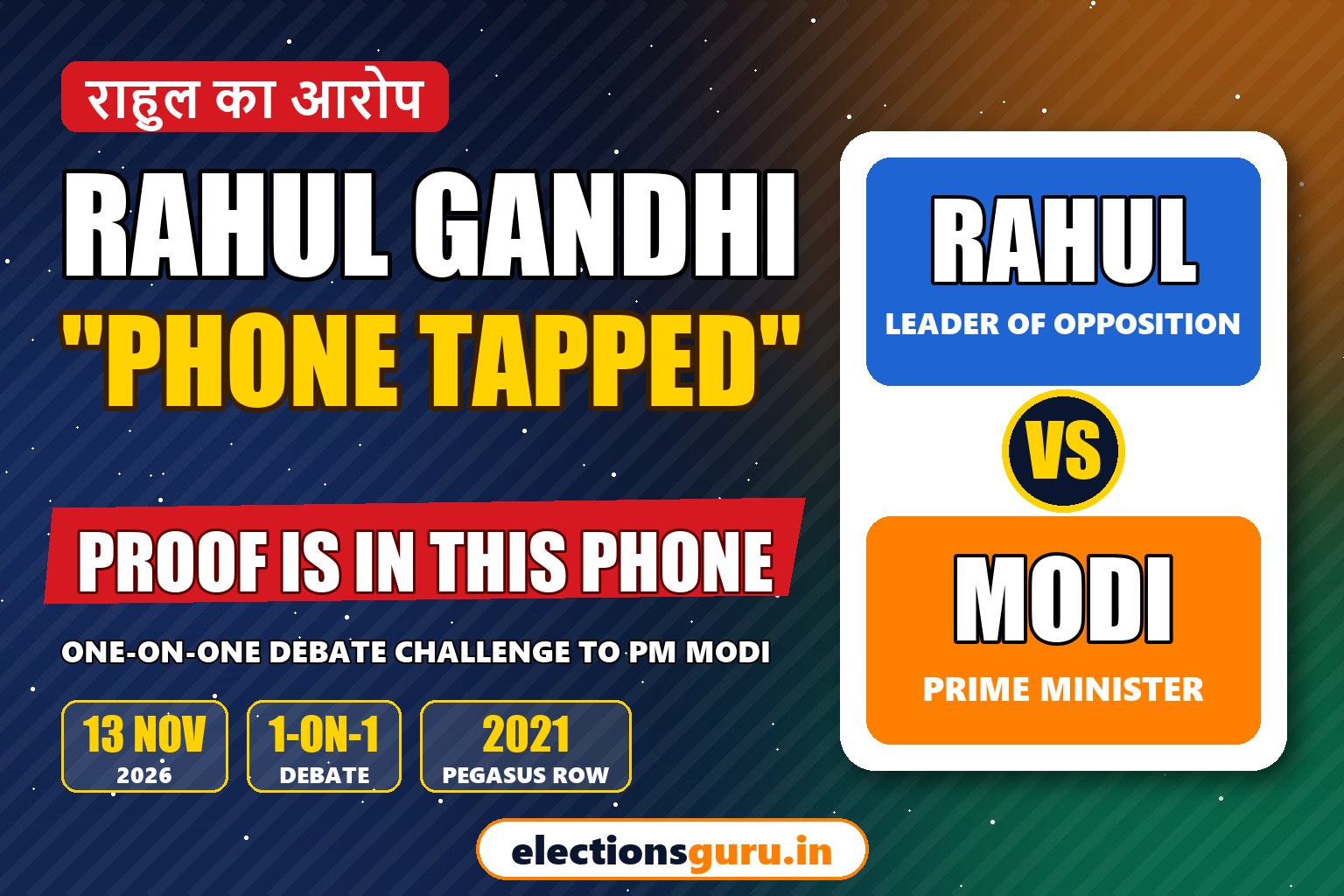
Leader of the Opposition in the Lok Sabha Rahul Gandhi has made a fresh and dramatic allegation against Prime Minister Narendra Modi. On Friday, 13 November 2026, during an Instagram “Ask Me” session and in a video statement, he held up his phone and said: “The proof is in this phone, and the PM knows it since he taps my phone.”
In the same session, Rahul Gandhi renewed his challenge for a one-on-one debate with the Prime Minister, said he would accept even Gautam Adani or RSS chief Mohan Bhagwat as the judge, and listed issues from vote theft to China. He did not show any technical evidence for the phone-tapping claim. In this Election Guru explainer we cover what he said, the debate challenge, the history of snooping allegations including Pegasus, and how legal phone interception works in India.
Rahul Gandhi Phone Tapping Allegation at a Glance
| Detail | Information |
|---|---|
| Who | Rahul Gandhi, Leader of the Opposition in the Lok Sabha |
| When | Friday, 13 November 2026 |
| Where | Instagram “Ask Me” session and video statement |
| Allegation | PM Modi taps his phone; the phone holds “proof” of his allegations |
| Evidence shown | None; no verifiable technical evidence presented |
| Linked demand | One-on-one public debate with PM Modi |
| Proposed judges | Gautam Adani or RSS chief Mohan Bhagwat |
| Official response | No direct BJP or government reply reported at the time of writing |
What Exactly Rahul Gandhi Said
According to Outlook and ETV Bharat, Rahul Gandhi said he has proof of his allegations against the Prime Minister on his phone and that the PM is aware of it because his phone is being tapped. “The proof is in this phone, and the PM knows it since he taps my phone,” he said while showing the device.
On the debate, he said: “I want a one-on-one debate. I don’t want a debate entailing long speeches.” He proposed that the two leaders sit across a table and make their allegations against each other, and said a face-to-face debate would show who is acting on behalf of foreign powers. Congress repeated the challenge in a post on X the same day.
Why a Public Debate and Not Parliament?
Asked why he wanted a public debate when the BJP says Parliament is the right platform, Rahul Gandhi said he is not allowed to speak freely in the Lok Sabha and that his microphone is switched off. The BJP has repeatedly rejected such claims and has said the Leader of the Opposition should raise issues through parliamentary rules.
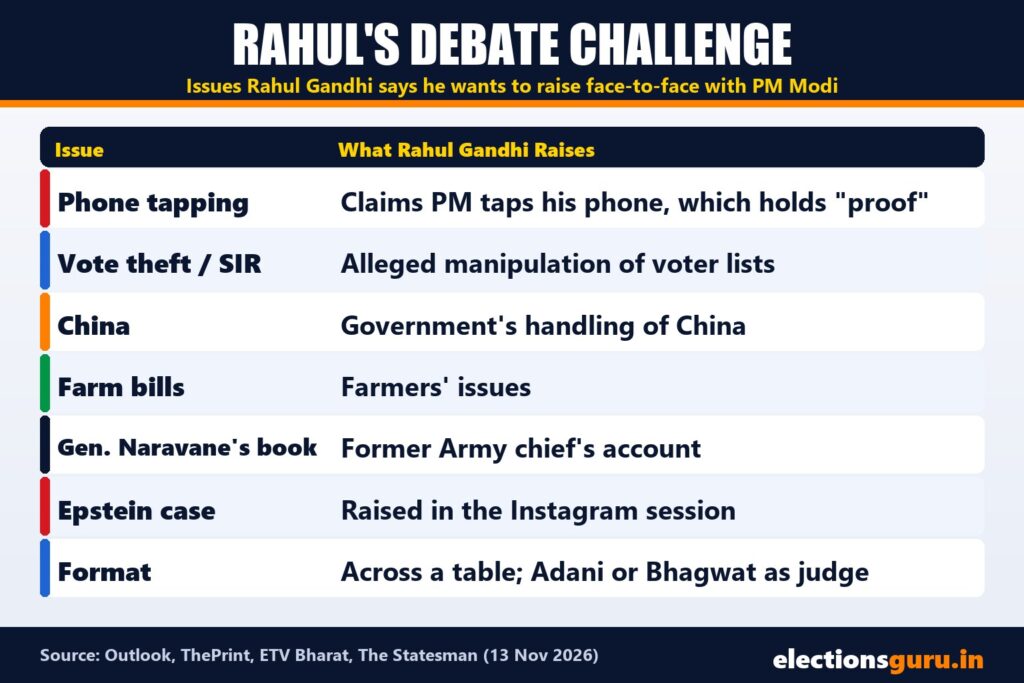
Issues Rahul Gandhi Wants to Debate
| Issue | Background |
|---|---|
| Alleged vote theft | Congress has accused the BJP and Election Commission of manipulating voter lists |
| SIR of electoral rolls | Large-scale deletions in many states under the Special Intensive Revision |
| China | Congress has questioned the government on China’s role and the trade deficit |
| Farm bills | Farmers’ concerns, a long-running Congress theme |
| General M.M. Naravane’s book | Former Army chief’s memoir has been cited by Congress |
| Jeffrey Epstein case | Raised by Rahul Gandhi during the session |
Also Read: INDIA Bloc vs CEC Gyanesh Kumar: Vote Chori Row Explained
History of Snooping Allegations in India
Rahul Gandhi’s claim is the latest in a long line of phone-tapping and surveillance controversies in Indian politics, involving governments of different parties.
| Year | Controversy | Outcome |
|---|---|---|
| 1988 | Phone-tapping row in Karnataka | Chief Minister Ramakrishna Hegde resigned |
| 1991 | Congress alleged Haryana policemen were spying on Rajiv Gandhi residence | Congress withdrew support; Chandra Shekhar government resigned |
| 2010 | Niira Radia tapes | Leaked conversations of lobbyist with politicians and journalists |
| 2019 | WhatsApp disclosed Pegasus targeting of Indian users | Government sought explanation from WhatsApp |
| 2021 | Pegasus Project revelations | Rahul Gandhi’s numbers reportedly on leaked list; SC set up technical committee |
| 2026 | Rahul Gandhi alleges PM taps his phone | No evidence shown yet |
The Pegasus Case: What Happened
In July 2021, an international media consortium reported that phone numbers of several Indian politicians, journalists and activists appeared on a leaked list of potential targets of Pegasus, a spyware sold by Israel’s NSO Group only to governments. Rahul Gandhi was among those named, and reports said two of his phones may have been targeted. The government neither confirmed nor denied using Pegasus, citing national security.
The Supreme Court appointed a technical committee supervised by former judge Justice R.V. Raveendran. In August 2022, the court said the committee found malware on 5 of the 29 phones examined but could not conclude that it was Pegasus, and noted that the government had not cooperated with the probe. In 2021, BJP leaders had dared Rahul Gandhi to submit his phone for examination if he believed it had been tapped.
How Legal Phone Tapping Works in India
Lawful interception of phone calls is allowed in India only under strict conditions, mainly on grounds of national security, public order and prevention of crime.
| Law / Rule | What It Allows |
|---|---|
| Telecommunications Act, 2023 | Interception on specified grounds such as sovereignty, security and public order (replaced the Indian Telegraph Act, 1885 provisions) |
| Information Technology Act, 2000 (Section 69) | Interception, monitoring or decryption of digital information |
| Authorisation | Union Home Secretary at the Centre, State Home Secretary in states |
| Review | Review committee headed by the Cabinet Secretary (Centre) or Chief Secretary (states) |
| PUCL v. Union of India (1997) | Supreme Court laid down safeguards against arbitrary tapping |
| Puttaswamy judgment (2017) | Privacy declared a fundamental right |
Unauthorised interception is a crime. If Rahul Gandhi’s claim were proven, it would be a serious violation of the right to privacy. Equally, making such a claim without evidence invites criticism, and the BJP is likely to demand that he share the “proof” or hand over his phone for examination.
Political Reactions So Far
- Congress: repeated the debate challenge on X and backed Rahul Gandhi’s claims
- BJP: no direct response to the phone-tapping claim reported at the time; it has earlier rejected his allegations and his claim that his mic is switched off
- Opposition allies: have raised surveillance concerns in the past, especially during the Pegasus row
Why This Matters Before 2027
With seven state elections and a presidential election due in 2027, Rahul Gandhi is sharpening his personal attack on Prime Minister Modi. The debate challenge is designed to project him as the main challenger, while the phone-tapping claim keeps surveillance and privacy in the headlines. Whether he backs the claim with evidence will decide how far it goes.
Also Read: Elections in 2027: Full List of State and National Polls
Rahul Gandhi as Leader of the Opposition
Rahul Gandhi became Leader of the Opposition in the Lok Sabha in June 2024, after the Congress won 99 seats in the general election, its best performance since 2009. The post gives him a constitutional role, including a seat on selection committees for key appointments such as the Central Vigilance Commissioner and the Election Commissioners. Since then, he has sharpened his attacks on the government over voter lists, caste census, the economy and China.
| Year | Rahul Gandhi Milestone |
|---|---|
| 2004 | First elected to Lok Sabha from Amethi |
| 2017 | Becomes Congress president |
| 2019 | Resigns as Congress president after defeat; wins Wayanad |
| 2022-23 | Bharat Jodo Yatra from Kanyakumari to Kashmir |
| 2024 | Wins Rae Bareli; becomes Leader of the Opposition |
| 2026 | Phone-tapping claim and debate challenge |
Debate Challenges in Indian Politics
Face-to-face debates between top leaders are common in the United States but rare in India. Rahul Gandhi has challenged Prime Minister Modi to a debate several times, and in 2024 a group of former judges and a journalist invited both leaders to a public debate, which Rahul Gandhi accepted but the BJP declined. The BJP has generally said that the Prime Minister answers to Parliament and to the people through elections, and that such challenges are publicity stunts.
Right to Privacy and Surveillance
In the 2017 K.S. Puttaswamy judgment, a nine-judge Supreme Court bench declared privacy a fundamental right under Article 21. That means any surveillance by the state must meet the tests of legality, necessity and proportionality. Earlier, in PUCL v. Union of India (1997), the court had laid down safeguards for telephone tapping, including authorisation by the Home Secretary, time limits and a review committee. The Digital Personal Data Protection Act, 2023 is India’s newest data law, though it gives the government wide exemptions on security grounds.
What Could Happen Next
- BJP may demand that Rahul Gandhi make his “proof” public or submit his phone for examination
- Congress could raise the issue in Parliament or approach the courts
- Rahul Gandhi may release the material he says is on his phone
- The debate challenge is likely to remain a campaign theme in 2027
Congress’s Wider Campaign Against the Government
The phone-tapping claim fits into a broader Congress campaign over the past year. The party has accused the government and the Election Commission of “vote chori” through voter list manipulation, led protests over the Special Intensive Revision, demanded a Joint Parliamentary Committee probe into the Adani group after reports on project costs, and questioned the government’s China policy, citing a record trade deficit with Beijing. Rahul Gandhi has also used social media formats such as Instagram “Ask Me” sessions to reach younger audiences directly, bypassing traditional media.
| Congress Campaign | Main Allegation |
|---|---|
| Vote chori / SIR | Manipulation of voter lists |
| Adani | Demand for JPC probe |
| China | Security and trade deficit concerns |
| Phone tapping | Surveillance of Leader of the Opposition |
| Debate challenge | PM avoiding direct questions |
Election Guru Analysis
Rahul Gandhi’s phone-tapping allegation is a high-stakes political move. It links to his broader campaign on “vote chori” and institutional capture, and the debate challenge is meant to put the Prime Minister on the defensive. But without evidence, the claim risks being dismissed as rhetoric, as similar claims were in the past. The ball is now in two courts: Rahul Gandhi’s, to show the “proof” he says is on his phone, and the government’s, to respond to a serious charge from the Leader of the Opposition.
Rahul Gandhi Phone Tapping Allegation Against PM Modi FAQ
What did Rahul Gandhi allege on 13 November 2026?
He alleged that PM Modi taps his phone and said the phone holds proof of his allegations against the Prime Minister.
Did Rahul Gandhi show any evidence of phone tapping?
No. Reports say he did not present any verifiable technical evidence during the Instagram session.
What debate did Rahul Gandhi propose?
A one-on-one debate with PM Modi across a table, without long speeches, on issues such as vote theft, SIR, China and farm bills.
Whom did Rahul Gandhi suggest as debate judges?
He said he would have no objection to Gautam Adani or RSS chief Mohan Bhagwat acting as the judge.
Was Rahul Gandhi named in the Pegasus case?
Yes. In 2021, reports said his phone numbers appeared on a leaked list of potential Pegasus targets.
What did the Supreme Court committee find in the Pegasus case?
In August 2022, the court said malware was found on 5 of 29 phones examined, but it could not be concluded that it was Pegasus.
Is phone tapping legal in India?
Only with authorisation on specific grounds such as national security and public order, under the Telecommunications Act, 2023 and the IT Act, with review safeguards.